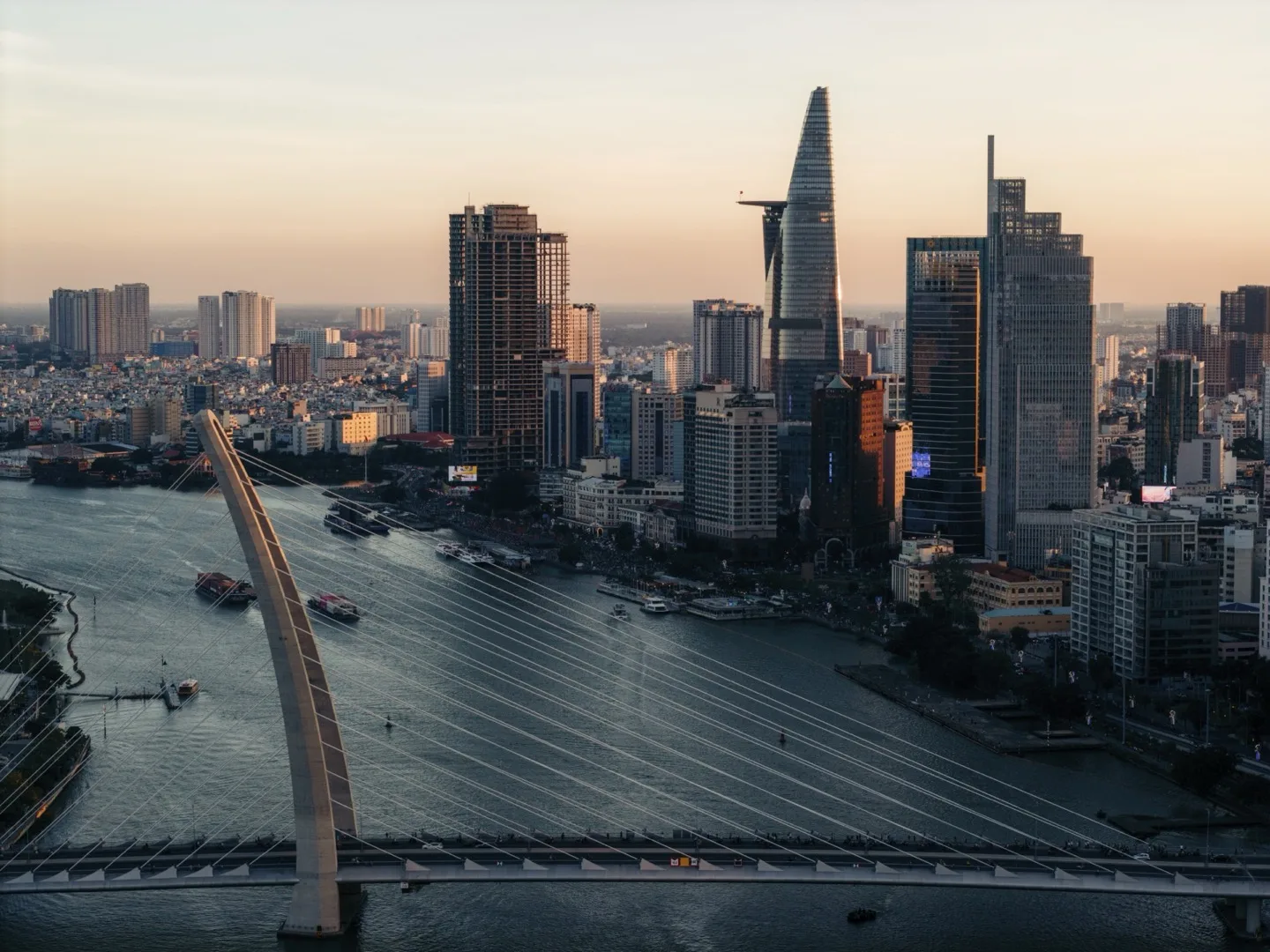
Moving to Dubai from Vietnam: Visa, Property, Banking & Schools 2026

- The Vietnamese community in the UAE is small but growing fast — estimated at 5,000–10,000 residents in 2026 — driven by tech, finance, logistics, and trade professionals leaving Ho Chi Minh City and Hanoi for Dubai's tax-free environment.
- Vietnamese passport holders need a pre-arranged visa for the UAE — there is no visa-on-arrival as of 2026. Standard options are the 60-day visit visa (sponsored by a UAE host or hotel), employment visa, freelance permit, business setup, and the 10-year Golden Visa via AED 2 million property investment.
- Vietnam taxes residents on worldwide income at 5–35% progressive rates plus 8–10% VAT on consumption. The UAE has 0% personal income tax. Becoming a UAE tax resident (183+ days) and dropping Vietnamese tax residency removes the worldwide-income exposure.
- Vietnamese citizens have full freehold property ownership rights in Dubai's designated areas — same terms as any other foreign buyer. No nationality restrictions, no special clearance, no extra fees.
- UAE banks accept Vietnamese passport holders once you hold a residence visa and Emirates ID. SWIFT transfers from Vietnamese banks to UAE work but can be slow; Wise is faster and cheaper for VND-to-AED conversions.
- No Vietnamese-curriculum schools exist in Dubai. Most Vietnamese families choose IB schools (Dubai International Academy, GEMS World Academy), British curriculum (Cranleigh, Wellington), or American (American School of Dubai).
Why Vietnamese Professionals Are Choosing Dubai
Vietnam is one of the fastest-growing economies in Southeast Asia. GDP growth has consistently sat between 5% and 7% per year, manufacturing exports continue to expand, and the tech ecosystem in Ho Chi Minh City and Hanoi is producing a new generation of founders, engineers, and venture-backed operators. Yet despite the tailwinds, a meaningful flow of Vietnamese professionals and entrepreneurs is now choosing to relocate — and Dubai sits prominently on the shortlist.
The reasons are pragmatic. Vietnam taxes resident individuals on worldwide income at progressive rates from 5% to 35%, with an additional 8–10% value-added tax on most consumption. Corporate income tax is 20%, and business friction — licensing, banking, foreign-currency rules, cross-border invoicing — remains high relative to regional hubs like Singapore or Dubai. For a Vietnamese tech founder selling SaaS into Europe, a logistics operator working between China and the Gulf, or a finance professional in cross-border crypto and trade settlement, the operating cost of staying in Vietnam keeps compounding.
Dubai offers the inverse profile. Personal income tax is 0%. Corporate tax is 9% above an AED 375,000 profit threshold, with free-zone qualifying income still taxed at 0% in many cases. The city operates as a global hub bridging Asia, Europe, Africa, and the Indian subcontinent — geography that suits Vietnamese exporters, traders, and digital businesses already operating across multiple time zones. Direct flights from Ho Chi Minh City and Hanoi to Dubai run daily on Emirates and Vietnam Airlines, with flight times of roughly seven hours and a three-hour time difference.
The Vietnamese embassy in Abu Dhabi and the gradually forming Vietnam Business Council in Dubai are signs of a maturing community. You are not pioneering — you are joining a small but increasingly well-networked diaspora that already includes engineers at major tech firms, hospitality professionals, traders, and a growing number of property investors using Dubai as a base.
Visa Options for Vietnamese Citizens
Vietnamese passport holders do not currently receive visa-on-arrival in the UAE. As of 2026, you must arrange a visa before travel. The good news is that the UAE's e-visa infrastructure is fast and well-organised — most visit visas are issued in 3–5 working days. For long-term residence, several pathways exist depending on whether you are arriving as an employee, a freelancer, a business owner, or an investor. Always verify current visa rules with the UAE's Federal Authority for Identity, Citizenship, Customs & Port Security before booking, as policies can change.
Tourist / Visit Visa
The standard visit visa for Vietnamese nationals is 30 or 60 days, single or multiple entry. It is sponsored by a UAE host (a relative, a hotel through your booking, or an authorised travel agency). Costs are typically AED 350–650 depending on duration and type. This visa is the standard entry path for scouting trips, property viewings, and business meetings before any long-term move.
Employment Visa
If a UAE employer hires you, they sponsor your residence visa — typically valid for 2 years. The employer handles the labour quota, work permit, medical examination, Emirates ID, and visa stamping. Once issued, you can sponsor your spouse and children, provided your monthly salary is at least AED 4,000 plus accommodation (or AED 5,000 inclusive). This is the most common path for Vietnamese tech workers, finance professionals, and hospitality staff moving to Dubai.
Freelance Permit
Independent professionals — software developers, designers, consultants, content creators, marketers — can obtain a freelance permit through one of several free zones. Dubai Media City, Internet City, and twofour54 (Abu Dhabi) issue freelance permits that include a residence visa. Annual costs range from AED 7,500 (Dubai Media City) to AED 5,500 (Ajman Free Zone, SHAMS Sharjah). This is a strong fit for Vietnamese remote workers serving international clients.
Investor / Business Owner Visa
Setting up a UAE company — mainland or free zone — includes residence visa allocation. Free zones such as IFZA, Meydan Free Zone, and DMCC allow 100% foreign ownership, simplified setup, and visa quotas based on office space. For most Vietnamese founders, a free-zone licence is the practical starting point. Total first-year setup typically runs AED 15,000–30,000 depending on the zone and activity. For a deeper look at the company-as-buyer angle, see our guide on setting up a Dubai company to buy property.
Golden Visa (10-Year Residence)
The UAE Golden Visa offers 10-year renewable residence to investors, entrepreneurs, specialised talent, and outstanding students. For property investors, the threshold is AED 2 million in real estate value. The property can be under mortgage — the full purchase price counts toward eligibility, not just your equity. Multiple properties can be combined to reach the threshold. For Vietnamese buyers planning a property investment anyway, the Golden Visa is often the cleanest route to long-term residence security. Our Golden Visa 2026 guide covers the full eligibility, cost, and processing breakdown.
Property Visa (2-Year Residence)
If your investment is between AED 750,000 and AED 2 million, you qualify for a 2-year renewable residence visa tied to the property. The unit must be completed (not off-plan), and you need valid health insurance. This is a useful step-up option for Vietnamese investors entering Dubai with a smaller initial budget and planning to scale up later.
| Visa Pathway | Duration | Typical Cost | Best For |
|---|---|---|---|
| Visit visa (60-day) | 30–60 days | AED 350–650 | Scouting trips, property viewings |
| Employment visa | 2 years (renewable) | Employer-sponsored | Tech, finance, hospitality professionals |
| Freelance permit | 2 years (renewable) | AED 5,500–9,500/year | Remote workers, consultants, creators |
| Investor / business setup | 2–3 years (renewable) | AED 15,000–30,000 first year | Founders, traders, exporters |
| Property visa | 2 years (renewable) | AED 750K+ property investment | Mid-budget property investors |
| Golden Visa | 10 years (renewable) | AED 2M+ property investment | Long-term settlers, large investors |
Tax: Vietnam vs the UAE
The single biggest financial driver of relocation for Vietnamese professionals is tax. Understanding both sides of the equation matters — Vietnam's exit rules are more nuanced than the UAE's clean-slate regime.
Vietnamese Tax Residency Rules
Vietnam taxes resident individuals on worldwide income. You are a Vietnamese tax resident if you spend 183 or more days in Vietnam in a calendar year, or if you have a permanent residence (registered address) in Vietnam. Personal income tax rates are progressive: 5% on income up to VND 60 million, scaling to 35% above VND 960 million per year. Business and self-employment income is taxed separately, and VAT on most goods and services sits at 8–10%.
Once you spend fewer than 183 days in Vietnam and establish UAE residency (Emirates ID, tenancy contract, utility bills), you generally cease to be a Vietnamese tax resident — and the worldwide-income obligation falls away. Vietnamese-source income (rental property in Vietnam, dividends from Vietnamese companies, freelance work invoiced from Vietnam) remains taxable in Vietnam under the non-resident regime, typically at flat rates of 2–20% depending on income type.
UAE Tax Position
The UAE has 0% personal income tax, 0% capital gains tax, and 0% inheritance tax for individuals. Corporate tax of 9% applies to mainland and free-zone companies on profits above AED 375,000, but free-zone qualifying income often remains 0% if structured correctly. VAT is 5% on most goods and services — a fraction of Vietnam's 8–10%.
To establish UAE tax residency for treaty purposes, the practical bar is 183 days of physical presence per calendar year, plus a UAE residence visa, Emirates ID, and a tenancy contract. The Federal Tax Authority issues Tax Residency Certificates (TRCs) on application for those who meet the criteria.
Practical Departure Steps for Vietnamese Tax Residents
- Document your departure. Keep entry/exit stamps, flight records, and your UAE tenancy contract — these are the evidence you would need if Vietnamese tax authorities query your non-residency.
- Restructure Vietnamese income. If you own a Vietnamese company, take advice on whether to retain it as a non-resident shareholder or restructure ownership through a UAE holding entity.
- Vietnam-UAE Double Tax Treaty. Vietnam and the UAE signed a Double Tax Avoidance Agreement that came into force in 2010. It covers employment income, business profits, dividends, interest, and royalties — preventing double taxation on cross-border income.
- Time asset sales. If you plan to sell Vietnamese assets (property, business shares) at a gain, the timing of the sale relative to your tax residency status materially changes the tax outcome.
Property Investment: What Vietnamese Buyers Need to Know
Vietnamese nationals enjoy full freehold property ownership rights in Dubai's designated freehold areas — the same terms as any other foreign buyer. There are no nationality-based restrictions, no extra fees, and no special approvals. The buying process is regulated by the Dubai Land Department and is significantly more transparent than the foreign-buyer regime in Vietnam, where foreigners face apartment-quota limits, leasehold-only structures (50-year terms), and restrictions on land ownership.
For Vietnamese buyers, the contrast is stark: in Dubai, you receive a registered title deed in your name, you can sell freely, and you can pass the property on without inheritance tax. Many Vietnamese investors find Dubai's property regime cleaner and more familiar than the leasehold-only options available to them domestically.
Popular Areas Among Vietnamese Buyers
Based on transaction patterns from Asian-buyer agencies and community feedback, Vietnamese families and investors tend to gravitate toward areas with strong rental yields, modern builds, and proximity to schools. The list below reflects typical AED budgets:
| Area | Typical Budget | Why Vietnamese Buyers Like It | Gross Rental Yield |
|---|---|---|---|
| JVC (Jumeirah Village Circle) | AED 500K–900K (1BR) | Affordable entry, family-friendly, strong rental demand | 7–8.5% |
| Business Bay | AED 800K–1.5M (1BR) | Central location, business hub feel — appeals to founders and finance professionals | 6–7.5% |
| Dubai Marina | AED 1.2M–2.5M (1–2BR) | Waterfront lifestyle, strong short-term rental potential, walkable | 6–7% |
| Dubai Hills Estate | AED 1.4M–2.5M (townhouse) | Green, family-oriented, near top schools — preferred by relocating families | 5.5–6.5% |
| Dubai Creek Harbour | AED 1.3M–2.5M (1–2BR) | New waterfront master plan, off-plan payment plans, capital appreciation focus | 5.5–6.5% |
| Arjan | AED 450K–750K (studio/1BR) | Lowest entry point for new builds, emerging community, strong yields | 7.5–9% |
The buying process involves selecting the property, signing a Memorandum of Understanding (MOU), paying a 10% deposit, and completing the transfer at the DLD. Total transaction costs — DLD registration (4%), agency commission (2% + VAT), trustee fees, and admin — typically come to 7–8% of the purchase price. For the full step-by-step walkthrough, see our non-resident buyer's guide and our step-by-step Dubai purchase guide.
Financing for Vietnamese Buyers
Vietnamese non-residents can obtain UAE mortgages, but the LTV (loan-to-value) is capped at 50–60% of the purchase price for non-residents, versus up to 80% for UAE residents. Interest rates for non-residents typically run 1–1.5 percentage points higher than for residents. Once you have a UAE residence visa, the picture improves significantly — full residential mortgage rates apply. Our non-resident mortgage guide covers the documentation, rates, and bank-by-bank breakdown.
Cost of Living: Ho Chi Minh City vs Dubai
Ho Chi Minh City and Hanoi are dramatically cheaper than Dubai on paper — but the comparison is misleading without factoring in tax, salary scales, and the lifestyle differential. Here is a direct snapshot for a single professional or couple without children, based on 2026 mid-year data:
| Expense | HCMC (Monthly VND / USD) | Dubai (Monthly AED / USD) | Notes |
|---|---|---|---|
| Rent (1BR, central) | 15M–30M VND / $600–1,200 | 5,000–8,000 AED / $1,360–2,180 | Dubai rents 1.5–2x higher; more space and modern facilities |
| Utilities (electric, water, cooling) | 2M–4M VND / $80–160 | 600–1,000 AED / $165–275 | Dubai AC costs are significant May–October; HCMC has no heating need |
| Groceries | 5M–10M VND / $200–400 | 1,500–2,500 AED / $410–680 | HCMC vastly cheaper for fresh produce; Dubai imports drive cost up |
| Dining out | 100K–500K VND / $4–20 per meal | 50–150 AED / $14–41 per meal | Street food and casual dining gap is large; fine dining comparable |
| Transportation | 1M–3M VND / $40–120 | 500–1,500 AED / $136–410 | HCMC scooter culture cheap; Dubai requires a car or relies on Metro/taxi |
| Health insurance | Mostly via state social insurance + top-up | 500–1,500 AED / $136–410 | Dubai requires private health insurance; employer plans are common |
| School fees (per child) | 5M–25M VND / $200–1,000 international | 3,000–8,500 AED / $815–2,315 | Dubai international schools 2–3x more expensive than HCMC equivalents |
| Income tax | 5–35% progressive | 0% | The single biggest financial difference |
| Internet + mobile | 500K–1M VND / $20–40 | 400–600 AED / $110–165 | HCMC fibre is excellent and very cheap; Dubai telecom has limited competition |
The takeaway: a Vietnamese professional earning the equivalent of $3,000 per month after tax in HCMC would need roughly $5,000–6,000 per month in Dubai to maintain a comparable lifestyle — but with 0% income tax, the gross salary required in Dubai is significantly lower than the gross salary that would deliver $3,000 net in Vietnam. For a finance or tech professional moving on a Dubai package of AED 25,000–35,000 per month, the comparison usually flips in Dubai's favour once tax is factored in. Run your own numbers with our Relocation Cost Estimator or see the deeper breakdown in our 2026 cost of living guide.
Relocating to Dubai?
Get Your Relocation Checklist
Cost of living, visa requirements, housing tips, and everything you need to plan your move.
✓ You're in! Check your inbox.
Banking: Opening Accounts and Transferring Money from Vietnam
Once you hold a UAE residence visa and Emirates ID, opening a bank account is straightforward. Major banks — Emirates NBD, ADCB, FAB, Mashreq, and RAK Bank — accept Vietnamese passport holders without nationality-based friction. The process takes 3–7 working days and requires your passport, residence visa, Emirates ID, proof of address (tenancy contract or DEWA bill), and a salary certificate or proof of income.
For most Vietnamese expats, Emirates NBD and Mashreq are practical starting points. Emirates NBD has the widest branch and ATM network. Mashreq's NEO digital onboarding is fast and well-suited to remote-leaning workers. RAK Bank tends to be more flexible for newly arrived residents with lower minimum balances.
Transferring VND to AED
The VND/AED exchange rate is generally stable — Vietnam's currency is managed by the State Bank of Vietnam — but the spread between transfer methods can still cost meaningful amounts on large moves. Vietnamese banking regulations also require source-of-funds documentation for transfers above $50,000 equivalent (or VND 1.2 billion), and outbound transfers above this threshold must comply with the State Bank of Vietnam's foreign exchange controls.
| Method | Speed | Typical Fee | Exchange Rate |
|---|---|---|---|
| Wise (TransferWise) | 1–2 business days | 0.5–1.5% of transfer amount | Mid-market rate (best available) |
| Bank SWIFT transfer (Vietcombank, BIDV, etc.) | 2–5 business days | $30–60 + intermediary fees | Bank rate (1.5–3% markup) |
| UAE exchange houses (Al Ansari, LuLu) | Same day (cash) | No fee (built into rate) | Competitive for cash; less so for transfers |
| Crypto (USDT/USDC via licensed exchange) | Minutes to hours | 0.5–2% combined spread | Variable; requires both-side compliance |
For most Vietnamese expats, Wise or a Vietnamese bank's outbound SWIFT (with proper documentation) are the cleanest options. Always retain documentation showing the source of funds — UAE banks routinely ask for it on inbound transfers above AED 100,000.
The Vietnamese Community in Dubai
The Vietnamese community in Dubai is small but tightly connected. The Embassy of Vietnam in Abu Dhabi is the official diplomatic channel; for routine consular services Vietnamese residents in Dubai usually travel to Abu Dhabi or use the embassy's mobile consular days. A Vietnam Business Council in Dubai has been forming as Vietnam-UAE trade ties expand — the UAE became one of Vietnam's top trade partners in the Middle East following the Vietnam-UAE Comprehensive Economic Partnership Agreement (CEPA) signed in 2024.
Vietnamese Food and Groceries
Vietnamese restaurants are still relatively rare in Dubai compared to Indian, Filipino, or Thai cuisine, but the gap is closing. Pho-focused restaurants exist in JLT, Business Bay, and Dubai Marina. Asian supermarkets in Karama, Al Quoz, and at LuLu Hypermarket carry Vietnamese fish sauce, rice paper, dried noodles, and key spices. Halal-friendly Vietnamese ingredients are widely available, which makes home cooking straightforward.
Cultural Fit and Integration
Vietnamese workers and entrepreneurs typically integrate well in Dubai. The city's multinational, English-first business environment removes language barriers for professionals already operating internationally. The Muslim-majority cultural backdrop is a fresh experience for most Vietnamese arrivals, but Dubai's tolerance and diversity mean this rarely creates friction. Vietnamese cultural events — Tet (Lunar New Year) gatherings, Mid-Autumn Festival celebrations — are organised informally through community WhatsApp and Zalo groups.
Schools: What Vietnamese Families Need to Know
One important reality to flag upfront: there are no Vietnamese-curriculum schools in Dubai as of 2026. For families relocating with school-age children, this means choosing between major international curricula. The good news is that Dubai's school sector is regulated by the Knowledge and Human Development Authority (KHDA), which publishes annual inspection ratings — making school selection more transparent than in many global cities.
International Baccalaureate (IB) Schools
The IB is the most popular curriculum choice among Vietnamese families staying long-term. IB qualifications are accepted by Vietnamese universities, and the curriculum's analytical, multilingual focus suits families who may move again. Top IB schools include Dubai International Academy (Emirates Hills, Al Barsha), GEMS World Academy (Al Barsha), and Raffles World Academy (JLT). Annual fees range from AED 50,000 to AED 95,000 depending on grade level.
British Curriculum Schools
British curriculum schools are highly rated by KHDA and popular among Vietnamese families. Wellington International School, Cranleigh Abu Dhabi, Dubai College, Jumeirah College, and Repton Dubai consistently rank among Dubai's top performers. Fees range from AED 40,000 (entry-level) to AED 110,000+ at premium schools. British qualifications (IGCSE, A-Levels) are well-recognised by Vietnamese and global universities.
American Curriculum Schools
American School of Dubai (Al Barsha), Dubai American Academy (Al Barsha), and GEMS American Academy (Khalifa City, Abu Dhabi) are leading American-curriculum options. Fees run AED 60,000–95,000 per year. SAT-aligned pathways make these strong choices for families targeting US universities. For a fuller breakdown, see our 2026 Dubai schools guide.
Healthcare: Vietnamese vs Dubai System
Vietnam's healthcare system mixes state-funded hospitals (which tend to be crowded) with private hospitals like Vinmec, FV Hospital, and Hoan My, which provide international-standard care at moderate cost. Most working professionals carry private health insurance on top of state social insurance.
In Dubai, private health insurance is mandatory and is provided by your employer if you are on an employment visa. Employer plans typically cover consultations, diagnostics, emergency care, and hospitalisation, with co-payments of AED 0–50 per visit. Self-employed and freelance residents purchase their own plans starting around AED 5,000–7,000 per year for basic compliant coverage, scaling to AED 12,000–25,000 for comprehensive plans. Quality of care at Mediclinic, Aster, NMC, and Cleveland Clinic is excellent — comparable to FV Hospital or Vinmec at the top end. Our Dubai healthcare guide covers insurance, hospital networks, and costs in depth.
Practical Moving Checklist: Vietnam to Dubai
Before You Leave Vietnam
- Confirm your visa or job offer. Do not ship belongings or terminate your Vietnamese lease until your UAE residence pathway is locked.
- Document apostille / legalisation. Vietnam is not a member of the Hague Apostille Convention (as of 2026), so personal documents (birth certificate, marriage certificate, university diplomas) require consular legalisation through the Vietnamese Ministry of Foreign Affairs and the UAE Embassy in Hanoi. Plan 4–8 weeks for this process.
- Driving licence. Vietnam is not currently on the UAE's automatic driving-licence conversion list, which means you will need to take a UAE driving theory and road test to obtain a UAE licence. Allow 2–4 months and AED 4,000–7,000 for the full process. Our Dubai driving licence guide covers the process and costs.
- Notify your Vietnamese bank. Inform your bank about your relocation. Maintaining a Vietnamese account for ongoing obligations (Vietnam-source rental income, family support transfers) is usually sensible.
- Tax records. Settle outstanding Vietnamese tax filings before departure, and document your departure date for non-residency claims.
Shipping Belongings, Pets, and Vehicles
- International movers. AGS Movers, Crown Relocations, and Asian Tigers operate Vietnam-to-Dubai routes. Sea freight from Ho Chi Minh City or Haiphong to Dubai takes 18–28 days. Door-to-door service typically runs 5–7 weeks total.
- Customs. Personal household goods imported under your UAE residence visa are generally duty-exempt provided you have held your visa for at least three months. Bring a detailed inventory list.
- Pets. Dogs and cats can be imported with a microchip, valid rabies vaccination (administered 21 days to 12 months before travel), a Vietnamese veterinary health certificate, and a UAE Ministry of Climate Change and Environment (MOCCAE) import permit (AED 300). Quarantine is not typically required for pets arriving with complete documentation.
- Vehicles. Importing a personal vehicle from Vietnam is rarely worthwhile — UAE customs duties (5%), GCC compliance retrofit costs, and shipping make it uneconomic unless the vehicle has high sentimental or rarity value. Most Vietnamese arrivals buy locally in Dubai.
- Restricted items. The UAE prohibits certain medications (check the Ministry of Health list), pork products, and culturally inappropriate items. E-cigarettes and vaping equipment require specific approvals.
First Two Weeks in Dubai
- Medical examination. Required for residence visa processing — blood tests and chest X-ray at a DHA-authorised centre.
- Emirates ID. Applied for alongside your visa. Biometrics at an ICP centre. Card arrives in 2–3 weeks.
- Bank account. Open as soon as you have your Emirates ID. Bring all documents on the first visit.
- Mobile. Postpaid plans with du or Etisalat require Emirates ID. Prepaid SIMs are available immediately with passport only.
- Health insurance. Confirm employer coverage is active or, if self-employed, buy a compliant plan within the first 30 days.
For a complete fee breakdown of every step, see our Dubai residency visa costs guide.
Frequently Asked Questions
Do Vietnamese citizens need a visa to enter Dubai?
Yes. Vietnamese passport holders do not currently receive visa-on-arrival in the UAE. You need a pre-arranged visit visa (sponsored by a UAE host, hotel, or travel agency) before travel. Most visit visas are issued in 3–5 working days. For long-term stays, you need a residence visa through employment, business setup, freelance permit, or property investment. Verify current rules with the UAE ICP before booking.
Can Vietnamese citizens buy property in Dubai?
Yes. Vietnamese nationals have full freehold ownership rights in Dubai's designated areas — the same terms as any other foreign buyer. There are no nationality-based restrictions, no extra fees, and no special approvals. You can purchase property even before holding a UAE residence visa.
How much do I need to invest to qualify for the Golden Visa?
The minimum property investment for a 10-year Golden Visa is AED 2 million. The property can be under mortgage — the full purchase price counts, not just your equity. Multiple properties can be combined to reach the threshold. Investments between AED 750,000 and AED 2 million qualify for a 2-year property visa instead.
Will Vietnam still tax me after I move to Dubai?
Vietnam taxes residents on worldwide income. Once you spend fewer than 183 days in Vietnam in a calendar year and establish UAE residency (Emirates ID, tenancy contract), you generally cease to be a Vietnamese tax resident — and the worldwide-income obligation ends. Vietnamese-source income (rental property, dividends from Vietnamese companies) remains taxable in Vietnam under the non-resident regime. The Vietnam-UAE Double Tax Treaty prevents double taxation on cross-border income.
Are there Vietnamese-curriculum schools in Dubai?
No. There are no Vietnamese-curriculum schools in Dubai as of 2026. Vietnamese families typically choose IB schools (Dubai International Academy, GEMS World Academy), British curriculum schools (Wellington, Cranleigh, Jumeirah College), or American curriculum schools (American School of Dubai). All are well-regulated and inspected by KHDA.
Can I convert my Vietnamese driving licence in Dubai?
Vietnam is not currently on the UAE's automatic conversion list, which means you will need to take a UAE driving theory and road test to obtain a UAE licence. The full process takes 2–4 months and costs AED 4,000–7,000 including lessons, tests, and the licence fee. Your Vietnamese licence is valid during your first 30 days as a tourist.
How do I transfer savings from Vietnam to the UAE?
Wise offers the best rates for VND-to-AED transfers, typically 0.5–1.5% above mid-market. Bank SWIFT transfers from Vietcombank, BIDV, or Techcombank work but cost more. Vietnamese foreign-exchange controls require source-of-funds documentation for transfers above $50,000 equivalent. UAE banks similarly request documentation on inbound transfers above AED 100,000 — keep your records organised.
Is there a Vietnamese community in Dubai?
Yes — small but growing. The community is estimated at 5,000–10,000 in 2026 and includes engineers, finance professionals, hospitality workers, traders, and a growing number of property investors. The Embassy of Vietnam (Abu Dhabi) provides consular services, and informal community groups organise around Tet, Mid-Autumn Festival, and business networking events. The Vietnam-UAE CEPA signed in 2024 has accelerated trade and migration flows in both directions.
Every Vietnam-to-Dubai move is different — career situation, family size, school timing, and whether you are buying property all shape the right path. If you are planning a relocation and want tailored advice on visas, neighbourhoods, schools, or property investment, our REC Lifestyle Specialists are here to help. Reach out through our community or send us a message — we are actively supporting Vietnamese professionals and families making the transition.
Planning Your Move?
Get personalized relocation advice from our Dubai team.
Thank You!
We'll get back to you within 24 hours.
Moving & Relocation Companies in Dubai
Explore providers from our business directory
Still have questions?
Ask a follow-up, or get connected with a vetted Dubai professional.
Join our Telegram channel
Handover alerts, new launches & DLD data — first, in real time.