Binghatti Phantom Handover (2026): Financing Your Final Payment, Mortgage Options & Costs
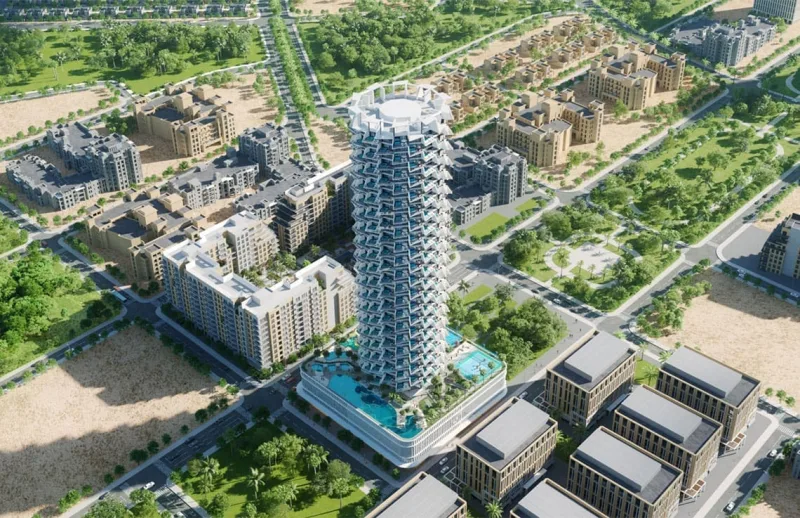
- Binghatti Phantom is a completed 44-storey, 354-unit tower in JVC District 17 by Binghatti Developers, with 1, 2 and 3-bedroom apartments and the brand's signature interlocking facade.
- The launch payment plan was 70/30 — roughly 20% on booking, 50% during construction, and a 30% final payment due at handover.
- Because the building is now ready, you can apply for a standard residential mortgage on a completed unit: up to ~80% LTV for residents and ~50–60% for non-residents (as of 2026).
- Budget beyond the price: DLD transfer fee 4%, mortgage registration 0.25% + AED 290, trustee ~AED 4,200, valuation AED 2,500–3,500, plus JVC service charges of roughly AED 8–15 per sq ft per year.
- JVC is one of Dubai's higher-yielding areas — gross rental yields commonly run 6–10%, with net yields around 7–9%, making the investor maths attractive after handover.
Last updated: June 2026. If you bought a unit in Binghatti Phantom — or you are buying a ready apartment there on the resale market — the moment that matters most is handover. That is when the final 30% of the price comes due, when the keys (and the service-charge bills) become yours, and when a mortgage can do the heavy lifting if you would rather not wire the whole balance in cash. This guide walks a Binghatti Phantom owner through the building's real numbers, the structure of the final payment, how to finance it with a Dubai mortgage on a completed unit, the full cost stack, and the investor case for JVC.
Binghatti Phantom: the building, in real numbers
Binghatti Phantom is a residential high-rise in Jumeirah Village Circle (JVC), District 17, developed by Binghatti Developers. According to the developer's own project page and DLD-registered project data, the tower is structured as an underground level, ground level, four podium levels, a first-floor amenity deck, 37 residential floors and one mechanical floor — commonly described as a 44-storey building. It holds 354 residential units and 15 ground-floor retail outlets.
The unit mix is apartments only — no villas, and the tower is marketed around 1, 2 and 3-bedroom homes rather than studios. Verified sizing from the official source breaks down as follows:
| Unit type | Size (sq m) | Size (sq ft) | Indicative launch price (AED) |
|---|---|---|---|
| 1-bedroom | 73.8 – 85.1 | 794 – 916 | from ~999,999 |
| 2-bedroom | 147.6 – 170.9 | 1,589 – 1,840 | from ~1,999,999 |
| 3-bedroom | 196.7+ | 2,117+ | from ~2,499,999 |
Prices above are indicative launch figures and will not match today's market — by the time you read this, the building is complete and trades on a ready/resale basis, so the relevant number is the current valuation, not the original launch price. The amenity set is the standard Binghatti package: swimming pools, a gym, landscaped gardens, children's play areas, sports facilities and BBQ spaces, with ground-floor retail for daily convenience.
Why the JVC location matters for your unit
Jumeirah Village Circle is a master-planned, freehold community sitting roughly in the middle of "new Dubai," bounded by Al Khail Road and Sheikh Mohammed Bin Zayed Road, which puts the major employment hubs within an easy commute. The developer cites about 20 minutes to Burj Khalifa and Palm Jumeirah and roughly 25 minutes to Dubai International Airport from the Phantom site. For a tenant — the person who ultimately pays your mortgage if you let the unit — JVC's appeal is the combination of relative affordability, a dense supply of cafes, supermarkets, gyms and schools inside the community, and that central road position. District 17, where Phantom stands, is one of the more established pockets of JVC, which supports both occupancy and resale liquidity. The flip side every owner should weigh is supply: JVC has a heavy development pipeline, so rents and capital values are competitive, and a well-finished, branded tower like Phantom needs to stand out on condition and presentation to command the top of its rent band.
The Binghatti brand and the Phantom's design
Binghatti, founded in 2008, is one of the largest privately held developers in the UAE and has scaled aggressively in recent years — the company reported a record Q1 2026 with net profit of around AED 1 billion. Its buildings are instantly recognisable thanks to a signature interlocking facade: interwoven balconies and bold geometric forms that draw on Middle Eastern art and, by the developer's own account, on the precision of the automotive and watchmaking worlds. Binghatti Phantom carries that language through with darker "Phantom" detailing and premium interior finishes. For an owner, the practical upside of buying into a recognisable, high-output developer brand is liquidity — Binghatti stock in JVC tends to have an active resale and rental market.
The payment plan and the final handover payment
Binghatti Phantom launched on a 70/30 payment plan. In practical terms that meant:
| Stage | Share of price | When it falls due |
|---|---|---|
| Booking / down payment | ~20% | At reservation / SPA signing |
| Construction milestones | ~50% | Spread across the build (per the SPA schedule) |
| Final / handover payment | ~30% | On completion and handover |
This is a during-construction plan, not a long post-handover instalment plan. That distinction matters: with a 70/30 structure, the big final tranche (~30% of the price) is due at or just before you take possession. On a 1-bedroom around AED 1m, that is roughly AED 300,000 landing at once — and that is exactly the payment most owners look to finance rather than fund from cash. If your interest is in deals that let you pay across the years after you move in instead, read our breakdown of post-handover payment plans in Dubai to see how they compare with a developer's during-construction plan like Phantom's.
Always reconcile these percentages against your own Sale and Purchase Agreement (SPA). Developer plans vary unit by unit and over different launch phases, so your contractual schedule is the single source of truth for the exact amount and the exact handover trigger.
Financing the final payment: a mortgage on a completed unit
Here is the good news for a Phantom owner facing the 30% balloon: because the building is finished, you are not stuck with the harsher off-plan financing rules. You are buying — or completing the purchase of — a ready, completed property, which banks treat more favourably than off-plan. Off-plan financing in Dubai is typically capped near 50% loan-to-value (LTV); completed homes unlock the standard, higher LTVs.
How much can you borrow?
| Buyer profile | Typical max LTV (ready home) | Minimum down payment |
|---|---|---|
| UAE resident, first home under AED 5m | up to ~80% | ~20% + fees |
| UAE resident, second home / above AED 5m | lower (often ~60–65%) | ~35–40% + fees |
| Non-resident buyer | ~50–60% | ~40–50% + fees |
These are 2026 market norms set against Central Bank of the UAE guidance, not a guarantee for your file — your employer, income, age and existing debt all move the final number. A resident owner who only needs to cover the final 30% is in a comfortable position: an 80% LTV on the full price comfortably exceeds the outstanding handover tranche, and the loan simply pays down the developer balance at transfer. A non-resident at 50–60% LTV needs to check that the loan plus the deposits already paid covers the price, or be ready to top up the gap in cash. For the full non-resident playbook — eligible banks, documents and rate premiums — see our non-resident Dubai mortgage guide.
What rate to expect
As of 2026, fixed-rate Dubai mortgages for the initial period commonly sit around 3.99% to 4.5% for strong, salary-transfer profiles, while EIBOR-linked variable rates run higher, roughly 5.5% to 6.5%+, depending on the bank's margin over 3-month EIBOR, the benchmark published by the Central Bank of the UAE. The lowest headline rates require salary transfer, a sub-70% LTV and a preferred-employer profile. Run your own numbers before committing: our Dubai mortgage calculator shows what you can borrow, and the mortgage repayment calculator turns a rate and term into a real monthly figure on your Phantom unit.
The process and timing
Financing a handover payment is time-sensitive, so start early — ideally well before your handover notice lands. The sequence usually looks like this:
- Pre-approval (about 3–5 working days): the bank assesses income and debt and issues a pre-approval valid for a set window.
- Property valuation: the bank instructs a valuer on the completed Phantom unit (AED 2,500–3,500). The loan is sized off the lower of price or valuation.
- Final offer letter (FOL): the bank confirms the loan amount, rate and conditions.
- Transfer at the DLD/trustee office: the bank releases funds, the developer's balance is settled, the mortgage is registered, and the title deed transfers to you.
Because lender margins, fees and processing speed vary, many buyers use a broker to run the file across several banks at once. Our guide to the best mortgage brokers in Dubai covers how they are paid and what to ask. One affordability concept worth understanding before you apply is the bank's Debt Burden Ratio (DBR) — UAE banks generally cap total monthly debt repayments at 50% of income, and that ceiling, not the LTV, is often what actually limits the loan.
A worked example: financing a 1-bedroom handover
To make the numbers concrete, take a resident owner completing a 1-bedroom Phantom unit at a valuation of AED 1,100,000, having already paid the 70% (AED 770,000) across booking and construction, with the final 30% (AED 330,000) due at handover. Rather than wire the AED 330,000 in cash, the owner takes an 80% LTV mortgage of AED 880,000. At transfer, the bank's funds clear the AED 330,000 developer balance and effectively refinance the equity already paid, leaving the owner with a loan and roughly 20% equity in the home. The one-off costs layered on top would look approximately like this:
| Item | Basis | Approx. amount (AED) |
|---|---|---|
| DLD transfer fee | 4% of 1,100,000 | 44,000 |
| Mortgage registration | 0.25% of 880,000 + 290 | 2,490 |
| Trustee office fee | fixed | 4,200 |
| Valuation | bank-instructed | ~3,000 |
| Arrangement fee | up to ~1% of loan | up to ~8,800 |
That is roughly AED 60,000–63,000 in one-off costs on top of the price, dominated by the 4% DLD fee. On the financing side, an AED 880,000 loan over 25 years at, say, a 4.25% fixed initial rate works out to a monthly repayment in the region of AED 4,800 — against a 1-bedroom JVC rent of AED 60,000–80,000 a year (AED 5,000–6,700 a month). Plug your own valuation and rate into the repayment calculator to size the exact monthly figure, because even a half-point rate change moves it materially.
Financing your property?
Get matched with a mortgage broker
We'll connect you with a vetted, DLD-registered Dubai mortgage broker who compares rates across 15+ banks. Free — brokers are paid by the bank, not you.
Request received!
We'll connect you with a vetted mortgage broker shortly.
Budgeting the handover: every cost beyond the price
The final payment is not the only money that moves at handover. Plan for the full transaction stack so nothing surprises you at the trustee office. The figures below are 2026 standards.
| Cost item | Amount (2026) | Notes |
|---|---|---|
| DLD transfer fee | 4% of price | Largest fee; in practice usually paid in full by the buyer |
| Mortgage registration fee | 0.25% of loan + AED 290 | Only if financing |
| Trustee / registration office fee | ~AED 4,200 | AED 4,000 + 5% VAT for units AED 500k+ |
| Property valuation | AED 2,500 – 3,500 | Bank-instructed, paid by buyer |
| Bank arrangement / processing fee | up to ~1% of loan | Varies by lender; sometimes waived on promotions |
| Life / property insurance | varies | Usually mandatory with a mortgage |
| JVC service charges | ~AED 8 – 15 per sq ft / year | Recurring; payable to the building owners' association |
As a rule of thumb, total upfront transaction costs run around 7–10% of the price once a mortgage is in the picture — the 4% DLD fee dominates, and the mortgage-related charges add a couple of points on top. On a ~916 sq ft 1-bedroom, JVC service charges at, say, AED 12/sq ft work out to roughly AED 11,000 a year — a recurring cost that directly affects your net rental yield, so it is worth confirming Phantom's exact rate from the owners' association before you model returns.
Snagging: do not skip it
Even in a completed, well-built tower, handover is the moment to snag — inspect the unit for defects (finishes, fittings, AC, plumbing, paint, alignment) and log them with the developer before you sign the handover acceptance. New units in the UAE typically come with a defects-liability period, so documented snags get fixed at the developer's cost. For a step-by-step walkthrough of the inspection and the paperwork, see our Dubai property handover guide.
The investor angle: JVC yields and your let strategy
JVC has become one of Dubai's most reliable buy-to-let districts, and Phantom sits squarely in that thesis. As of 2026, JVC gross rental yields commonly land in the 6–10% range depending on unit type, with net yields frequently quoted around 7–9% — comfortably ahead of prime areas like Downtown, where net yields cluster nearer 4–5%. Smaller units carry the strongest yields: studios and 1-bedrooms tend to outperform larger 2 and 3-bedroom homes on a percentage basis.
| Unit type (JVC) | Typical annual rent (2026) | Indicative gross yield |
|---|---|---|
| 1-bedroom | ~AED 60,000 – 80,000 | ~7–9% |
| 2-bedroom | ~AED 90,000 – 120,000 | ~6–8% |
| 3-bedroom | ~AED 130,000+ | ~6–7% |
Rent figures are JVC market ranges and vary by floor, view, finish and furnishing — a brand-new, high-floor Phantom unit should sit at the upper end of its band. The developer's own ROI guidance for Phantom is around 6–7% annually, which is a deliberately conservative net figure once service charges are deducted.
Long let vs short let
A standard annual (long) let is the lower-effort path: one tenant, an Ejari-registered contract, predictable cash flow, and service charges as your main running cost. A short-term (holiday-home) let can lift gross income meaningfully in a well-located JVC tower, but it carries higher operating costs — DTCM permit, furnishing, cleaning, management fees and occupancy risk — so the net advantage is smaller than the headline gross suggests. If you are weighing the two for your Phantom unit, model it with our short-term rental income estimator before committing to furniture and a holiday-home licence. Whichever route you choose, the financing decision and the let decision interact: a mortgaged unit needs its rent to clear the monthly repayment plus service charges before it is genuinely cash-flow positive.
For the broader picture on how Dubai mortgages work end to end — eligibility, rates, LTV bands and the full application — our Dubai mortgage guide is the place to start before you approach a bank for your Phantom handover.
Frequently Asked Questions
Is Binghatti Phantom completed and ready for handover?
Yes. As of 2026, Binghatti's official project page lists Binghatti Phantom as completed, with handover taking place around the Q4 2025–2026 window. Because it is a ready building, it now trades on a completed/resale basis rather than off-plan, which means buyers can apply for standard residential mortgages on the units. Always confirm the exact status and handover date for your specific unit against your SPA and the developer's handover notice.
What was Binghatti Phantom's payment plan, and when is the final payment due?
Binghatti Phantom launched on a 70/30 payment plan: roughly 20% on booking, 50% spread across construction milestones, and a final ~30% due at handover. The handover tranche is the large lump sum — about AED 300,000 on a ~AED 1m unit — that most owners look to finance with a mortgage. Your SPA is the authoritative source for the exact percentages and the precise handover trigger on your unit.
Can I get a mortgage to cover the final handover payment on a Phantom unit?
Yes. Since the building is completed, you can apply for a standard residential mortgage on a ready property. UAE residents can typically borrow up to about 80% LTV on a first home under AED 5m, while non-residents are usually capped around 50–60% LTV (as of 2026). The loan is released at the DLD transfer, settles the developer's outstanding balance, and the mortgage is registered against the title. Get pre-approved before your handover notice so the timing lines up.
What are the total costs of taking handover at Binghatti Phantom?
Beyond the price, budget for the Dubai Land Department (DLD) transfer fee (4%), mortgage registration (0.25% of the loan + AED 290 if financing), a trustee office fee (~AED 4,200), a bank-instructed valuation (AED 2,500–3,500), a possible arrangement fee (up to ~1% of the loan) and mandatory insurance. Together these typically add 7–10% on top of the price. Then there are recurring JVC service charges of roughly AED 8–15 per sq ft per year, payable to the owners' association.
What rental yield can a Binghatti Phantom apartment achieve in JVC?
JVC is among Dubai's higher-yielding areas. As of 2026, gross rental yields commonly run 6–10% depending on unit type, with net yields frequently around 7–9% after service charges — well above prime areas like Downtown. Smaller 1-bedroom units tend to deliver the strongest yields. Binghatti's own conservative ROI guidance for Phantom is around 6–7% net annually. A brand-new, high-floor unit should achieve the upper end of the JVC rent range for its size.
Financing your property?
Get matched with a mortgage broker
We'll connect you with a vetted, DLD-registered Dubai mortgage broker who compares rates across 15+ banks. Free — brokers are paid by the bank, not you.
Request received!
We'll connect you with a vetted mortgage broker shortly.
Is your building actually on schedule?
Check the official DLD construction percentage and expected date on the live Handover Tracker — and get an email when it moves.
More Dubai handovers
Dubai Science Park
Skyhills Residences Handover (2026): Financing Your Final Payment, Mortgage Options & Costs

Dubai Creek Harbour
Cedar at Dubai Creek Harbour: Handover & Financing Your Final Payment (2026)
Dubai Studio City