Al Sufouh Area Guide 2026: Media City, Palm & Madinat Jumeirah Living


Free PDF
Get the Madinat Jumeirah Living master plan
Districts, phases and where prices sit, in one file you can keep and share. Sent to your inbox, no account needed.
Download the PDF- Al Sufouh is a freehold coastal district split into Al Sufouh 1 and Al Sufouh 2, sitting between Dubai Internet City/Media City and the Palm Jumeirah–Umm Suqeim coastline, threaded by the Dubai Tram along Al Sufouh Road.
- Existing villas (mostly 3–5 bedrooms) list for sale between roughly AED 13.8 million and AED 28 million, averaging around AED 17.9 million, with rents typically AED 240,000–410,000 a year, per Bayut listings data.
- Madinat Jumeirah Living (MJL) — Meraas/Dubai Holding's low-rise master community inside Al Sufouh 2 — is reshaping the area's apartment supply, with new-build 1-bedroom units launching from around AED 1.45 million and blended pricing near AED 2,850 per sq ft.
- Secondary apartments outside MJL (including Sufouh Gardens) carry a wide asking range, with six-month Bayut averages near AED 3.6 million and typical rents from roughly AED 115,000 to 123,000 a year across the mix.
- Dubai Knowledge Park and a cluster of established schools — Dubai College, the International School of Choueifat, GEMS Wellington International and GEMS Dubai American Academy — sit within a five-minute drive, making Al Sufouh a genuine family option, not just an investor play.
- Against its neighbours, Al Sufouh undercuts Palm Jumeirah on villa pricing by a wide margin while sitting close enough to the Palm, Media City and Marina to share their commute and lifestyle radius.
- Data on Al Sufouh is genuinely thinner than for Palm Jumeirah, Marina or JBR — this guide flags every figure that reflects a small or asking-price-only sample rather than deep transaction history.
Al Sufouh rarely gets its own headline. It sits in the gap most market commentary skips over — south-west of Dubai Media City and Dubai Internet City, north-east of Umm Suqeim and the wider Jumeirah coastline, with Palm Jumeirah visible from its beachfront edge. That in-between position has kept it out of the spotlight for years, even as Madinat Jumeirah Living, Meraas' low-rise master community, has quietly become one of the more closely watched addresses in Dubai's prime residential market. This guide treats Al Sufouh as two areas in one: the older villa district of Al Sufouh 1, and Al Sufouh 2, now dominated by MJL's phased apartment delivery. Every price below is attributed to its source, and where the underlying data is thin — which is more often here than in Dubai's larger, more liquid districts — we say so rather than presenting a single number as gospel. Last updated: July 2026.
Where Is Al Sufouh? Location, Layout and Al Sufouh 1 vs Al Sufouh 2
Al Sufouh runs along the coast on the inland side of Sheikh Zayed Road, bordered by Dubai Marina and Dubai Media City to the north-west and Umm Suqeim to the south-east, with direct beach frontage facing Palm Jumeirah across the water. Per Bayut's Al Sufouh area guide, the district is split into two numbered sub-areas that function quite differently in practice.
Al Sufouh 1 is the older, villa-dominated half, home to freehold standalone homes on generous plots plus low-rise apartment developments such as Sufouh Gardens. It borders Dubai Media City and Dubai Internet City directly, which is why it has long attracted media, tech and airline-industry tenants who want a short commute without living inside a tower block. Al Sufouh 2 is where Madinat Jumeirah Living sits, along with Dubai Knowledge Park — the free-zone cluster for education and training businesses — and a run of international schools. The two halves share the same postcode logic but read as different products: Al Sufouh 1 is largely a resale villa and low-rise apartment market, while Al Sufouh 2 is increasingly an off-plan and newly handed-over apartment market built around one master developer.
Connectivity runs through two corridors: Sheikh Zayed Road (E11) for fast east-west access across the city, and Al Sufouh Road (D94), the coastal service road that also carries the Dubai Tram. Al Khail Road provides the inland alternative into Dubai Knowledge Park and onward to Al Barsha. For context on how this fits into Dubai's freehold map more broadly, see our guide to freehold areas foreigners can buy in Dubai.
Madinat Jumeirah Living (MJL): Al Sufouh's New Face
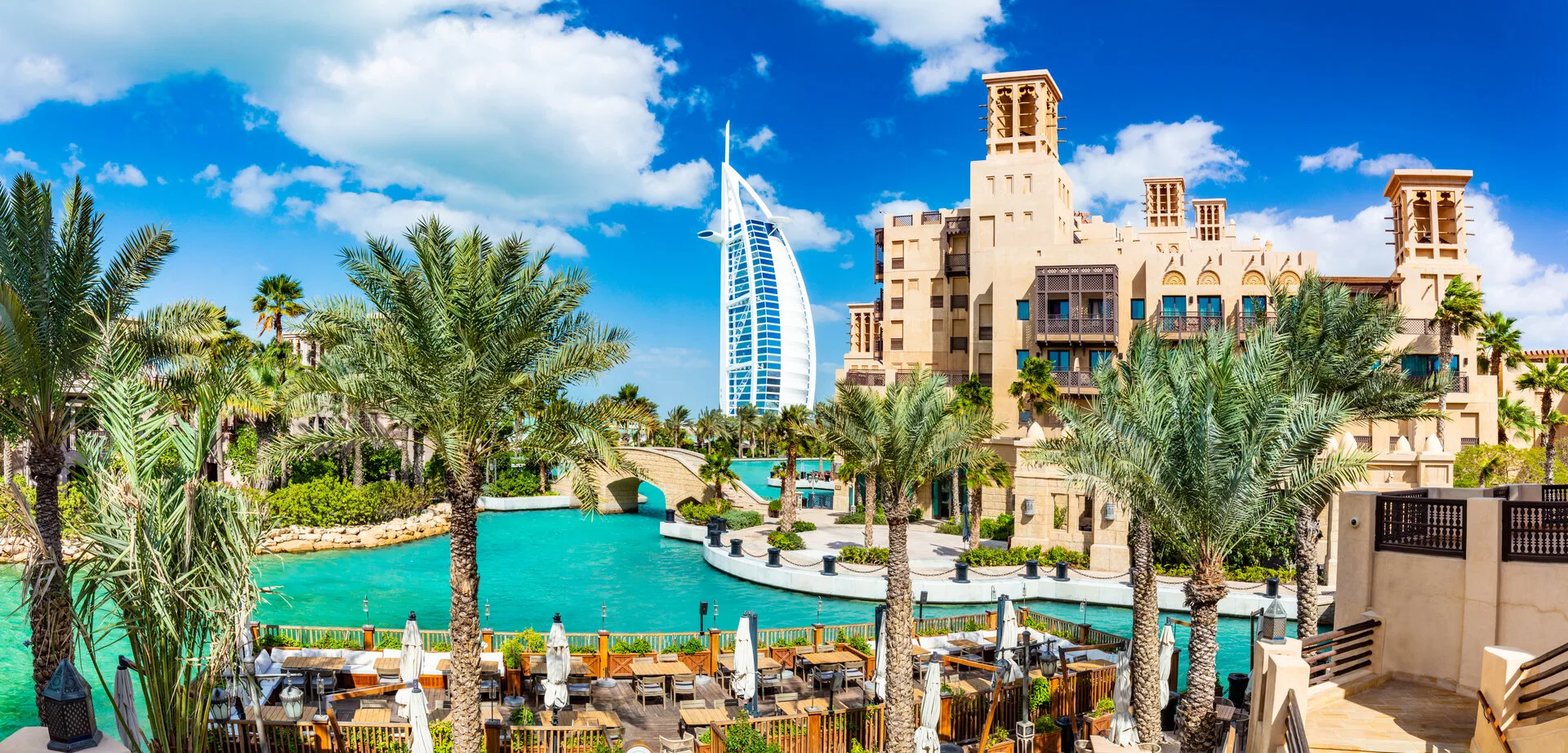
Madinat Jumeirah Living is the reason Al Sufouh has moved from a quiet villa backwater to a project developers actively market. MJL is developed by Meraas, which has operated as a subsidiary of Dubai Holding since 2020, and sits directly beside the Madinat Jumeirah resort and Burj Al Arab, inside Al Sufouh 2. The official MJL Residences page positions the community around low-rise apartment buildings, internal waterways and resort-style amenities rather than the tower-block format used across most of new-build Dubai.
MJL is being delivered in phases with several branded sub-projects, each with its own price entry point at launch: Lamaa opened from roughly AED 1.45 million with a 2025 handover target; Jomana followed with 1- to 4-bedroom apartments from around AED 1.91 million; and Elara, the more recent phase, launched 1- to 4-bedroom units from about AED 2.30 million with a 2026 handover target. Blended across the community, brokerage tracking of MJL resale and off-plan stock puts average pricing near AED 2,850 per sq ft, with quoted rental yields in the 5–6.5% range — a level consistent with a maturing, amenity-rich master community rather than a speculative early-launch project. Construction progress on the community was reported at 95.43% by internal developer inspection and 84.46% by RERA's own inspection as of early March 2026 — a reminder that even within one project, "percentage complete" depends on who is doing the measuring, and buyers checking a specific building's status should pull it directly via the MJL investor portal or the Dubai REST app rather than relying on marketing collateral.
The practical effect on Al Sufouh: MJL has added several thousand low-rise apartment units to a district that, historically, was almost entirely villas plus a handful of older apartment blocks. That supply shift is why any current-year snapshot of "Al Sufouh apartment prices" increasingly means MJL pricing, blended with a much smaller pool of older stock.
Villas in Al Sufouh: Prices, Rents and What You Get
The villa stock in Al Sufouh 1 is what the district was built on. Homes are typically 3- to 5-bedroom standalone properties on generous plots, with private gardens and — in a meaningful share of listings — private pools, reflecting a low-density, privacy-first layout rather than the gated-community format used in newer Dubailand or Dubai South villa projects.
Per Bayut's Al Sufouh villa listings, asking sale prices range from around AED 13.8 million to AED 28 million, averaging approximately AED 17.9 million across current listings. On the rental side, Bayut's villa rental data shows asking rents spanning roughly AED 240,000 to AED 410,000 a year, while Bayut's own DLD-derived 12-month transactional average sits noticeably lower, around AED 210,772 a year. That gap between asking prices and closed transactions is worth flagging explicitly: Al Sufouh's villa sample is small relative to Palm Jumeirah, Jumeirah or Dubai Marina, so a handful of premium or discounted listings can move the average more than in a deeper market. Treat the sale and rent averages here as directional rather than a precise index.
Apartments Beyond MJL: Sufouh Gardens and the Secondary Market
Not every apartment in Al Sufouh is inside MJL. Sufouh Gardens, in Al Sufouh 1, is an older low-rise apartment community that predates the MJL master plan and continues to trade on the resale market, alongside a scattering of smaller freehold apartment buildings near Dubai Media City's edge.
Across this broader, blended apartment pool — MJL and non-MJL combined — Bayut's six-month listings data put the average asking price for a flat in Al Sufouh at approximately AED 3.6 million. On the rental side, Property Finder's Al Sufouh rental data shows an average new-rental figure of roughly AED 114,987 a year against AED 118,516 for renewed rentals, while Bayut's own listing range for apartments spans from about AED 57,000 to AED 270,000 a year, averaging near AED 123,363. As with the villa numbers, this range spans everything from modest older units near Media City to newly delivered MJL apartments with sea and resort views — the district is genuinely bimodal, and a single "average rent" figure flattens a real gap between old and new stock.
| Property type | Typical sale price (AED) | Typical annual rent (AED) | Source basis |
|---|---|---|---|
| Villas (Al Sufouh 1, 3–5BR) | 13.8M – 28M (avg ~17.9M) | 240,000 – 410,000 | Bayut asking listings |
| Secondary apartments (non-MJL) | Avg asking ~3.6M (blended) | ~115,000 – 123,000 (avg) | Bayut / Property Finder |
| MJL — Lamaa (1–4BR) | From ~1.45M | Not yet established (handover 2025) | Developer launch pricing |
| MJL — Jomana (1–4BR) | From ~1.91M | Not yet established | Developer launch pricing |
| MJL — Elara (1–4BR) | From ~2.30M (handover 2026) | Not yet established | Developer launch pricing |
| MJL blended average | ~AED 2,850/sq ft | Gross yield ~5–6.5% | Brokerage MJL tracking |
Figures are asking-price and launch-price data, not a full transaction index. MJL rental figures will firm up as more units reach handover and complete a full lease cycle; treat the 5–6.5% yield estimate as an early indicator rather than a settled number.
Getting Around: Dubai Tram, Al Sufouh Road and Commute Times
Al Sufouh's single biggest infrastructure asset is the Dubai Tram. The line runs the length of Al Sufouh Road, connecting the district directly into the Dubai Marina and JBR tram network and, via interchange, into the Dubai Metro Red Line at the Marina end — a rare case in Dubai where a coastal villa-and-apartment district has rail access on its own doorstep rather than relying purely on road feeder routes. Trams on the corridor run for roughly 20 hours a day, which matters for staff and service workers commuting into Media City, Internet City and the Knowledge Park cluster as much as it does for residents.
By road, Sheikh Zayed Road gives Al Sufouh fast access east toward Downtown and Business Bay and west toward Dubai Marina and Jebel Ali, while Al Sufouh Road itself provides the slower, more scenic coastal alternative past Madinat Jumeirah and toward Umm Suqeim and Jumeirah. Dubai International Airport is a genuine cross-city drive from here — this is very much a west-coast address, not a downtown-adjacent one — but Al Maktoum International's long-term expansion plans make the western corridor increasingly relevant for anyone weighing multi-decade location bets, a theme we cover in our Dubai investment overview.
For anyone working inside Dubai Media City, Dubai Internet City or the Knowledge Park free zones, the practical commute from Al Sufouh is measured in minutes rather than the 30–45-minute drives common from newer, cheaper communities further out along Sheikh Zayed Road or into Dubailand. That short commute is a genuine, if under-marketed, part of Al Sufouh's value proposition — tenants working in media, tech, aviation or education roles inside those free zones can walk or tram to work, which supports steady rental demand even in months when the wider market cools.
Free Weekly Insights
Get Dubai Market Updates in Your Inbox
Expert analysis, market data, and practical tips — trusted by Dubai professionals.
✓ You're in! Check your inbox.
Schools, Dubai Knowledge Park and Family Life
Education access is one of Al Sufouh's understated strengths. Dubai Knowledge Park sits inside Al Sufouh 2 itself — a free-zone cluster built around training providers, universities and HR-services firms — and a genuine concentration of established schools sits within a five-minute drive: Dubai College, the International School of Choueifat (ISC), the American University of Dubai, GEMS Wellington International School, GEMS Dubai American Academy and iCademy Middle East, covering British, American and SABIS curricula between them. That density of options within a single five-minute radius is unusual even by Dubai standards, where families in newer master communities often accept a 15–20 minute school run as the trade-off for lower entry prices; Al Sufouh buyers largely avoid that trade-off.
Day-to-day amenity access leans on neighbours rather than internal retail: Mall of the Emirates and the Dubai Marina Mall corridor are both a short drive away, and Madinat Jumeirah itself — with its souk, restaurants and beach clubs — sits on Al Sufouh 2's doorstep, giving residents resort-grade dining and leisure without needing to leave the immediate area. For a family relocating from overseas, that combination of walkable schooling, established healthcare access via the Dubai Marina and Al Barsha medical clusters, and a beach on the doorstep is a meaningfully different pitch from a purely investment-grade off-plan community still building out its own retail podium.
Al Sufouh vs Media City vs Palm Jumeirah vs Umm Suqeim
Al Sufouh's identity only makes full sense next to its neighbours. It is cheaper than Palm Jumeirah by a wide margin, more residential and less commercial than Media City, and villa-for-villa broadly comparable to Umm Suqeim, though with a materially thinner sales data set.
| Area | Property mix | Villa/apt price benchmark | Freehold status |
|---|---|---|---|
| Al Sufouh | Villas + MJL/secondary apartments | Villas avg ~AED 17.9M | Freehold |
| Dubai Media City | Apartments only | Apt avg ~AED 4.45M (~AED 2,632/sq ft) | Freehold |
| Palm Jumeirah | Villas + apartments | Villas avg ~AED 60.3M (~AED 4,818/sq ft) | Freehold |
| Umm Suqeim | Villas (mostly) | Villa rents (Umm Suqeim 3) avg ~AED 833,000 | Mixed freehold/leasehold |
Media City and Palm Jumeirah figures per Bayut asking-price and sale-transaction data; Umm Suqeim per Bayut's Umm Suqeim 3 rental data. See our full Palm Jumeirah area guide and Umm Suqeim area guide for the full breakdowns.
The read-through: Al Sufouh villas cost roughly a third of Palm Jumeirah's average, while sitting close enough to the Palm — and to Media City's office corridor — that residents can access both lifestyle radii without paying Palm-level premiums. Against Umm Suqeim, the two districts sit in a similar villa-plus-freehold-pocket category, but Umm Suqeim currently has deeper published sales data, which is why we flag Al Sufouh's numbers as more asking-price-driven throughout this guide. Against Media City, the comparison flips: Media City is a pure apartment market with no villa stock and a tighter, tower-dense footprint, so buyers choosing between the two are really choosing between Al Sufouh's low-rise, garden-and-beach lifestyle and Media City's denser, more office-adjacent convenience — two different products that happen to share a border.
Who Buys in Al Sufouh? Freehold Status and Buyer Profile
Al Sufouh is a freehold area, meaning foreign nationals can hold full title rather than the leasehold arrangements that apply in some of Dubai's older, more central villa districts. That status, combined with the Media City/Internet City border and MJL's newer stock, produces two distinct buyer profiles rather than one.
The first is the established villa buyer: often a long-term resident family working in the adjacent media, tech or aviation free zones, drawn by privacy, garden space and a short commute rather than by yield. The second is the MJL buyer: increasingly an investor or upgrading end-user attracted by low-rise resort-style architecture, the Madinat Jumeirah address and a rental-yield profile (5–6.5% per brokerage tracking) that compares favourably with denser tower-block competitors closer to Downtown. For a broader look at how buyer profiles differ by visa and investment pathway, see our Golden Visa through property investment guide — MJL's AED 2 million-plus units comfortably clear the current Golden Visa property threshold.
A family renting a two-bedroom tower apartment in Downtown decides to buy rather than continue renewing. They shortlist a two-bedroom unit in MJL's Jomana phase, priced from around AED 1.91 million at launch versus a comparable Downtown resale asking closer to AED 3 million-plus. The MJL unit trades floor-to-ceiling Burj Khalifa views for low-rise architecture, direct Madinat Jumeirah access, and proximity to GEMS Wellington and Dubai College for their children — a straightforward lifestyle-over-skyline trade that increasingly defines who buys into Al Sufouh 2 rather than Downtown or Business Bay.
Investment Case: Yields, MJL Delivery Progress and Outlook
Al Sufouh's investment case runs on two separate tracks. The villa side is a scarcity story: a small, low-density stock of freehold homes in a coastal location, with limited scope for new supply because there is little undeveloped land left in Al Sufouh 1. That scarcity supports the district's premium sale pricing relative to less established villa areas, even though the achieved-rent data suggests gross yields on villas sit toward the lower end of Dubai's range — consistent with a market where buyers are paying for land, privacy and location rather than optimising for rental income.
The apartment side, dominated by MJL, is a supply-growth story instead. Several thousand new low-rise units are being phased in through Lamaa, Jomana and Elara, with the community's overall construction progress tracked differently by the developer (95.43%) and RERA (84.46%) as of early March 2026 — buyers should always verify a specific building's status directly through the Dubai REST app or the DLD's own project-tracking tools before relying on a marketing timeline. Quoted gross yields of 5–6.5% sit in a reasonable mid-market band for a newly established prime-adjacent community, though with less transaction history behind them than an established area like Dubai Marina or JBR. Run any specific unit through our own ROI calculator before treating a brokerage-quoted yield as your own expected return — assumptions on service charges, void periods and management fees vary meaningfully between MJL's low-rise product and a standard tower unit.
An investor with an AED 20 million budget compares a 4-bedroom villa in Al Sufouh 1, asking around AED 18–20 million, against entry-level villa stock on Palm Jumeirah, where Bayut's tracked average sits closer to AED 60 million. Palm Jumeirah wins on brand recognition, resale liquidity and short-term-rental demand; Al Sufouh wins on land size for the money and a materially lower entry point into a freehold coastal address with Palm views. Neither is "wrong" — the decision turns on whether the buyer is optimising for prestige and exit liquidity (Palm) or for space and value per dirham (Al Sufouh), and the investor ultimately splits the difference by buying the Al Sufouh villa and banking the roughly AED 40 million saved.
Frequently Asked Questions
Is Al Sufouh a freehold area?
Yes. Al Sufouh is a freehold district, meaning foreign nationals can hold full title to villas and apartments, including units in Madinat Jumeirah Living, without the leasehold restrictions that apply in some of Dubai's older, more central neighbourhoods.
What does a villa cost in Al Sufouh?
Per Bayut listings data, villas in Al Sufouh 1 typically ask between AED 13.8 million and AED 28 million, averaging around AED 17.9 million. Rents on the same stock generally range from AED 240,000 to AED 410,000 a year, though Bayut's DLD-derived 12-month transactional average sits lower, near AED 210,772, reflecting a small and asking-price-skewed sample.
What is Madinat Jumeirah Living (MJL) and where is it?
MJL is a low-rise master community developed by Meraas, a Dubai Holding subsidiary, located inside Al Sufouh 2 next to the Madinat Jumeirah resort and Burj Al Arab. It is being delivered in phases — Lamaa, Jomana and Elara among them — with 1- to 4-bedroom apartments and blended pricing tracked at around AED 2,850 per sq ft.
What is the entry price for a Madinat Jumeirah Living apartment?
Launch pricing has varied by phase: Lamaa opened from around AED 1.45 million, Jomana from around AED 1.91 million, and the more recent Elara phase from around AED 2.30 million, each covering 1- to 4-bedroom layouts, per developer launch pricing.
Does Al Sufouh have Dubai Metro or Tram access?
Al Sufouh does not have its own Dubai Metro station, but the Dubai Tram runs the full length of Al Sufouh Road, connecting into the Dubai Marina and JBR tram network and onward to the Metro Red Line via interchange at the Marina end. Trams on the line operate for roughly 20 hours a day.
How does Al Sufouh compare to Palm Jumeirah on price?
Al Sufouh is substantially cheaper. Bayut's tracked average villa sale price on Palm Jumeirah sits around AED 60.3 million versus roughly AED 17.9 million in Al Sufouh — while Al Sufouh still offers beach frontage and views toward the Palm from across the water.
What schools are near Al Sufouh?
Several established schools sit within roughly a five-minute drive of Al Sufouh 2, including Dubai College, the International School of Choueifat, the American University of Dubai, GEMS Wellington International School, GEMS Dubai American Academy and iCademy Middle East, spanning British, American and SABIS curricula. Dubai Knowledge Park, a free zone for education and training businesses, also sits inside the district.
What rental yields can I expect in Al Sufouh?
Brokerage tracking of Madinat Jumeirah Living puts gross rental yields around 5–6.5%, a reasonable mid-market figure for a newly established prime-adjacent community, though with a shorter transaction history than areas like Dubai Marina or JBR. Villa yields on the older Al Sufouh 1 stock appear lower based on the gap between asking sale prices and achieved rents, consistent with a scarcity-driven, land-value market rather than a yield-optimised one.
Who typically buys or rents in Al Sufouh?
Two distinct profiles: long-established villa residents working in the adjacent Dubai Media City, Dubai Internet City or aviation-sector free zones who prioritise privacy and garden space, and a newer wave of MJL buyers and investors drawn by low-rise resort-style architecture, the Madinat Jumeirah address, and yields that compare favourably with denser tower stock closer to Downtown.
Browse every neighbourhood we've mapped on our area guides hub, or dig into the Dubai Marina area guide for the tower-living comparison. Inside the REC community, members trading MJL unit numbers and Al Sufouh 1 villa comparables share what they're seeing on the ground before it shows up in any published index — useful context before you commit to a district this data-thin.
Have Questions?
Get personalized advice from our Dubai real estate team.
Thank You!
We'll get back to you within 24 hours.
Real Estate Agencies in Dubai
Explore providers from our business directory
Still have questions?
Ask a follow-up, or get connected with a vetted Dubai professional.
Join our Telegram channel
Handover alerts, new launches & DLD data — first, in real time.