Palm Jumeirah — Complete Area Guide 2026: Villas, Apartments, Hotels & Investment Analysis

Quick Facts
- Palm Jumeirah is a man-made archipelago shaped like a palm tree, adding 78 km of coastline to Dubai and home to approximately 10,000 residential units.
- 2026 average prices: apartments AED 2M–10M, townhouses AED 5M–15M, villas AED 15M–100M+.
- Gross rental yields range from 4–6% for long-term lets, with branded residences and holiday homes achieving higher returns.
- Home to iconic developments: Atlantis The Royal, One Palm, FIVE Palm, Shoreline Apartments, Golden Mile, Palm Tower, Nakheel Mall.
- Branded residences from Atlantis, Six Senses, Dorchester Collection, Kempinski, Raffles command significant premiums.
- Service charges range from AED 18–45 per sqft, with branded properties at the higher end.
- Connected via the Palm Monorail (linking to Dubai Tram at Gateway Station), road access through the trunk, and a sub-sea tunnel to the crescent.
The Engineering Marvel: History of Palm Jumeirah
Palm Jumeirah is arguably the most recognisable real estate development on Earth. Conceived in the late 1990s by Sheikh Mohammed bin Rashid Al Maktoum and developed by Nakheel, the project was designed to dramatically increase Dubai's coastline and establish the emirate as a global luxury destination. Construction began in 2001, with the first residents moving in by 2006 — an extraordinary timeline for an engineering project of this magnitude.
The island was created by dredging sand from the seabed of the Persian Gulf and spraying it into the iconic palm tree shape using GPS positioning technology. Over 94 million cubic metres of sand and 7 million tonnes of rock were used in its construction. The 11-kilometre crescent breakwater, built from rock quarried in the Hajar Mountains, protects the island from waves and tidal forces. At the time of its completion, Palm Jumeirah was the largest artificial island ever created — a feat that earned it recognition as one of the modern wonders of the world.
The development fundamentally changed Dubai's real estate landscape. Before Palm Jumeirah, Dubai had approximately 72 kilometres of natural coastline. The Palm added 78 kilometres of new waterfront — more than doubling the city's beachfront real estate. This was not merely an engineering achievement; it was a strategic economic play that created an entirely new luxury property segment and positioned Dubai alongside Monte Carlo, the French Riviera, and Miami Beach in the global luxury property market.
Today, Palm Jumeirah is home to approximately 30,000 residents, several world-class hotels (including Atlantis The Palm, Atlantis The Royal, One&Only The Palm, Waldorf Astoria, and FIVE Palm Jumeirah), and some of the most expensive residential properties in the Middle East. In 2025, the Palm recorded over 3,800 property transactions worth approximately AED 32 billion, with several individual villa sales exceeding AED 100 million.
Understanding the Palm: Trunk, Fronds and Crescent
Palm Jumeirah's design creates three distinct residential zones, each with different property types, price dynamics, and lifestyle characteristics. Understanding these zones is essential for making informed purchase decisions.
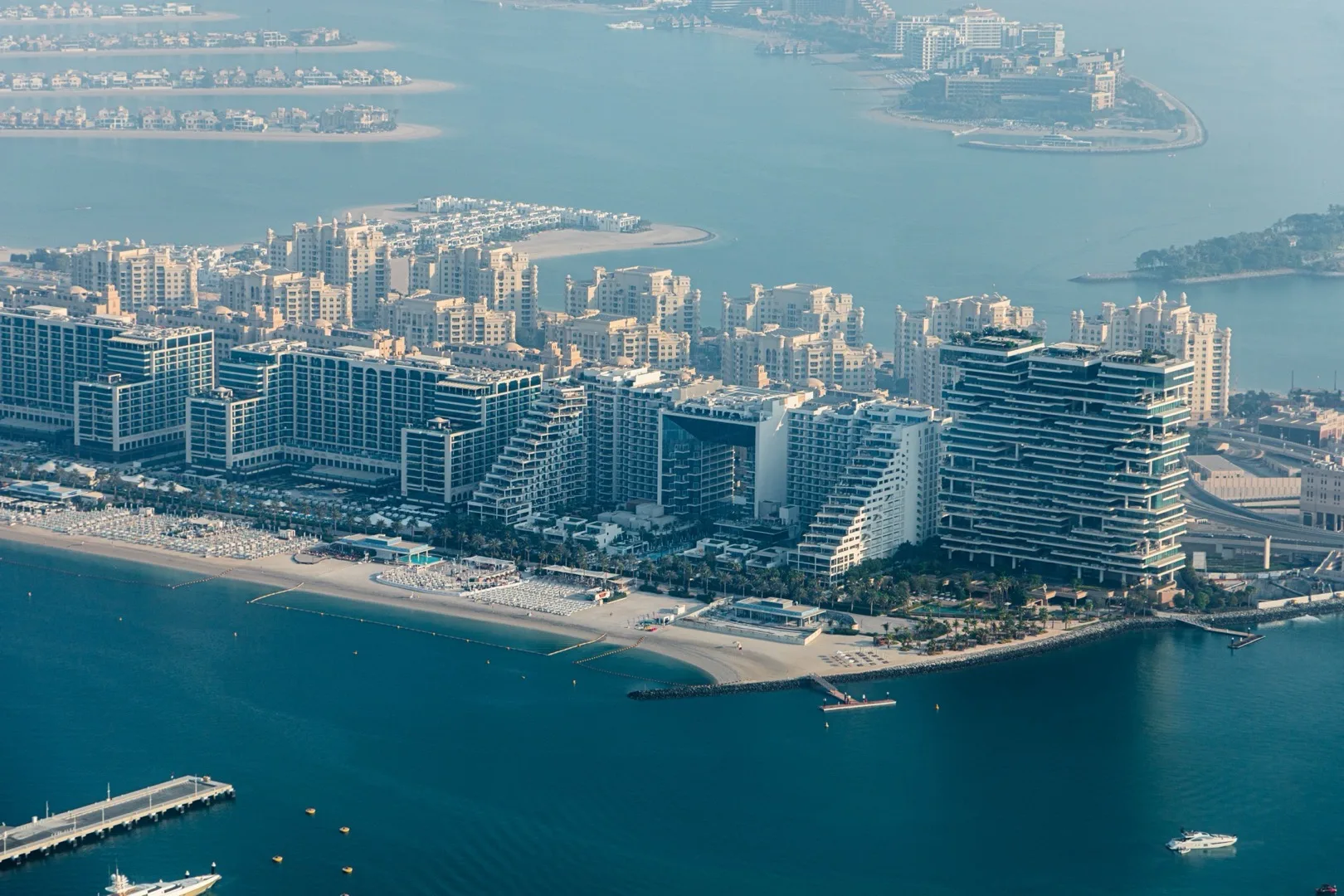
The Trunk: The trunk is the 2-kilometre causeway that connects the mainland to the palm's crown. It serves as the primary access road and is home to several apartment buildings, including the Shoreline Apartments, Golden Mile, and Palm Tower (The View at the Palm). The trunk is the most urbanised section of the Palm, offering the closest proximity to mainland amenities, the Dubai Tram connection at Palm Gateway, and Nakheel Mall (one of Dubai's premium shopping centres). Properties on the trunk tend to be more affordable than frond villas and appeal to residents seeking a balance between island living and urban convenience.
The Fronds: Sixteen fronds branch outward from the crown of the palm, each containing rows of luxury villas and townhouses with private beach access. Frond properties are numbered (A through P, plus additional fronds), and location matters — fronds facing the open sea or Atlantis generally command premiums over inward-facing fronds. The fronds are the most sought-after residential addresses on the Palm, offering privacy, beachfront living, and a suburban pace that contrasts sharply with the density of mainland Dubai. Villa prices on the fronds range from AED 15 million to over AED 100 million for custom-built mega-mansions on tip plots.
The Crescent: The crescent is the outer arc that shields the Palm from open-sea waves. It is primarily a hospitality zone, home to Atlantis The Palm, Atlantis The Royal, Waldorf Astoria, FIVE Palm Jumeirah, and several other hotel and resort developments. Residential properties on the crescent are limited and typically take the form of hotel-branded residences or serviced apartments. Access is via an undersea tunnel from the fronds — an engineering feature that adds to the area's exclusivity.
Key Developments and Branded Residences
Palm Jumeirah has become the epicentre of Dubai's branded residence market, with several global luxury hotel operators attaching their names — and service standards — to residential projects. Branded residences on the Palm consistently command 20–40% premiums over comparable non-branded properties, justified by the combination of hotel-level services, managed maintenance, and brand cachet.
Atlantis The Royal Residences: The newest ultra-luxury addition to the Palm, Atlantis The Royal Residences offer buyers access to the hotel's facilities, including its celebrity-chef restaurants, rooftop infinity pool, and private beach. Residences range from 2-bed apartments (approximately AED 15M) to expansive penthouses (AED 80M+). These properties are positioned at the absolute top of the Dubai luxury market and attract UHNW buyers from Russia, India, and Europe.
One Palm by Omniyat: A 90-unit ultra-luxury tower developed by Omniyat, One Palm is one of the most exclusive residential addresses in Dubai. Units are finished to the highest specifications, with private pools, panoramic sea views, and dedicated concierge services. Prices start from approximately AED 20M for smaller units and exceed AED 60M for penthouses.
FIVE Palm Jumeirah Residences: A hotel-branded residence offering fully furnished apartments with access to FIVE's beach club, restaurants, and entertainment facilities. Popular with holiday home investors due to the brand's strong appeal with leisure travellers. 1-bed apartments start from approximately AED 3.5M, with 2-beds from AED 6M.
Shoreline Apartments: Nakheel's original apartment development on the trunk, comprising 20 low-rise buildings around shared pools and gardens. Shoreline units are the most affordable entry point to Palm ownership, with studios from AED 1.5M and 2-beds from AED 2.5M–4.5M. While the buildings are now nearly two decades old, their beachfront location and relatively lower price points sustain strong tenant demand.
Golden Mile: A mixed-use development on the trunk featuring apartments above retail galleria space. Units range from studios (AED 1.2M) to 3-beds (AED 5M). The galleria's restaurants and shops provide convenient ground-floor amenities, and the development's location near Nakheel Mall adds practical appeal.
Palm Tower (The View at the Palm): A 52-storey tower by Nakheel offering apartments and the St. Regis-branded residences on upper floors. The observation deck on the 52nd floor provides panoramic views of the Palm — and the residential units above the 30th floor enjoy some of the most spectacular vistas in Dubai. Apartments start from approximately AED 2.5M for 1-beds.
Six Senses Residences (The Palm): An ultra-luxury branded residence offering wellness-focused living with Six Senses spa access, organic restaurants, and biophilic design. Prices start from approximately AED 18M for 2-bed units. This development targets the growing segment of UHNW buyers prioritising health and wellness amenities.
Property Types and 2026 Price Ranges
Palm Jumeirah offers the widest range of luxury property types in Dubai, from accessible trunk apartments to nine-figure frond villas. The market is segmented into clearly defined tiers, each serving different buyer profiles and investment strategies.
| Property Type | Location | Price Range (AED) | Price/sqft (AED) |
|---|---|---|---|
| Studio / 1-Bed Apartment | Trunk (Shoreline, Golden Mile) | 1.2M–3.5M | 1,800–2,800 |
| 2-Bed Apartment | Trunk / Palm Tower | 2.5M–7M | 2,200–3,500 |
| 3-Bed Apartment | Palm Tower / One Palm | 5M–20M | 2,500–5,000 |
| Townhouse | Fronds (Garden Homes) | 5M–15M | 1,800–2,800 |
| Signature Villa | Fronds | 15M–50M | 2,000–3,500 |
| Custom / Tip Villa | Frond Tips | 50M–150M+ | 3,500–7,000+ |
| Branded Residence | Crescent / One Palm | 15M–80M+ | 4,000–8,000+ |
The most significant price driver on the Palm is plot position. Frond tip plots — which offer 270-degree water views and the most expansive beach frontage — command premiums of 100–300% over mid-frond positions. Similarly, outward-facing fronds (with open-sea views) trade at 15–30% premiums over inward-facing fronds (which look toward the trunk). For apartment buyers on the trunk, sea-view units command 20–35% premiums over units facing the road or internal gardens.
Capital appreciation on Palm Jumeirah has been exceptional since 2020. Average villa prices have increased by approximately 80–120% since the post-COVID recovery began, driven by a surge in demand from UHNW international buyers (particularly from Russia, India, the UK, and Europe). The limited supply of frond villas — approximately 1,500 in total — creates inherent scarcity that supports prices even during broader market corrections. For detailed buying steps, see our comprehensive buying guide.
Rental Yields and Investment Analysis
Palm Jumeirah's rental yield profile is distinct from most Dubai communities. Long-term rental yields are moderate (4–6% gross), reflecting the higher purchase prices, but the Palm excels in two areas: branded residence income and short-term holiday home returns.
| Property Type | Annual Rent (AED) | Gross Yield | Holiday Home Yield (est.) |
|---|---|---|---|
| 1-Bed Apartment (Shoreline) | 100K–140K | 4.5–5.5% | 7–9% |
| 2-Bed Apartment (Trunk) | 150K–250K | 4.0–5.5% | 6–9% |
| Garden Home (Townhouse) | 300K–500K | 4.0–5.0% | 5–7% |
| Signature Villa | 500K–1.5M | 3.5–5.0% | 5–8% |
| Branded Residence (FIVE, Atlantis) | 200K–600K | 3.5–5.0% | 7–11% |
The Palm's investment thesis rests more on capital appreciation and prestige than on pure yield. Between 2020 and 2026, frond villa values have more than doubled, representing annualised returns of 12–18% before rental income. For investors seeking yield, the trunk apartments (particularly Shoreline and Golden Mile units converted to holiday homes) offer the best balance of income and price accessibility. Use our ROI Calculator to model different scenarios.
For Golden Visa eligibility, virtually all Palm Jumeirah properties exceed the AED 2 million threshold, making the community a natural choice for investors seeking residency benefits alongside their property investment.
Lifestyle: Beach Clubs, Dining and Entertainment
Palm Jumeirah offers a resort-calibre lifestyle that few residential communities anywhere in the world can match. The island's hospitality DNA — with over a dozen five-star hotels and resorts — creates an environment where residents have access to world-class dining, beach clubs, spas, and entertainment within minutes of their homes.
Beach Clubs: The Palm is home to several of Dubai's most celebrated beach clubs. White Beach at Atlantis The Royal, Azure Beach at Rixos, DRIFT Beach at One&Only, and West Beach at Five Palm Jumeirah offer residents and guests access to private beaches, infinity pools, and curated F&B experiences. Many Palm residents hold annual memberships at one or more beach clubs, creating a social ecosystem that rivals Mediterranean resort towns.
Dining: The concentration of celebrity-chef restaurants on the Palm is unmatched in the Middle East. Nobu (Atlantis), Heston Blumenthal's Dinner (Atlantis The Royal), Jose Andres' Jaleo (Atlantis The Royal), Ossiano (underwater restaurant at Atlantis), and dozens of other high-end dining establishments line the crescent and trunk. For everyday dining, Nakheel Mall and the Golden Mile Galleria provide a range of casual to mid-range options.
Nakheel Mall: Completed in 2019, Nakheel Mall is the Palm's primary shopping and entertainment hub. Anchored by a Waitrose supermarket, Vox Cinema, Trampo (trampoline park), and over 300 retail and F&B outlets, the mall addresses daily needs and leisure requirements. The rooftop dining terrace offers panoramic views of the Palm and the Dubai Marina skyline.
Water Sports and Marina: The Palm's sheltered waters are ideal for water sports, including kayaking, paddleboarding, jet skiing, and sailing. Several frond villas include private marina berths, and the Palm West Beach public beach area provides free beach access for all residents. Boat tours around the Palm are one of Dubai's most popular tourist activities, adding to the area's vitality.
The Boardwalk: An 11-kilometre waterfront boardwalk runs along the inner crescent of the Palm, connecting the trunk to Atlantis. Open for walking, jogging, and cycling, the boardwalk provides stunning sunset views and has become a popular fitness and social gathering spot for residents.
Transport and Accessibility
Palm Jumeirah's island geography creates both advantages (exclusivity, low through-traffic) and challenges (limited access points, potential bottlenecks). Understanding the transport infrastructure helps buyers assess daily commute practicality.
Road Access: The primary road access to Palm Jumeirah is via the trunk, which connects to the mainland at the intersection with King Salman bin Abdulaziz Al Saud Street. During peak hours (7:30–9:00 AM and 5:30–7:30 PM), the trunk road can experience congestion, particularly for frond residents. An undersea tunnel connects the fronds to the crescent, providing alternative routing for residents of outer fronds.
Palm Monorail: The Palm Monorail runs from Gateway Station (on the trunk, connecting to the Dubai Tram) to Atlantis Aquaventure Station on the crescent. While primarily used by tourists visiting Atlantis, the monorail provides a traffic-free alternative for residents commuting to the mainland. The connection to the Dubai Tram — which links to the Dubai Metro Red Line — enables public transport access to the entire city, though with transfer time the journey is better suited to leisure than daily commuting.
Drive Times: Under normal traffic conditions, Palm Jumeirah is approximately 20 minutes from Dubai Marina, 25 minutes from Downtown Dubai, 30 minutes from DIFC, and 45 minutes from Dubai International Airport. During peak hours, these times can increase by 30–50%.
Service Charges on Palm Jumeirah
Service charges on Palm Jumeirah are among the highest in Dubai, reflecting the premium maintenance requirements of an artificial island — including beach replenishment, marine infrastructure, extensive landscaping, and high-end common facilities. Buyers must factor these charges into net yield calculations, as they can significantly impact returns.
| Development | Service Charge (AED/sqft) | Notes |
|---|---|---|
| Shoreline Apartments | 18–22 | Nakheel-managed, includes beach maintenance |
| Golden Mile | 16–20 | Includes galleria common areas |
| Palm Tower (Nakheel) | 22–28 | Premium facilities, observation deck maintenance |
| Frond Villas (Signature) | 3–6 | Per sqft of plot; private maintenance additional |
| FIVE Palm Residences | 35–45 | Hotel-branded, includes full hotel services |
| One Palm | 30–40 | Ultra-luxury, bespoke management |
For villa owners, service charges cover communal infrastructure (roads, lighting, beach maintenance, security) but not the villa itself — owners are responsible for their own garden maintenance, pool upkeep, and structural repairs. Annual maintenance costs for a Signature Villa can range from AED 80,000 to AED 200,000+ depending on size and specification. Read our service charges guide for a detailed breakdown across Dubai communities.
Free Weekly Insights
Get Dubai Market Updates in Your Inbox
Expert analysis, market data, and practical tips — trusted by Dubai professionals.
✓ You're in! Check your inbox.
Pros and Cons of Palm Jumeirah
Pros:
- Iconic address: Globally recognised location that provides unmatched prestige and brand value for property owners.
- Capital appreciation: Among the strongest price growth in Dubai over the past five years, driven by genuine scarcity and international ultra-luxury demand.
- Beach access: Private beach frontage for frond villas and shared beach access for apartment residents — true beachfront living.
- World-class amenities: Beach clubs, celebrity restaurants, five-star hotels, and Nakheel Mall provide resort-quality daily life.
- Supply constraint: Fixed island footprint means no new frond villas can be built, ensuring permanent scarcity for existing stock.
- Golden Visa eligibility: All properties comfortably exceed the AED 2M threshold for 10-year residency.
- Security: Gated community with controlled access points and 24/7 security infrastructure.
Cons:
- High entry prices: Even the most affordable apartments start at AED 1.2M, and villas require AED 15M+ — limiting the buyer pool.
- Traffic congestion: Single access road (trunk) creates peak-hour bottlenecks that can significantly extend commute times.
- High service charges: Particularly for branded residences (AED 35–45/sqft), which erode net yields substantially.
- Lower rental yields: Gross yields of 4–6% are below Dubai averages, making the Palm less attractive for pure yield investors.
- Limited daily conveniences: While Nakheel Mall addresses most needs, residents who prefer hypermarket choice, hardware stores, or specific retailers will need to drive to the mainland.
- Villa maintenance costs: Beachfront properties require ongoing investment in sand management, salt corrosion prevention, and landscaping.
Who Should Buy on Palm Jumeirah?
Ideal for:
- UHNW buyers seeking a prestigious global address with strong capital preservation and appreciation potential.
- End-users wanting genuine beachfront living with resort-quality amenities and a secure, exclusive environment.
- Golden Visa applicants who want residency benefits combined with a trophy asset.
- Holiday home investors targeting the luxury short-term rental market — Palm addresses command premium nightly rates.
- Corporate buyers seeking executive housing in a globally recognised location for senior staff relocation.
Less suitable for:
- Yield-focused investors — communities like Dubai Marina or JLT offer significantly higher rental returns.
- Budget-conscious buyers — the minimum entry point is among the highest in Dubai.
- Daily commuters to areas like DIFC, Deira, or Dubai Silicon Oasis — the island's location adds meaningful travel time.
- Families prioritising school proximity — no schools on the island itself, requiring daily commutes to mainland campuses.
Mortgage and Financing Considerations
Palm Jumeirah properties are readily financed by UAE banks, though the higher ticket sizes trigger different LTV tiers. For properties above AED 5 million, UAE residents can typically borrow up to 70% LTV (compared to 80% for properties under AED 5M). Non-residents can access 60–65% LTV. Given that even entry-level Palm apartments often exceed AED 2 million, buyers should plan for substantial down payments.
Interest rates for Palm properties are generally in line with broader market rates (4.5–6.5% in 2026), though some banks may apply premium valuations due to the island's trophy asset status. Pre-approval is recommended before beginning property searches, as the high price points mean even small rate differences translate into significant cost variations over loan terms. Use our mortgage calculator to estimate repayments and compare our mortgage guide for bank-by-bank comparison.
Future Developments and Market Outlook
Palm Jumeirah's fixed geography means future development is limited to a handful of remaining plots, primarily on the trunk and crescent. Nakheel's Palm Jebel Ali — the long-delayed second palm island — is now under active development, and its eventual completion may provide a more affordable alternative to Palm Jumeirah while simultaneously validating the palm island concept further.
Several branded residence projects are still under construction or recently completed on the crescent, including additional phases of the Atlantis The Royal Residences and the Six Senses development. These will add limited supply to the ultra-luxury segment but are unlikely to impact the established apartment and villa markets on the trunk and fronds.
The long-term outlook for Palm Jumeirah remains strongly positive. The island's inherent supply constraint (no new fronds can be built), combined with growing global demand for waterfront luxury real estate, positions Palm properties as some of the most durable store-of-value assets in the Middle East. For investors with a long-term horizon and sufficient capital, Palm Jumeirah represents a fundamentally sound allocation within a diversified property portfolio.
Healthcare and Medical Facilities
Palm Jumeirah does not contain a full hospital, which is a practical consideration for families and elderly residents. However, several clinics operate on the island, and major hospitals are accessible within a reasonable drive.
King's College Hospital London — Dubai Hills: A major international hospital approximately 20 minutes from the Palm, offering emergency, surgical, and specialist services. This is the nearest full-service hospital for most Palm residents and is widely considered one of Dubai's best healthcare facilities.
Emirates Hospital — Jumeirah: Located approximately 15 minutes from the trunk, this multi-speciality hospital provides comprehensive inpatient and outpatient care. Popular with Palm residents for its quality of service and relatively convenient location.
Palm Jumeirah Medical Clinics: Several outpatient clinics operate on the trunk, including Aster Clinic, Medcare, and a number of specialist practitioners. These clinics handle routine consultations, dental care, dermatology, physiotherapy, and minor procedures. For non-emergency medical needs, these on-island facilities reduce the need to drive to the mainland.
Pharmacies: Pharmacies are available in Nakheel Mall and at various points along the trunk. Most stock comprehensive over-the-counter ranges and process prescriptions efficiently. Home delivery pharmacy services also cover the Palm.
For residents requiring regular specialist care, the 15–25 minute drive to mainland hospitals is a minor inconvenience. Emergency ambulance response times to the Palm are typically 8–15 minutes, depending on the specific location (trunk vs frond tips). Residents with serious ongoing medical conditions should factor in the island's distance from major hospitals when making purchase decisions.
Security and Community Management
Palm Jumeirah benefits from a robust security infrastructure that reflects its status as one of the most valuable residential communities in the Middle East. The island has controlled access points — vehicle access is via the trunk road, which is monitored by CCTV and can be restricted during security events. Nakheel's community management team operates 24/7 security patrols, CCTV monitoring, and emergency response capabilities across all common areas.
Individual villa communities on the fronds have additional security measures, including perimeter fencing, guard posts at frond entrances, and ANPR (Automatic Number Plate Recognition) cameras. Apartment buildings on the trunk (Shoreline, Golden Mile, Palm Tower) maintain their own building security with lobby concierge, CCTV, and access control systems.
The island's geography is inherently security-positive — with limited access points and water boundaries on all sides, it is one of the most naturally secure communities in Dubai. Crime rates are extremely low, and the combination of the resident demographic (UHNW individuals with private security) and community-level security infrastructure creates an environment where safety is virtually taken for granted.
For villa owners, private security services are available from several providers at approximately AED 8,000–15,000 per month for 24/7 guard coverage. Many UHNW villa owners also install comprehensive smart security systems (cameras, sensors, biometric access) with total costs ranging from AED 50,000 to AED 200,000 depending on property size and specification.
Schools and Education Near Palm Jumeirah
Palm Jumeirah does not contain any schools on the island itself, which is one of the primary considerations for families evaluating the area. However, several well-regarded educational institutions are located within a 10–20 minute drive on the mainland, making the Palm viable for families willing to accept a daily school commute.
GEMS Wellington International School — Al Sufouh: One of Dubai's most sought-after British curriculum schools, located approximately 10 minutes from the Palm trunk. Offers a comprehensive programme from Foundation Stage through Year 13 (A-Levels and BTEC). Known for strong academic results and extensive extracurricular activities. Annual fees range from AED 50,000–95,000.
Dubai International Academy (DIA) — Al Barsha: An IB World School offering the full International Baccalaureate programme, located approximately 12 minutes from the Palm. Popular with internationally mobile families, with annual fees from AED 45,000–85,000.
Kings' School Al Barsha: A well-established British curriculum primary school approximately 15 minutes from the Palm. Known for its nurturing environment and strong pastoral care, with fees from AED 45,000–62,000.
Nurseries: Several nurseries operate on or near the Palm, including Redwood Montessori (Shoreline area) and nurseries in the Golden Mile Galleria. These provide early years education and childcare convenience for families with young children living on the island.
The school commute is the primary trade-off for Palm families. During morning peak hours, the drive from the fronds to Al Sufouh or Al Barsha schools can take 20–30 minutes (versus 10–15 minutes off-peak). Many Palm families mitigate this by using school bus services, which operate dedicated routes to the island. For families considering the Palm specifically for its lifestyle while accepting the school commute trade-off, the key is ensuring that the chosen school offers reliable transport services to the island.
Renovation and Customisation
For villa buyers on the Palm, renovation and customisation are common — particularly for older Signature Villas that may need updating to match current luxury market expectations. Renovation budgets for a full Signature Villa upgrade (interiors, kitchen, bathrooms, landscaping, pool) typically range from AED 500,000 to AED 3 million, depending on scope and specification level.
Key renovation considerations for Palm villas include: salt corrosion protection for all external metalwork and fixtures (the marine environment is harsh on unprotected materials), beach frontage maintenance (sand management and erosion prevention), swimming pool systems (saltwater vs freshwater, heating, chemical management), and landscaping in sandy, saline soil conditions. Working with contractors experienced in beachfront property renovation is essential — mainland renovation firms without marine experience often underestimate the environmental challenges.
For apartment buyers in Shoreline and Golden Mile, renovation scope is more limited but still relevant. Many units have original 2007–2010 specifications (dated kitchens, bathrooms, and flooring) that benefit from updating. A comprehensive 2-bed apartment renovation typically costs AED 80,000–200,000 and can add 10–15% to rental value and resale price. NOC approval from the building management is required before commencing any structural or layout modifications.
Frequently Asked Questions
Is Palm Jumeirah a good investment in 2026?
What is the cheapest property you can buy on Palm Jumeirah?
Are Palm Jumeirah villas freehold for foreigners?
How much are service charges on Palm Jumeirah?
Is the Palm Jumeirah monorail useful for daily commuting?
Palm Jumeirah vs Emirates Hills — which is better for luxury living?
Disclaimer: This article is for informational purposes only and does not constitute financial, legal, or investment advice. Property prices, rental yields, and market conditions are based on publicly available data and market estimates as of early 2026. Actual returns may vary. Always conduct independent due diligence, consult a licensed real estate professional, and seek legal and financial advice before making any property investment decisions. Past performance is not indicative of future results.
Have Questions?
Get personalized advice from our Dubai real estate team.
Thank You!
We'll get back to you within 24 hours.
Real Estate Agencies in Dubai
Explore providers from our business directory
Still have questions?
Ask a follow-up, or get connected with a vetted Dubai professional.
Join our Telegram channel
Handover alerts, new launches & DLD data — first, in real time.