Palm Jebel Ali 2026: Everything About Dubai's New Palm Island Development


Free PDF
Get the Palm Jebel Ali brochure & floor plans
The developer's own file, with layouts and unit plans. Sent to your inbox, no account needed.
Download the PDF- Palm Jebel Ali is now in active construction. In April 2026 Nakheel awarded AED 3.5 billion in contracts to build 544 villas across the early fronds.
- The island is planned to be roughly twice the size of Palm Jumeirah, with seven islands, 16 fronds and 90+ km of new beachfront, designed to house around 35,000 families.
- The first villa contracts target Q4 2028 completion; early frond launches (Beach Collection, Coral Collection) carry handover dates around Q3–Q4 2027. Full island buildout extends into the 2030s.
- Verified 2026 pricing: 5-bed villas from around AED 18 million, 6-bed around AED 21.5 million, 7-bed premium villas from roughly AED 29–43 million — broadly 60% below comparable Palm Jumeirah product per square foot.
- This is a long-horizon, calculated play — not a quick flip. It also launches into a softer, conflict-affected 2026 Dubai market, which raises the bar for due diligence.
As of mid-May 2026, Palm Jebel Ali has moved decisively from "revived concept" to active construction site. For over a decade it existed as a half-reclaimed outline visible on satellite imagery — a ghost of Dubai's pre-2008 ambitions. That has changed: Nakheel has unveiled a redesigned masterplan, awarded major building contracts, and broken ground on the early fronds.
If Palm Jumeirah transformed Dubai's coastline and became a global icon, Palm Jebel Ali aims to redefine it at far larger scale. But scale brings scrutiny — and the project is now selling into a Dubai market that, after a conflict-affected first quarter, looks very different from the one-way bull run of 2021–2024. This guide covers what is verified about Palm Jebel Ali in 2026: the masterplan, the construction status, real pricing, the risks, and how to buy.
Nakheel's official frond plot plans are downloadable — get the Palm Jebel Ali plot-plan PDF to check exact villa positions before speaking to anyone.
What Is Palm Jebel Ali?
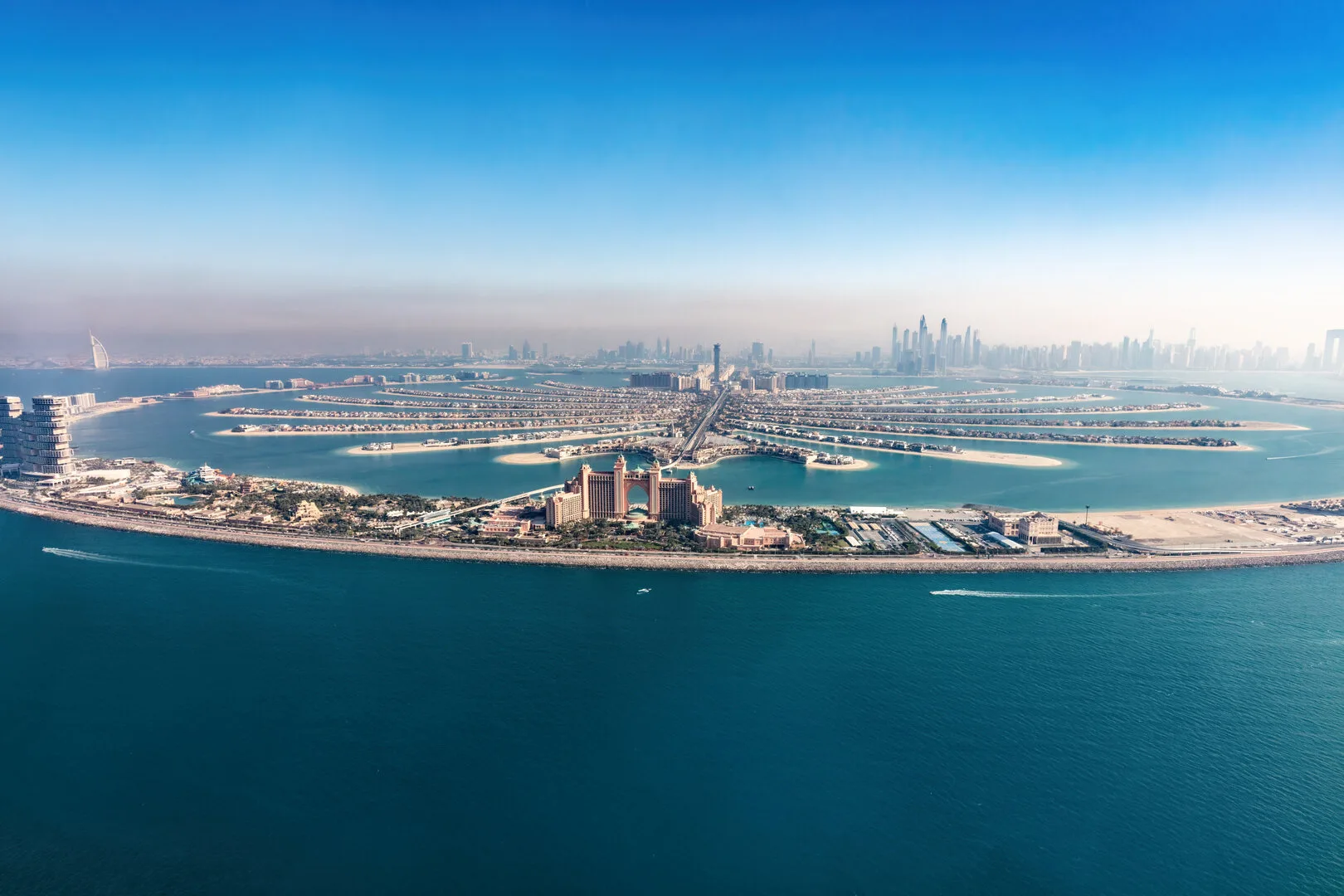
Palm Jebel Ali is the second palm-shaped artificial island being built off the coast of Dubai, located southwest of Palm Jumeirah along the Sheikh Zayed Road corridor. It is developed by Nakheel — the master developer behind Palm Jumeirah, The World Islands and Deira Islands — and was originally announced in 2002 as part of Dubai's planned trilogy of palm islands.
Land reclamation began in the mid-2000s, and by 2007 the trunk, crescent and fronds were partially visible from satellite imagery. The 2008 global financial crisis then halted the project, and the reclaimed land sat untouched for years. The revival forms part of Dubai's 2040 Urban Master Plan and the D33 economic agenda, which targets a major expansion of public beaches and waterfront housing supply. Nakheel, now operating under Dubai's consolidated real estate umbrella, has announced a completely redesigned masterplan that differs significantly from the 2002 concept.
The Masterplan: Twice the Size of Palm Jumeirah
The scale of Palm Jebel Ali is the headline, and the verified figures are substantial in their own right — there is no need to inflate them.
| Feature | Palm Jumeirah | Palm Jebel Ali (planned) |
|---|---|---|
| Relative size | Reference island | Roughly twice as large |
| Structure | 16 fronds + crescent | 7 islands, 16 fronds |
| New beachfront added | Reference | 90+ kilometres |
| Planned residential capacity | ~10,000+ homes (built out) | ~35,000 families |
| Hotels & resorts planned | ~30+ | ~80 |
| Development era | 2001–2007 | Revived 2023, building from 2026 |
The redesigned masterplan moves away from the original residential-only concept toward a mixed-use island ecosystem: resort and hospitality islands, residential frond communities, marina and retail districts, and dedicated green space. The crescent breakwater is planned for luxury resorts and beach clubs rather than the villas in the 2002 design. The fronds host a mix of villa types, from family homes to large signature mansions with private beach access.
Current Development Status in 2026
This is where Palm Jebel Ali has changed most since earlier reporting. As of mid-May 2026 the project is in active, contracted construction — not just enabling works.
Confirmed and underway:
- Land reclamation for the trunk and primary fronds is complete and stabilised.
- In April 2026, Nakheel awarded AED 3.5 billion (around USD 950 million) in contracts to build 544 villas — Ginco General Contracting taking 354 villas across Fronds A–D, and United Engineering Construction (UNEC) taking 190 villas across Fronds E–F.
- Nakheel has said roughly AED 750 million of major infrastructure works — roads, utilities, power distribution, telecom — are scheduled for completion by the end of 2026.
- Marine works, the bridge connection from Sheikh Zayed Road, and frond-level enabling and earthworks are progressing across multiple fronds.
- Show villas and sales facilities are operational, and several frond collections have launched commercially.
Palm Jumeirah took roughly five years from reclamation start to first resident move-in (2001–2006) — and it was a smaller, simpler island. Palm Jebel Ali's first villa contracts target Q4 2028 completion, with early frond launches citing handover around Q3–Q4 2027. Full island buildout — all islands operational with complete community services — realistically extends into the 2030s. Treat the early handover dates as targets, not guarantees.
Expected Timeline
| Milestone | Scope | Target |
|---|---|---|
| Major infrastructure phase | Roads, utilities, power, telecom (~AED 750M of works) | End of 2026 |
| Early frond launches | Beach Collection / Coral Collection villas | Handover cited Q3–Q4 2027 |
| First major villa contracts | 544 villas, Fronds A–F | Completion target Q4 2028 |
| Full island buildout | All islands operational, full community services and resorts | Into the 2030s |
These dates are drawn from Nakheel's public statements and contract announcements. Dubai has a track record of both accelerating and delaying megaprojects depending on market conditions — and 2026's conflict-driven construction cost inflation (reported at around 30% across the Dubai market) is a real pressure on schedules.
Property Types and What Is Available
Palm Jebel Ali's residential offering is deliberately broader than Palm Jumeirah's original villa-only approach.
Beachfront frond villas: The signature product. Early launches include the Beach Collection (5- and 6-bedroom beachfront villas) and the Coral Collection (ultra-luxury 7-bedroom villas), with private beach access and direct waterfront positioning. These are the closest comparison point to Palm Jumeirah's frond villas.
Signature and premium villas: Larger plots on prime fronds, targeting the ultra-high-net-worth segment.
Beachfront plots: Unlike Palm Jumeirah, where villas were developer-built, Nakheel has offered select plots for custom builds on certain fronds — appealing to buyers who want bespoke architecture on an iconic address.
Marina and resort residences: The masterplan also envisages waterfront apartments in the marina district and branded resort residences on the hospitality islands, offering lower entry points than standalone villas. As of mid-2026 the villa fronds are the most active part of the sales pipeline.
Verified 2026 Pricing and Palm Jumeirah Comparison
Pricing on Palm Jebel Ali is still evolving as new fronds launch, but the early-2026 figures below are drawn from Nakheel's released collections and brokerage market reporting.
| Product | Palm Jebel Ali (2026) | Notes |
|---|---|---|
| 5-bedroom beachfront villa | From ~AED 18 million | Beach Collection launch pricing |
| 6-bedroom beachfront villa | ~AED 21.5 million median | Roughly AED 2,600–2,700 per sq ft |
| 7-bedroom premium villa | From ~AED 29–43 million | Coral Collection and signature tiers |
| Per-sq-ft vs Palm Jumeirah | Roughly 60% lower | The core of the investment thesis |
Payment plans on early launches have been competitive by Dubai standards — an 80/20 split (80% during construction, 20% on handover) has been used on several frond collections to drive sales velocity.
The roughly 60% per-sq-ft discount to Palm Jumeirah is the foundation of the bull case: if Palm Jebel Ali matures to even a fraction of Palm Jumeirah's pricing, early buyers benefit. The caveat is that Palm Jebel Ali is not first-of-its-kind the way Palm Jumeirah was — it launches into a Dubai market where luxury waterfront already exists. The discount reflects real construction and timeline risk, not a free lunch.
Nakheel as Developer: The Balanced View
Any investment in Palm Jebel Ali is fundamentally a bet on Nakheel's ability to deliver at scale.
What inspires confidence: Palm Jumeirah is the most successful artificial island development in history — completed, occupied and well-established. Nakheel has delivered tens of thousands of residential units across Dubai since 2001, emerged from its 2009 debt restructuring, and now operates under Dubai's consolidated government-backed property entity, which provides implicit sovereign support. Recent deliveries such as Nakheel Mall and Palm West Beach were well received.
What gives pause: Deira Islands and The World Islands both experienced significant delays and scope changes. The original Palm Jebel Ali was shelved entirely — the revival is itself an acknowledgment of past over-ambition. Managing construction across an island roughly twice the size of Palm Jumeirah is materially more complex than anything Nakheel has completed, and Dubai-wide construction cost inflation in 2026 adds schedule and budget pressure.
Infrastructure, Connectivity and Location
One genuine structural advantage over Palm Jumeirah is infrastructure planning. Palm Jumeirah was designed in the early 2000s, and its single trunk-road access has been a persistent bottleneck. Palm Jebel Ali's masterplan provides for multi-lane bridge access to Sheikh Zayed Road with planned secondary connections, modern desalination, sewage and power facilities built to island specifications from day one, and retail, schools and clinics integrated into the plan rather than retrofitted later. A large purpose-built marina is also planned for the trunk.
Location is the other advantage. Palm Jebel Ali sits in Dubai's fast-developing southwest corridor — close to Dubai South, the expanding Al Maktoum International Airport, Expo City Dubai, and the Jebel Ali Free Zone (JAFZA), one of the world's largest free zones. For the tens of thousands who work in that corridor, a waterfront island address minutes away is a genuine proposition. Whether the connectivity is delivered on schedule, however, remains a key variable to watch.
Following the Market?
Get Market Data in Your Inbox
DLD transaction data, price trends, and quarterly forecasts — before everyone else.
✓ You're in! Check your inbox.
The Investment Thesis — Bull and Bear
The bull case rests on four pillars: the Palm Jumeirah precedent (early buyers there saw exceptional long-run appreciation); Dubai's persistent beachfront premium; genuine scarcity of large-scale waterfront villa supply elsewhere in the city; and the roughly 60% per-sq-ft discount to Palm Jumeirah as a entry-point cushion.
The bear case is equally important and should be stress-tested before committing capital:
- Palm Jebel Ali is not Palm Jumeirah. Palm Jumeirah had zero comparable supply at launch. Palm Jebel Ali enters a market where luxury waterfront already exists, so the "it will reach Palm Jumeirah prices" assumption is not guaranteed.
- Market timing. The project is selling into a 2026 Dubai market that recorded its first quarterly residential price decline since 2020 in Q1, driven by a regional security conflict. The ceasefire and an April rebound improved sentiment, but a renewed flare-up reported on 5 May 2026 keeps the outlook fluid. Our data-based analysis of whether Dubai prices will drop in 2026 covers this in depth.
- Absorption risk. Palm Jebel Ali plans capacity for around 35,000 families over a decade. Dubai's luxury market needs to absorb that supply without price compression.
- Timeline slippage. A two-to-three-year delay from stated targets would not be unusual for a megaproject of this scale.
Lessons from Palm Jumeirah's Journey
Palm Jumeirah's 20-year arc is essential context. The early years were difficult — first residents in 2006–2007 dealt with construction dust, incomplete roads and limited services, and frond villa values fell sharply during the 2008–2011 downturn. Recovery to pre-crisis levels took until roughly 2013–2014, and the major surge came only post-2020. The destination infrastructure — the monorail, Nakheel Mall, The Pointe, Atlantis The Royal — took more than 15 years from first handover to fully materialise.
The lesson for a 2026 Palm Jebel Ali buyer: this is a 10–15 year investment horizon. Anyone expecting quick returns is likely to be disappointed — or, worse, forced to sell at a loss during the inevitable construction-phase volatility, particularly if it coincides with a soft market cycle.
Risks and Concerns
A balanced assessment must name the real risks directly:
- Timeline uncertainty: Plan for Phase 1 handover potentially later than the stated 2027–2028 targets.
- Market absorption: A large luxury pipeline — on Palm Jebel Ali and across Dubai — must be absorbed without price compression.
- Construction at scale: Building on reclaimed Gulf land brings soil stability, salt-water corrosion and heat-stress challenges, amplified at roughly twice Palm Jumeirah's scale.
- Opportunity cost: Capital in a construction-phase off-plan property generates zero yield for years.
- Market-cycle risk: Buying into the 2026 conflict-affected market means accepting that values could move either way before handover.
The long timeline to handover means you need financial resilience for several years of payments with no rental income. Buyers who stretched during Palm Jumeirah's early years and then met the 2008 crisis were among the worst affected. Build in a buffer.
How to Buy: The Process
Direct from Nakheel (primary market): Register interest through Nakheel's official sales channels or authorised brokerages. New phase launches are announced through Nakheel's website and registered agent networks. Booking requires a reservation fee, followed by a Sales and Purchase Agreement (SPA), with payments on a construction-linked schedule. All transactions are registered with the Dubai Land Department (DLD), and buyer funds are held in RERA-regulated escrow accounts.
Secondary market (resale of early plots): Some buyers from 2023–2024 launches are listing units at a premium. Secondary transactions require a No Objection Certificate (NOC) from Nakheel, and a 4% DLD transfer fee applies. Due diligence is critical — verify the seller's payment status, any outstanding instalments, and the exact plot specification.
Registration and escrow: All off-plan sales in Dubai must be registered with RERA. Developer payments go into RERA-regulated escrow accounts, and the developer cannot draw funds until construction milestones are independently verified — a framework introduced after the 2008 crisis specifically to protect off-plan buyers. You receive an Oqood (interim registration) from DLD until completion, when it converts to a full title deed. For a wider view of the market you would be buying into, see our guide to buying property in Dubai and our Dubai real estate investment guide.
Should You Invest Now or Wait?
Consider buying now if you have patient capital with a genuine 10–15 year horizon, can comfortably make construction-phase payments without rental income, want first-mover pricing on what could become a landmark address, are buying from Nakheel at launch pricing rather than inflated secondary premiums, and accept that values may dip before they appreciate.
Consider waiting if you need rental income within the next three to five years, would be financially stressed by a multi-year handover delay, are relying on quick capital appreciation, are uncomfortable with the idea that your investment could be worth less in 2028 than you paid in 2026, or simply prefer to see tangible construction progress and community formation before committing. A middle-ground approach some experienced investors use: take a single Phase 1 position now at primary pricing, then add later once construction progress and infrastructure are visible.
Final Thoughts
Palm Jebel Ali is the most ambitious waterfront development Dubai has undertaken, and in 2026 it is finally a real construction site rather than a satellite-image outline. The scale is genuine, the developer has sovereign backing, and the per-sq-ft discount to Palm Jumeirah is real.
But compelling is not the same as risk-free. This is an early-stage megaproject that will take a decade or more to fully materialise, launching into a Dubai market that has just had its first quarterly price decline since 2020. The buyers most likely to do well are those who go in with eyes open, capital reserves intact, a genuine long-term perspective, and every figure verified against official sources.
This article is for informational purposes only and is current as of 14 May 2026. It does not constitute financial, investment, or legal advice. Project timelines, pricing and masterplan details are based on publicly available developer announcements and market reporting and are subject to change. Always verify current details with Nakheel and the Dubai Land Department (DLD), and consult a licensed property or financial advisor before making any investment decision.
Frequently Asked Questions
Is Palm Jebel Ali actually being built in 2026?
Yes. As of mid-May 2026, Palm Jebel Ali is in active construction. In April 2026 Nakheel awarded AED 3.5 billion in contracts to build 544 villas across the early fronds, and roughly AED 750 million of major infrastructure works are scheduled for completion by the end of 2026.
When will Palm Jebel Ali be completed?
The first major villa contracts target Q4 2028 completion, and early frond launches cite handover around Q3–Q4 2027. Full island buildout — all islands operational with complete community services and resorts — realistically extends into the 2030s. These are targets, not guarantees; megaproject delays are common.
How much does a Palm Jebel Ali villa cost?
Based on early-2026 launches, 5-bedroom beachfront villas start from around AED 18 million, 6-bedroom villas sit around an AED 21.5 million median, and 7-bedroom premium villas start from roughly AED 29–43 million. On a per-square-foot basis this is broadly 60% below comparable Palm Jumeirah product.
How big is Palm Jebel Ali compared to Palm Jumeirah?
Palm Jebel Ali is planned to be roughly twice the size of Palm Jumeirah, structured as seven islands with 16 fronds, adding more than 90 kilometres of new beachfront and designed to house around 35,000 families, with about 80 hotels and resorts planned.
Is Palm Jebel Ali a good investment?
It can be, but only as a long-horizon play for the right buyer. The case rests on a roughly 60% per-sq-ft discount to Palm Jumeirah and scarcity of large-scale waterfront supply. The risks are timeline slippage, the need to absorb a large luxury pipeline, and the fact that it is launching into a softer, conflict-affected 2026 Dubai market. It is not a quick-flip asset.
Who is the developer of Palm Jebel Ali?
Nakheel, the same master developer behind Palm Jumeirah, The World Islands and Deira Islands. Nakheel now operates under Dubai's consolidated government-backed property entity, which provides implicit sovereign support — though its track record also includes the delayed Deira Islands and The World Islands projects.
What payment plans are available on Palm Jebel Ali?
Early frond launches have used competitive construction-linked payment plans, including 80/20 splits — 80% paid in instalments during construction and 20% on handover. Terms vary by collection and launch phase, so confirm the current plan directly with Nakheel or an authorised agent.
How does the regional conflict affect a Palm Jebel Ali purchase?
It raises the bar for due diligence. The 2026 regional security conflict triggered Dubai's first quarterly residential price decline since 2020 and roughly 30% construction cost inflation across the market — which pressures both pricing and timelines. The market rebounded in April, but a renewed flare-up was reported on 5 May 2026, so the situation remains fluid and should factor into any buying decision.
Related Articles
Want a Data-Backed Second Opinion?
Tell us your plans — we'll share what the data says about your timing.
Thank You!
We'll get back to you within 24 hours.
Real Estate Agencies in Dubai
Explore providers from our business directory
Still have questions?
Ask a follow-up, or get connected with a vetted Dubai professional.
Follow us on LinkedIn
Dubai market analysis and industry insight for professionals.