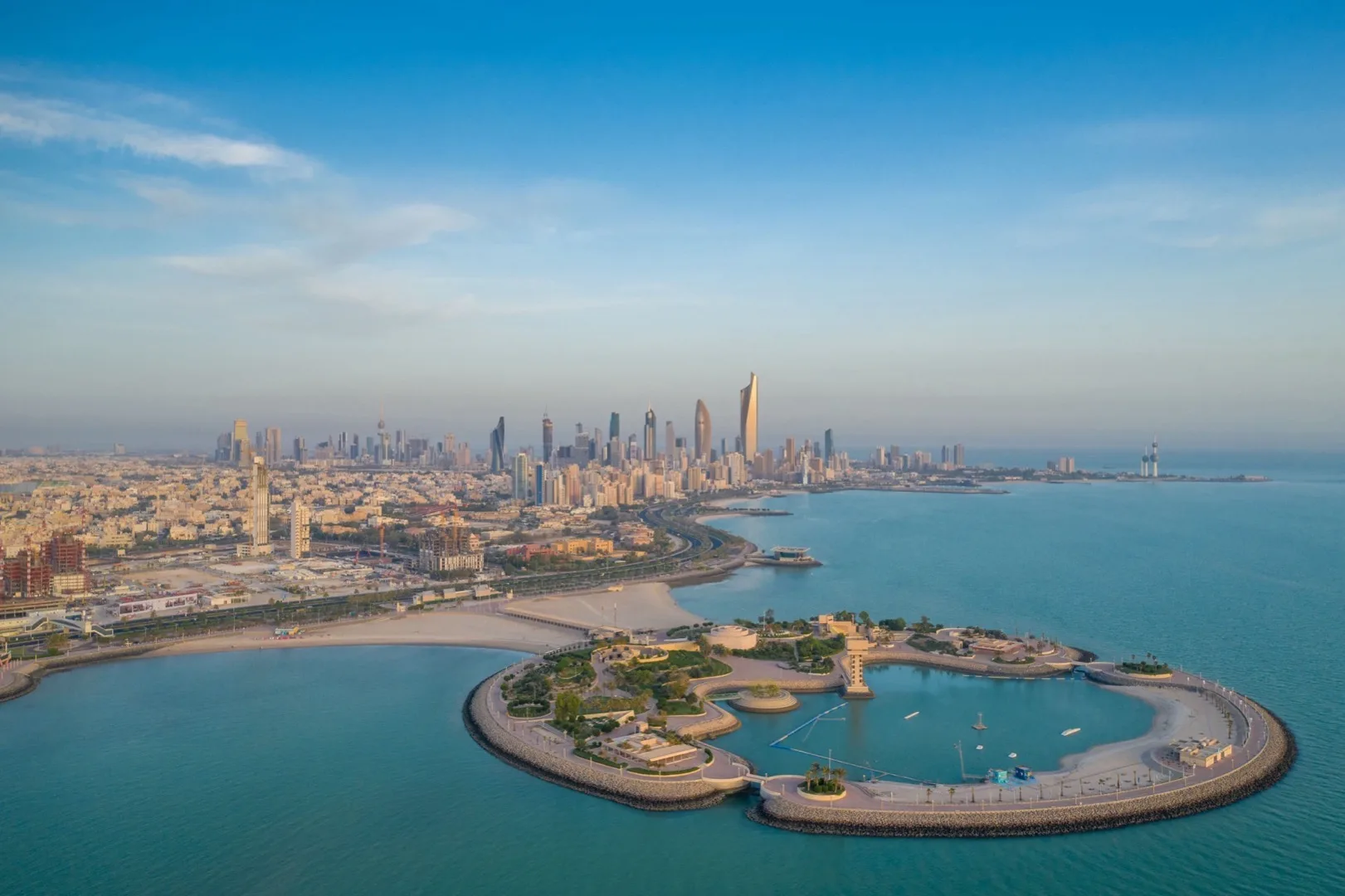
Moving to Dubai from Kuwait in 2026: Property, Visas & Banking

- This corridor has two completely different readers: Kuwaiti citizens, who as GCC nationals need no UAE visa, no sponsor and no residence permit — and the far larger group of expats currently working in Kuwait, who need a full UAE residence pathway.
- Since 1 July 2025, private-sector expats in Kuwait need an employer-approved exit permit (via the Sahel app) for every trip abroad — including the final one. Build it into your departure timeline; Qatar abolished this system, Kuwait reintroduced it.
- Your end-of-service indemnity under Article 51 of Kuwait's Labour Law is 15 days' basic pay per year for the first five years and one month per year thereafter (daily wage = monthly ÷ 26), capped at 18 months — and resigning before 10 years of service cuts the payout.
- Unpaid Kuwaiti bank loans can trigger a travel ban enforced at the airport. Settle or restructure debt and obtain a bank clearance letter well before your final salary.
- This is not a tax move — both countries levy 0% personal income tax. The honest drivers are Kuwait's tightening expat environment (Kuwaitisation, higher residency fees, no path to permanence) versus Dubai's 10-year Golden Visa ladder.
- The cost jump is the biggest in the GCC series: per Numbeo, Dubai's cost of living including rent is about 66.8% higher than Kuwait City, with rents roughly 143% higher.
- The dinar is the world's highest-valued currency (~AED 12.0 per KWD in mid-2026), but it is basket-pegged, not dollar-pegged — so the KWD–AED rate drifts slightly, unlike the fixed QAR or SAR crosses.
- Kuwaitis are heavyweight UAE buyers already: they hold 3,545 properties in the UAE — 42% of all GCC-national ownership, per GCC Statistical Center data.
The Kuwait-to-Dubai move is the busiest quiet corridor in the Gulf. Kuwaiti families have bought Dubai holiday homes for two decades, and GCC entry rules make that almost frictionless. But the bigger 2026 story is the expat one: professionals with ten or fifteen Kuwait years behind them are weighing a market where exit permits returned in 2025, residency fees jumped in December and Kuwaitisation keeps narrowing the career ceiling — against a city ninety minutes away that sells a 10-year visa with a property purchase. Income tax is zero on both sides, so nobody moves for take-home pay. This guide works through both journeys: the Kuwait-side exit, UAE visa routes, KWD–AED banking, what dinar savings buy in Dubai property, and the practical landing. Last updated: June 2026.
Every legal and government figure here is quoted from a named source; market figures are attributed and presented as ranges. Where a number could not be verified, it is omitted rather than guessed.
Two Readers, Two Rulebooks
As with every GCC corridor, identify which mover you are first, because the paths barely overlap.
Reader one: the expat currently resident in Kuwait. You hold an Article 18 (private sector) or other iqama sponsored by your employer, and that residency means nothing to UAE immigration. You need a full UAE residence pathway — employment, property-linked Golden Visa, or remote work — plus a Kuwait-side exit checklist that got longer in 2025: exit permit, indemnity settlement, bank clearance, residency cancellation and possibly a car export.
Reader two: the Kuwaiti citizen. As a GCC national you need no entry visa, no residence visa and no sponsor, and your Dubai property rights exceed those of any other foreign buyer. Your "relocation" is closer to opening a second base than emigrating.
Kuwaiti citizens can read the next section and skip to the property and banking chapters. Expats should work through the full sequence. For the nationality-neutral end-to-end process, our Moving to Dubai pillar guide maps every step, and the Qatar edition and Saudi Arabia edition of this series cover the neighbouring GCC corridors.
For Kuwaiti Citizens: What GCC Status Gets You in Dubai
The GCC economic framework gives citizens of member states reciprocal rights of movement, work and property, and the UAE implements them generously. Kuwaiti citizens enter the UAE by presenting a passport or GCC national ID — no entry visa, no sponsor, no residence permit, per the GDRFA's entry rules for GCC citizens. Taking a private-sector job requires a work permit from the Ministry of Human Resources and Emiratisation, but once issued the holder may start work immediately and is treated equally to UAE nationals in ministry procedures, per the UAE Government portal's GCC nationals page.
Property rights are the widest gap. Foreign buyers are confined to Dubai's designated freehold areas; UAE and GCC nationals can own anywhere in the emirate, including non-freehold districts such as Jumeirah, Mirdif, Al Barsha's villa belts and Nad Al Sheba that are closed to every other passport, as catalogued in Bayut's guide to non-freehold areas for Emiratis and GCC nationals. For a Kuwaiti buyer, the whole Dubai map is open.
And Kuwaitis use it. Per GCC Statistical Center data reported by Gulf News, Kuwaiti nationals hold 3,545 properties in the UAE — 42% of all GCC-national ownership in the country — and also top the GCC league in Bahrain and Saudi Arabia. The flow keeps growing: the Dubai Land Department's Q1 2026 report recorded AED 12.23 billion of GCC-national investment across 3,228 transactions in one quarter, up 14% year on year. A worked walkthrough of the Kuwaiti buying process sits in the case box below.
For Expats: Leaving Kuwait Properly
If you are an expat on a Kuwaiti iqama, the move starts with a clean exit — and Kuwait's exit has more moving parts in 2026 than any other Gulf state's.
The exit permit: Kuwait brought it back
This is the step that surprises readers of our Qatar guide, where exit permits were abolished in 2018. Kuwait went the other way: since 1 July 2025, every private-sector expat (Article 18 residency) needs an employer-approved exit permit for each trip abroad — holidays and permanent departures alike. Requests are filed through the Sahel app no earlier than seven days and no later than 24 hours before travel, routing automatically to the employer for approval, as reported in Gulf News' coverage of the Sahel exit-permit system. If an employer refuses without valid cause, the worker can complain to the Public Authority of Manpower — but for a final departure the practical advice is simpler: stay on good terms through your notice period, and do not book a non-refundable flight before the permit is approved.
The indemnity claim: know your Article 51 number
Your end-of-service indemnity is a legal entitlement under Kuwait Labour Law No. 6 of 2010. Article 51 grants monthly-paid workers 15 days' basic remuneration per year for the first five years of service and one month per year thereafter, capped at one and a half years' pay; the daily wage is monthly basic salary divided by 26, as set out in HR Chronicle's Kuwait gratuity explainer. Two traps matter. First, the calculation uses basic salary only — allowances do not count, so know your contractual split. Second, resignation reduces the payout under Article 53: half the entitlement between three and five years of service, two-thirds between five and ten, and the full amount only from ten years. If you are at year nine and planning the move, that threshold is worth real money — run the maths before setting a resignation date, and never sign a settlement that understates it.
Bank clearance: the trap that actually blocks exits
Kuwaiti banks act quickly against departing customers with outstanding liabilities. Unpaid personal loans, car finance or credit-card balances can result in a travel ban enforced at the airport, banks may freeze accounts once a final settlement hits them, and bounced cheques are treated as a criminal matter; lenders also pursue defaulters abroad through international collection agencies, per Kuwait Local's guide to expat loans and debt settlement. The standard practitioner advice: start the unwind 30–45 days before your final salary, settle or formally restructure every facility, close credit cards at least a month before travel, and obtain a stamped bank clearance letter — many employers want it before releasing the indemnity. Do not plan to service a Kuwaiti loan quietly from Dubai; the bans are real.
| Kuwait exit step | Timing | Key detail |
|---|---|---|
| Resignation + notice period | Per contract | Confirm Article 51 indemnity figure in writing; check the 10-year full-entitlement threshold |
| Loan settlement / restructuring | 30–45 days before final salary | Unpaid debt = travel ban risk; obtain bank clearance letter |
| Close credit cards | At least 1 month before travel | Outstanding balances block clearance |
| Car: sell or export | 2–4 weeks before exit | Deregister, obtain export certificate + export plates (GCC-spec = easy UAE entry) |
| Dependants' visas cancelled | Before or with sponsor's | Family residencies are cancelled at the Jawazat before the sponsor's own |
| Iqama / Civil ID cancellation | Final week (employer files) | Residency lapses automatically after 6 months abroad anyway — cancel formally for a clean record |
| Exit permit via Sahel | 7 days to 24 hours before departure | Employer must approve; required since 1 July 2025 |
| Indemnity + final settlement paid | On exit | Often conditional on the bank clearance letter |
Utilities (MEW), telecoms, school transfer certificates and tenancy deposits round out the list — none block your departure, but all are far harder to chase from Dubai.
Why People Are Leaving Kuwait: The Factual Version
Kuwait remains a wealthy, safe, zero-tax country. But the direction of policy for expats is unambiguous, and it is the honest backdrop to this corridor. Stated factually:
Kuwaitisation is policy, not rhetoric. The Civil Service Commission decided not to renew most expat contracts in government roles after March 2025 — a move affecting over 100,000 expatriate public workers, per Kuwait Times' reporting — while private-sector quotas under the Kuwait Vision 2035 agenda keep ratcheting up in sectors such as oil and gas. The career ceiling for foreigners is structural and lowering.
The residency system got stricter and dearer in December 2025. A sweeping overhaul under Ministerial Resolution No. 2249 of 2025 raised fees across categories and tightened controls, as reported by Khaleej Times. The same package kept the family-sponsorship salary floor at KWD 800 per month for most professions, per Middle East Briefing's summary of the rules — a bar many mid-income workers cannot clear, forcing years of family separation. The annual expat "health assurance" fee doubled to KWD 100 for most residency renewals, per Arab Times. And residency now lapses automatically after six consecutive months abroad.
Some restrictions have eased — credit where due. The contentious rule that hit workers aged 60+ without university degrees with annual fees of up to KWD 900 was revoked, per Gulf News. Kuwait adjusts as well as tightens.
The structural difference is permanence. However long you work in Kuwait, residency stays tied to an employer with no published path to long-term status. The UAE offers the opposite ladder: a 10-year Golden Visa from a property purchase or professional category, renewable and independent of any employer. That single difference — guest forever versus a decade of self-sponsored status — is the most cited reason this corridor exists. The two systems simply sell different futures.
UAE Visa Pathways for Expats Leaving Kuwait
Your Kuwaiti iqama earns you no shortcut into the UAE; you choose from the same three realistic routes as any other nationality.
| Route | Duration | Requirement | Indicative cost |
|---|---|---|---|
| Employment visa | 2 years, renewable | UAE job offer; employer sponsors | Borne by employer by law; dependants' medicals + Emirates IDs extra |
| Golden Visa (property) | 10 years, renewable | Property worth AED 2M+ (≈ KWD 167,000) | Roughly AED 9,900 in government fees: medical AED 700, 10-yr Emirates ID AED 1,153, residence permit AED 2,856.75, DLD application AED 4,020, admin ~AED 1,155 |
| Virtual Working Programme | 1 year, renewable | Remote income of USD 5,000+/month after the 2026 tightening, 6 months' bank statements, AED 500,000 health cover | ~AED 1,535 government fees |
The property route deserves emphasis in this corridor. Real-estate investors owning property with a purchase value of AED 2 million or more qualify for the 10-year renewable Golden Visa, per the UAE Government's Golden Visa page, applied for through the Dubai Land Department's investor service. For a Kuwait expat whose savings sit in the world's strongest currency, AED 2 million is about KWD 167,000 — within reach of senior professionals after a long Kuwait career — and it buys exactly what Kuwait never offered: residency that belongs to you, not your employer. The full mechanics are in our Golden Visa through property guide.
The remote-work route tightened in April 2026: the income floor rose from USD 3,500 to USD 5,000 per month, with six months of bank statements and AED 500,000 of health cover now required, per VisaHQ's report on the change. Model the full landing cost for your family with our relocation cost estimator.
Money: The Dinar Advantage, Explained Properly
Both countries levy zero personal income tax, so the financial comparison runs through currency and costs, not tax.
The Kuwaiti dinar is the world's highest-valued currency unit — about USD 3.26 per dinar at the Central Bank of Kuwait's published rates in 2026, which works out to roughly AED 11.9–12.0 per dinar against the dirham's USD 3.6725 peg. That makes the conversion psychology pleasant: a KWD 100,000 nest egg is about AED 1.2 million. But note the mechanical difference from the rest of the Gulf: since May 2007 the dinar has been pegged to an undisclosed basket of currencies, not to the dollar alone, per the Central Bank of Kuwait's exchange-rate policy. Unlike the fixed QAR–AED or SAR–AED crosses, the KWD–AED rate therefore drifts modestly with the basket. The drift is small — this is still a managed Gulf currency, not a floating one — but if you are timing a large property transfer, a one-percent move on AED 2 million is AED 20,000, so it is worth watching rather than ignoring.
Transfer mechanics are straightforward: a SWIFT transfer from your Kuwaiti bank converts KWD to AED at the bank's rate plus fees, and exchange houses compete hard on this corridor. For any non-Gulf balances — GBP, EUR, USD or INR accumulated over years of remitting — Wise typically converts at the mid-market rate with transparent fees, and supports sending money into Kuwait in KWD if funds need to move back during the transition, per Wise's Kuwait coverage — though KWD cannot be held as a Wise balance, so treat it as a transfer rail for your international currencies rather than a Kuwaiti banking replacement.
On the Dubai side: accounts open quickly once you hold an Emirates ID, but credit history does not transfer — years with NBK or Gulf Bank mean nothing to the Al Etihad Credit Bureau, so your first UAE credit card and car loan price you as a newcomer. Salary-transfer accounts dominate UAE retail banking, with minimum balances and waivers tied to your salary band.
Relocating to Dubai?
Get Your Relocation Checklist
Cost of living, visa requirements, housing tips, and everything you need to plan your move.
✓ You're in! Check your inbox.
Cost of Living: The Biggest Jump in the GCC Series
Here is the uncomfortable number: Kuwait City is cheap to live in, and Dubai is not. Per Numbeo's Kuwait City vs Dubai comparison (crowd-sourced, 2026), Dubai's cost of living including rent is about 66.8% higher, with rents roughly 143% higher, groceries 34.7% higher and restaurants 22.4% higher. Numbeo estimates you need around KD 2,169 (≈ AED 25,755) a month in Dubai to match a KD 1,300 lifestyle in Kuwait City. Whether you live in Salmiya, Salwa or the city itself, your housing line will multiply — negotiate your Dubai package accordingly.
| Monthly item (Numbeo, 2026) | Kuwait City (KWD) | Dubai (KWD equiv.) | Gap |
|---|---|---|---|
| 1-bed apartment, city centre | ~284 | ~759 | +168% |
| 3-bed apartment, city centre | ~598 | ~1,428 | +139% |
| Utilities, 85 m² apartment | ~20 | ~75 | +267% |
| Mid-range dinner for two | ~21.5 | ~25.3 | +18% |
| International primary school (annual) | ~2,914 | ~5,397 | +85% |
Two lines deserve attention. Utilities in Kuwait are among the most heavily subsidised on earth, so DEWA bills will feel like a different product. And the school-fee step is the biggest recurring increase for families; Dubai's top-tier schools run well beyond the crowd-sourced average. Our Dubai monthly budget breakdown works through a full family budget line by line. The honest framing: you trade the Gulf's cheapest big-city housing for its most liquid property market and deepest job market — the move only works if your package or asset strategy prices that in.
Property: What Dinar Savings Buy in Dubai
The dinar maths makes Dubai's entry points feel accessible. At roughly AED 12.0 per dinar, a KWD 60,000 deposit is about AED 718,000 — a 20% down payment on an AED 3.6 million home. For Kuwait-based buyers the strategic question is not affordability but structure: buy as a non-resident now, or move first and buy as a resident.
Mortgages: residency status decides your down payment
- Expat who becomes a UAE resident first: under the UAE Central Bank's mortgage regulations, resident expats can borrow up to 80% LTV on a first property up to AED 5 million (70% above that), per the CBUAE Rulebook. Off-plan is capped at 50% for everyone.
- Buyer still living in Kuwait (non-resident): UAE banks treat Kuwait-based applicants as non-residents and typically offer 50–60% LTV with a shorter lender list and conservative income assessment — our non-resident mortgage guide walks the process, documents and banks.
- Kuwaiti citizens: regulatory LTV caps group borrowers as UAE nationals versus non-nationals, so GCC citizens sit under the expat caps on paper — but banks actively court GCC-national buyers with their own pricing, and many Kuwaiti purchases on this corridor are simply cash.
On eligibility: expats buy within Dubai's designated freehold areas — zones, rules and restrictions are mapped in our foreign ownership guide — while Kuwaiti citizens can buy anywhere in the emirate, as covered above.
A Kuwaiti family wants a Dubai base for school holidays and buys a ready AED 2.4M (≈ KWD 200,000) two-bedroom in a freehold Marina tower. The process: fly in on a national ID — no visa, no sponsor. View, sign the MOU (Form F), pay the 10% deposit, then complete at a DLD trustee office: 4% DLD transfer fee (AED 96,000) plus trustee and admin charges, title deed issued the same day. No residence permit is needed before, during or after — GCC status covers presence in the UAE entirely, and unlike every other nationality in this series, the Golden Visa that the AED 2M+ purchase unlocks is purely optional (some Kuwaiti owners take it anyway for banking and utility convenience). Total friction: one trip, one transfer, roughly 6% in fees on top of price. When the family is not using the apartment, Dubai's short-let market can carry the service charges — a strategy thousands of GCC owners already run.
The Drive: Car, Furniture and Pets via the Saudi Coast Road
Kuwait to Dubai is drivable, but it is a longer haul than Doha's hop: there is no Kuwait–UAE border, so the route runs Kuwait City → Al Nuwaiseeb crossing into Saudi Arabia → down the Eastern Province coast (roughly 672 km from Al Khafji to the Al Batha crossing) → into the UAE → Abu Dhabi → Dubai. The total is about 1,200 km and 10–11 hours of driving, per Rome2Rio's route data, plus border time at two crossings — plan it as one very long day or an overnight in Saudi. Check Saudi transit requirements for your nationality and carry insurance valid in all three countries. Remember the exit permit: for a private-sector expat's final departure by road, the Sahel approval applies just as it does at the airport.
Bringing the car permanently
A Kuwait-registered car is almost certainly GCC-spec — the single biggest advantage of this corridor. GCC-spec vehicles already meet UAE standards, so there is no conformity-certificate hurdle that European or American imports face. The sequence: deregister in Kuwait and obtain an export certificate plus export plates, drive it down, clear UAE customs, then pass an RTA inspection, insure and register locally. Run the maths against simply selling in Kuwait and rebuying in Dubai's enormous used-car market — for ordinary cars the sums are often close, and skipping the 1,200 km drive has value of its own.
Furniture and pets
Household goods move by road freight in days rather than by sea in weeks — cross-Gulf movers such as BBC Cargo run dedicated Kuwait–UAE furniture routes by land, sea or air. Quotes are volume-based and vary widely with home size and packing level, so get at least three door-to-door quotes covering both customs clearances. Pets can travel by car with up-to-date vaccination records and health certificates, or fly the short KWI–DXB cargo hop with a UAE import permit arranged in advance.
Practical Landing: Licence, Schools, Healthcare
Driving licence — the easy one. Kuwait sits on the RTA's licence-exchange list alongside the other GCC states, so once you hold UAE residency you convert your Kuwaiti licence without a driving test — the list now spans 57 licence origins, per Gulf News' RTA exchange list. Bring the valid original licence and Emirates ID; an eye test and fees apply. Kuwaiti citizens can generally drive on their home licence as GCC nationals.
Schools — plan the transfer a term ahead. Kuwait's British, American, Indian (CBSE) and IB schools map directly onto Dubai's KHDA-regulated equivalents; the transfer certificate from your Kuwait school is the key document. Two warnings: popular year groups carry waiting lists, and the cost step is real — Numbeo's data above puts international primary fees about 85% higher on average. Apply before you land, not after.
Healthcare — do not let coverage lapse. Kuwait's public system charges expats the annual KWD 100 health-assurance fee plus per-visit charges; Dubai instead mandates private insurance for every resident, and your Kuwait coverage stops counting the day your iqama is cancelled. Employer-sponsored movers are covered from visa issuance; Golden Visa holders, remote workers and family members arriving early need a compliant policy from day one. For the gap weeks between systems, travel-medical cover such as SafetyWing is a pragmatic bridge, then switch to a DHA-compliant annual plan once your Emirates ID is issued.
A project engineer on a KWD 600 basic salary (plus allowances) resigns after 12 years to take a Dubai offer. Indemnity maths (Article 51): first five years at 15 days each = 75 days × (600 ÷ 26) ≈ KWD 1,731; years six to twelve at one month each = 7 × 600 = KWD 4,200; total ≈ KWD 5,931 ≈ AED 71,000 — paid in full because service passed the 10-year threshold (resigning at year 9 would have cut it to two-thirds). The cap of 18 months' pay (KWD 10,800) is not reached. Sequence: car loan settled six weeks early, bank clearance letter obtained, credit cards closed, the GCC-spec SUV export-plated and driven the Nuwaiseeb–Batha coast road, exit permit approved on Sahel before the final departure. Dubai side: the employer covers his visa; two children's school places were applied for a term ahead (budgeting the ~85% fee step over Kuwait), and rent for a comparable apartment runs well over double the Salmiya figure — offset in negotiation by Dubai's deeper market and the indemnity covering the entire transition: agency fee, deposits and school registration with room to spare.
Community: Where Kuwait's Movers Land in Dubai
Kuwaiti citizens cluster where Gulf families have always lived in Dubai — the largely non-freehold villa districts of Nad Al Sheba, Al Barsha's residential belts, Mirdif and Jumeirah's older streets, plus prime freehold buys in Downtown, Business Bay and the Palm for lock-and-leave holiday use. Because GCC nationals can buy in the Emirati neighbourhoods other foreigners cannot, a Kuwaiti family gets a housing option no other mover in this series has: an established Khaleeji community rather than an investor zone. Culturally the move is near-zero adjustment — language, weekend, food and family networks all carry over; the change is scale and pace.
Expats from Kuwait are mostly the same communities that dominate Kuwait's demographics — Indians are the largest group at about 1.04 million (29% of the population), followed by Egyptians around 661,000 and Filipinos near 226,000, per Times Kuwait's population analysis — precisely the communities with the deepest existing networks in Dubai. Landing zones follow budget rather than nationality: JVC, Al Nahda and International City for value; Bur Dubai and Karama for the old-Gulf feel closest to Salmiya's; Marina and JLT for tower life; Dubai Hills and Mirdif for family villas. These communities compare the two markets constantly, and the comparison usually lands the same way: Kuwait houses you cheaper, but Dubai offers the long-term visa ladder and a property market you can actually own a piece of.
Frequently Asked Questions
Do Kuwaiti citizens need a visa to move to Dubai?
No. As GCC nationals, Kuwaiti citizens enter the UAE with a passport or national ID — no entry visa, sponsor or residence permit, per GDRFA rules. Taking a private-sector job requires a MOHRE work permit, but once issued they may start work immediately with treatment equal to UAE nationals. There is no medical, stamping or status-change sequence at all.
Can Kuwaitis buy property anywhere in Dubai?
Yes. UAE and GCC nationals may own property anywhere in the emirate, including non-freehold districts such as Jumeirah, Mirdif, Al Barsha and Nad Al Sheba that are closed to other foreign buyers. Transactions register with the Dubai Land Department as usual with the standard 4% transfer fee. Kuwaitis already hold 3,545 properties in the UAE — 42% of all GCC-national ownership, per GCC Statistical Center data.
Do I need an exit permit to leave Kuwait for good?
If you are a private-sector expat (Article 18 residency), yes. Since 1 July 2025 every trip abroad — including a permanent departure — requires an employer-approved exit permit filed through the Sahel app between seven days and 24 hours before travel. If your employer refuses without valid cause you can complain to the Public Authority of Manpower, but practically: secure the approval before booking the final flight.
How is my Kuwait end-of-service indemnity calculated?
Article 51 of Kuwait Labour Law No. 6 of 2010 grants monthly-paid workers 15 days' basic salary per year for the first five years and one month per year thereafter, capped at 18 months' pay, with the daily wage calculated as monthly basic ÷ 26. Allowances do not count. Resignation reduces the payout under Article 53: half between three and five years of service, two-thirds between five and ten, and the full amount only from ten years. Calculate your figure independently before signing any settlement.
Can I be stopped from leaving Kuwait over a bank loan?
Yes — unpaid loans, car finance or credit-card balances can trigger a travel ban enforced at departure, and banks may freeze accounts once they learn you are on final settlement. Settle or formally restructure debt 30–45 days before your final salary, close cards at least a month before travel, and obtain a stamped bank clearance letter, which many employers require before releasing your indemnity.
Can I drive my car from Kuwait to Dubai and keep it?
Yes. The route runs through Saudi Arabia — roughly 1,200 km and 10–11 hours' driving via the Al Nuwaiseeb and Al Batha crossings. Deregister the car in Kuwait with an export certificate and export plates, clear UAE customs, then pass an RTA inspection, insure and register. A GCC-spec car faces no conformity hurdle. Kuwait is also on the RTA's licence-exchange list, so your driving licence converts without a test once you hold UAE residency.
Is Dubai much more expensive than Kuwait City?
Yes — this is the biggest cost jump in the GCC. Per Numbeo (2026), Dubai's cost of living including rent is about 66.8% higher, with rents roughly 143% higher, utilities more than triple Kuwait's subsidised bills, and international school fees about 85% higher on average. Both countries levy zero income tax, so there is no tax offset — the premium buys market depth, the long-term visa ladder and property you can own. Negotiate your package accordingly.
What does the KWD-AED exchange rate mean for my transfer?
The dinar is the world's highest-valued currency at about USD 3.26 — roughly AED 11.9–12.0 per dinar in mid-2026. Unlike the QAR or SAR, the KWD is pegged to an undisclosed currency basket rather than the dollar alone, so the cross rate drifts modestly. For a large property transfer, watch the rate rather than assuming it is fixed. KWD savings convert favourably: AED 2 million — the Golden Visa threshold — is about KWD 167,000.
What mortgage can I get in Dubai while still living in Kuwait?
UAE banks treat Kuwait-based applicants as non-residents, which typically means 50–60% LTV, fewer willing lenders and conservative income assessment. Once you become a UAE resident, the Central Bank caps rise to 80% LTV on a first home up to AED 5 million (70% above). Kuwaiti citizens fall under the non-UAE-national regulatory caps, though banks court GCC nationals with their own pricing — and many Kuwaiti purchases are cash.
Sequence beats speed on this corridor: clean Kuwait exit first — indemnity confirmed, bank clearance in hand, exit permit approved — then the right UAE route (or none, if you carry a Kuwaiti passport), then property with realistic LTV expectations. Start with our Moving to Dubai pillar guide and model your numbers with the relocation cost estimator. The REC community includes members who have made exactly this move — ex-Kuwait professionals and GCC-national investors who can pressure-test your plan against lived experience.
Planning Your Move?
Get personalized relocation advice from our Dubai team.
Thank You!
We'll get back to you within 24 hours.
Moving & Relocation Companies in Dubai
Explore providers from our business directory
Still have questions?
Ask a follow-up, or get connected with a vetted Dubai professional.
Join our Telegram channel
Handover alerts, new launches & DLD data — first, in real time.