Jumeirah Village Triangle (JVT) Area Guide 2026: Prices, Villas & Rental Yields

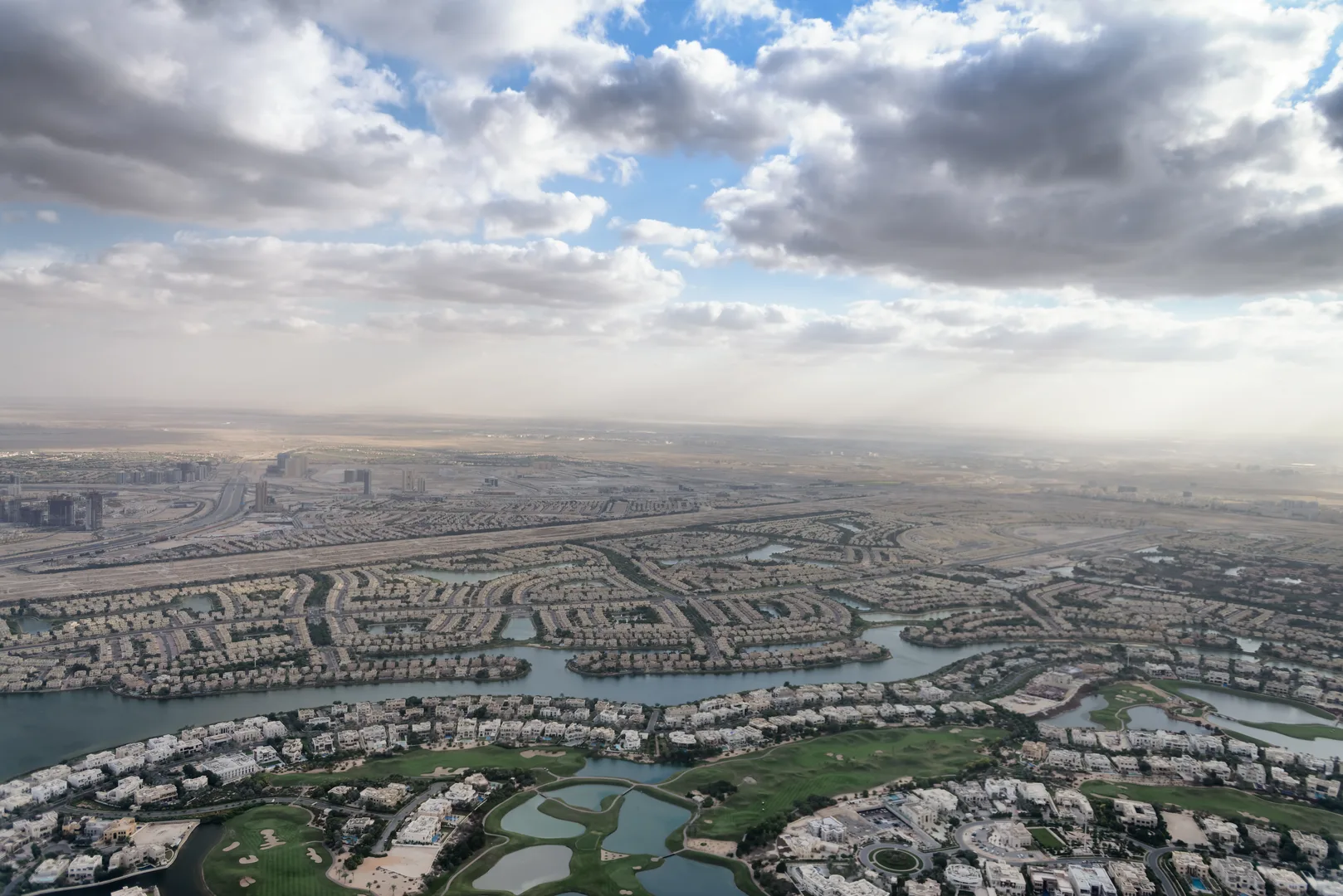
- JVT is a Nakheel freehold community of nine numbered districts spread across 242 hectares between Sheikh Mohammed Bin Zayed Road (E311) and Al Khail Road (E44), holding more than 13,000 villas, townhouses and apartments, per Nakheel's own project page.
- It is Jumeirah Village Circle's lower-density sibling: villas and townhouses cluster in Districts 5, 6, 8 and 9, wide internal roads replace JVC's tower-lined streets, and the community carries far fewer active projects than JVC's 80-plus.
- Indicative 2026 pricing: apartments average AED 1,636 per sqft (Bayut index, June 2026, +10.63% year-on-year); townhouses typically run AED 1.5–4 million depending on size and district; villas average around AED 3.66 million, with a wide AED 2.53m–9.95m range, per Property Finder listings.
- By contrast, JVC apartments average AED 1,511 per sqft with a far flatter +1.76% year-on-year move — JVT's smaller, more built-out supply has pushed its apartment index up faster even as villa asking prices in JVT itself fell roughly 5.5% year-on-year, a genuinely two-speed picture inside one community.
- There is no metro station inside JVT. The nearest is Al Fardan Exchange (formerly Al Khail/Nakheel station) on the Red Line, about a 12–15 minute drive away — this is a car-first, not a rail-first, community.
- Sunmarke School and Arcadia School both sit inside JVT itself (Districts 5 and 9); JSS International School is a short drive away in neighbouring JVC South, not inside JVT.
- Best fit: families who want villa or townhouse space and quieter internal roads without Arabian Ranches or Dubai Hills Estate pricing, plus yield-focused investors comfortable underwriting apartment yields case by case rather than trusting a single headline number.
Jumeirah Village Triangle gets confused with Jumeirah Village Circle constantly — same developer, adjoining land, near-identical name — and most of what gets written about "JVT" online is really a JVC guide with the wrong name stapled on. That confusion matters to a buyer, because the two communities behave differently in 2026: JVC is Dubai's densest mid-rise apartment machine, while JVT is a lower-rise, villa-and-townhouse-heavier community built around wide internal roads and nine numbered districts. This guide is JVT-specific — what it actually costs to buy or rent here in 2026, how its yields and price trend compare with JVC's, what the schools and road access genuinely look like, and who the area suits now that mainstream Dubai values are softening rather than climbing. Last updated: July 2026.
The Wider 2026 Market: A Buyer's Market, Not a Boom
Any JVT-specific numbers below need to sit inside the actual 2026 Dubai picture, which turned during the year rather than continuing 2025's run-up. Cavendish Maxwell reported H1 2026 residential transaction volumes down 13.9% year-on-year and values down 15.7%, with Anarock separately putting H1 2026 housing sales at roughly AED 226 billion, down 16%. Knight Frank has described the resulting picture as a "two-speed market" — a record 296 sales above $10 million even as mainstream, non-prime locations fell 5–20% depending on area. Rents have followed a similar pattern citywide: new leases are down roughly 20% by volume, with the average new tenancy around AED 60,000, down 6% year-on-year, per AGBI, even as renewals and villa rents in several communities have held up better.
JVT is a mainstream community, not a prime one, and it sits inside that softer market — but not uniformly. As the price tables below show, JVT's apartment segment actually moved up faster than JVC's over the past 12 months even as its villa segment's asking prices fell, which is a useful reminder that a single citywide narrative — "prices are down" or "prices are up" — rarely applies evenly across every property type in every community. A buyer or investor looking at JVT in July 2026 should expect genuine negotiating leverage on dated villa stock, and should not assume the area's smaller, scarcer apartment supply will behave the same way.
Where JVT Is and What It Actually Is
Jumeirah Village Triangle sits between Sheikh Mohammed Bin Zayed Road (E311) and Al Khail Road (E44), according to both Nakheel's own JVT page and Bayut's area guide. Nakheel developed the community as freehold land spanning 242 hectares, organised into nine numbered districts holding more than 13,000 residential units across villas, townhouses and apartments. Downtown Dubai and Jumeirah are roughly 20–25 minutes away by car, and Dubai International Airport is about 30 minutes out, per Bayut.
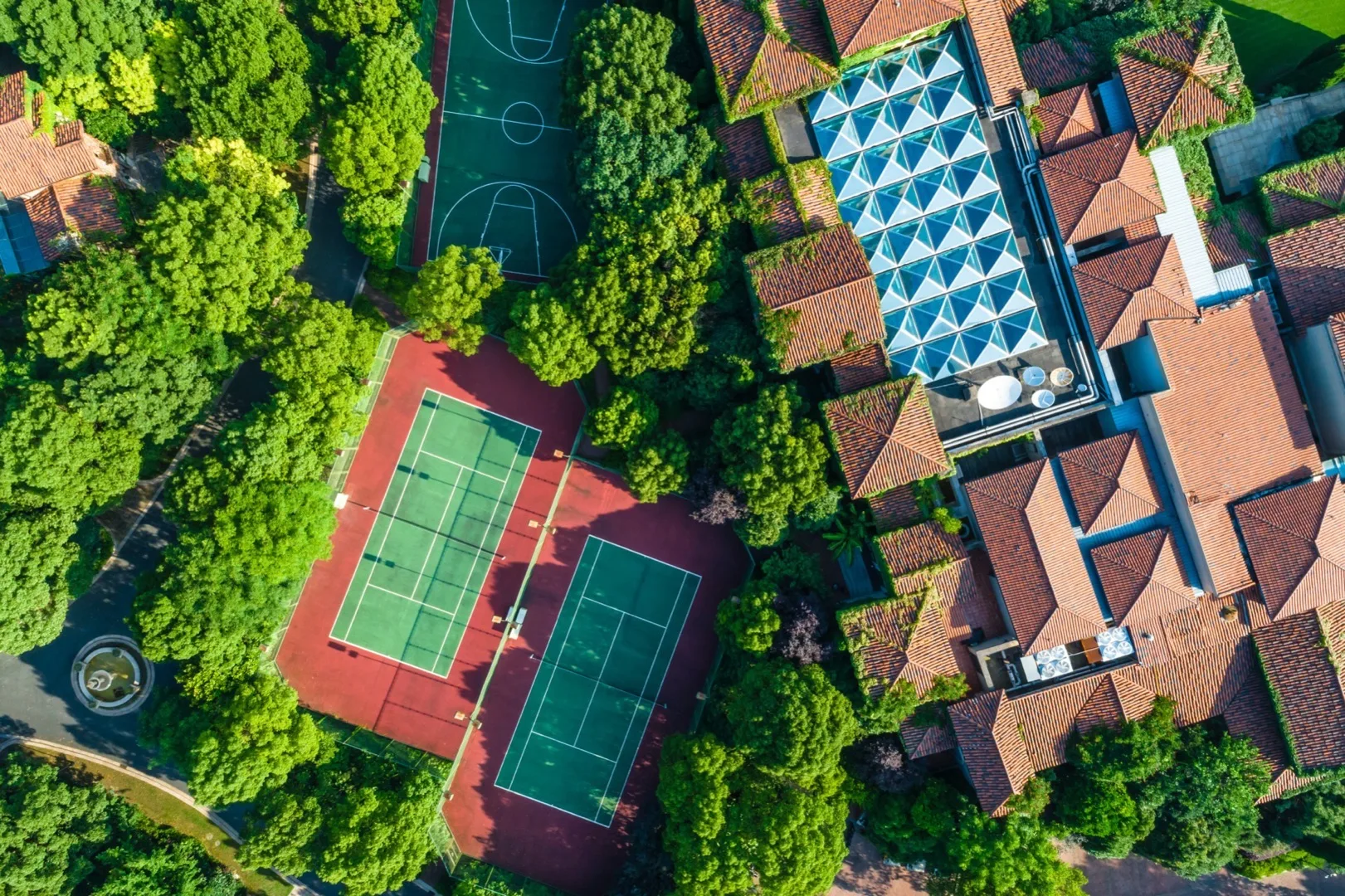
Villas and townhouses concentrate in Districts 5, 6, 8 and 9, built in Mediterranean and Arabian architectural styles with private gardens and dedicated parking, while apartment buildings are spread more broadly across the remaining districts. Nakheel's own page lists on-site amenities including basketball, tennis and padel courts, mosques, badminton courts, cricket pitches and kids' play areas, alongside Al Khail Avenue — described by Nakheel as a "large-scale shopping, leisure and entertainment destination" sitting within the community. That is a materially different amenity mix from JVC, where Circle Mall and a dense retail ground floor sit inside the community itself rather than in a dedicated avenue development.
Who Actually Lives in JVT
JVT's resident mix skews more toward families and longer-term households than JVC's, a direct function of its villa and townhouse share. Nine numbered districts each carry their own small cluster of parks, courts and mosques rather than one central amenity hub, so day-to-day life happens closer to home than it does in a tower-and-podium community — residents in Districts 5, 6, 8 and 9 in particular describe a quieter, lower-traffic feel with wide internal roads originally designed for villa access rather than dense through-traffic. Al Khail Avenue provides the community's main retail, dining and leisure anchor, supplemented by smaller neighbourhood retail scattered through the apartment districts. Community amenities across the master plan include basketball, tennis, padel and badminton courts, cricket pitches, mosques and children's play areas, per Nakheel's own project page — a genuinely family-oriented amenity list rather than a lifestyle-and-nightlife one.
That said, JVT is not exclusively a family villa enclave — its apartment districts draw a similar tenant profile to JVC's more affordable pockets: young professionals and smaller households prioritising value and reasonable commute times over walkability to a single retail strip. The two profiles coexist across the nine districts rather than mixing within any one of them, which is worth knowing before assuming the entire community has one single character.
New Supply: Off-Plan Launches Still Landing in JVT
JVT is not a finished, static community even with limited villa land left to build on — new apartment launches continue to land inside its districts. Live listings on Property Finder's JVT area guide show off-plan entry prices including Paradise One from around AED 1.2 million, Azha Millennium Residences from around AED 650,000, VOXA by Pantheon from around AED 709,000, Essenlife from around AED 752,000 and Guzel Towers Phase 4 from around AED 570,000. These are asking/launch prices for off-plan stock rather than DLD-registered comparables, and buyers should verify payment plan, handover date and developer track record directly with the developer before treating any of these as a like-for-like alternative to ready villa or townhouse stock in the same community.
JVT vs JVC: Why These Are Not the Same Community
The comparison is unavoidable and worth doing properly rather than gesturing at it. JVC is built around 80-plus active mid-rise apartment towers on a tighter grid, with retail and footfall concentrated at street level — it is the denser, apartment-first community, and our full JVC investment guide covers its pricing, ROI and 2026 pipeline in depth. JVT, by contrast, has fewer than 25 active projects, more of its land given over to villas and townhouses on wide internal roads, and a materially quieter, lower-traffic layout — the trade-off is a smaller retail and F&B base and a longer drive to a metro station.
The price data makes the divergence concrete rather than anecdotal. Per Bayut's June 2026 sale-price index, JVT apartments average AED 1,636 per sqft, up 10.63% over the prior 12 months, while JVC apartments average AED 1,511 per sqft, up a much flatter 1.76% over the same period. JVT's smaller, more built-out apartment stock has been repricing faster than JVC's larger, still-expanding supply — a pattern consistent with JVC absorbing more new handovers through 2026–2027 while JVT has comparatively little vacant land left to build on. That does not make JVT apartments cheaper on a like-for-like basis anymore; it makes JVT's supply scarcity the more relevant story for a buyer weighing the two.
| Metric | JVT | JVC |
|---|---|---|
| Apartment avg. price/sqft (Jun 2026) | AED 1,636 | AED 1,511 |
| 12-month price change | +10.63% | +1.76% |
| Active projects (approx.) | Fewer than 25 | 80+ |
| Dominant stock | Villas, townhouses + low-rise apartments | Mid-rise apartment towers |
| Density / feel | Lower-density, wide internal roads | Higher-density, tower-lined streets |
Sale price data per Bayut's sale-price indices for JVT and JVC, June 2026. Project counts are approximate and change as new launches complete.
For a wider read on affordable Dubai communities beyond just these two, see our comparison of JVC vs Arjan vs Dubai Silicon Oasis on rental yield.
Sale Prices by Property Type in 2026
JVT is genuinely mixed-stock, unlike apartment-only communities such as Barsha Heights — pricing varies far more by property type than it does in most Dubai submarkets of comparable size.
| Property type | Typical price (AED) | Approx. USD | Avg. price/sqft (AED) |
|---|---|---|---|
| Studio apartment | From ~500,000–570,000 | ~$136,000–155,000 | ~1,846 |
| 1-bed apartment | From ~850,000 | ~$231,000 | ~1,556 |
| 2-bed apartment | From ~1,200,000 | ~$327,000 | ~1,520 |
| 3-bed apartment | From ~1,500,000 | ~$408,000 | ~1,545 |
| Townhouse (typical range) | ~1,500,000–4,200,000 | ~$408,000–1,143,000 | ~1,100 |
| Villa (typical range) | ~2,530,000–9,950,000 (avg ~3,665,000) | ~$689,000–2,708,000 | ~999–1,838* |
Apartment figures per Bayut's sale-price index by unit type, June 2026. Townhouse and villa figures aggregated from live Property Finder listings, mid-2026, and should be treated as a starting range rather than a valuation — both property types show wide variation by district, plot size and finish. *Villa price/sqft shows a genuinely wide spread between broad asking-price averages (~AED 999/sqft) and recent transacted deals (~AED 1,838/sqft) on Property Finder's own data — a gap worth noting on its own, addressed below.
That asking-versus-transacted villa gap is a useful signal in the current market, not a data error. Per Property Finder's own listings data, JVT villa asking prices fell around 5.5% year-on-year even as recently transacted deals cluster at a notably higher price per sqft than the broad asking-price average — consistent with a market where sellers of dated stock are cutting asking prices to compete, while better-specified or newer villas that do transact still clear at a premium. For a buyer, that is negotiating room: in this market, the asking price on an older JVT villa is a starting point, not a floor.
Per Bayut's DLD-sourced transaction data, villas in Arabian Ranches sold at an average of roughly AED 8.54 million over the trailing 12 months. A comparable-sized JVT villa, by contrast, averages around AED 3.66 million on live listings — a gap of well over AED 4 million for a similarly sized freehold villa plot. That is not an apples-to-apples DLD-transaction-vs-listing comparison (Arabian Ranches' figure is transacted sales; JVT's is asking prices), but the gap is wide enough that the direction holds regardless: a family priced out of Arabian Ranches by roughly AED 4–5 million can very plausibly still buy a villa, not just an apartment, in JVT.
Rents in JVT: Apartments, Townhouses and Villas
Rents track the same mixed-stock pattern as sale prices. Per Property Finder's JVT area insights, average annual rents in mid-2026 run roughly AED 57,000 for a studio, AED 80,000 for a one-bed, AED 115,000 for a two-bed and AED 180,000 for a three-bed apartment.
Townhouse rents on live Property Finder listings cluster roughly as follows: one-beds around AED 120,000–140,000, two-beds around AED 120,000–175,000, three-beds around AED 220,000–260,000 and four-beds around AED 200,000–230,000 a year — the overlap between brackets reflects genuine variation in plot size, district and finish rather than a data error, and underlines why a specific unit's comparables matter more than an area average here. Villa rents span an even wider band: Property Finder's own JVT villa listings show an overall average of roughly AED 129,000 a year across all sizes, with two-bed villas typically AED 170,000–280,000 and five-bed villas ranging from around AED 398,000 up to AED 1.25 million at the very top end. Property Finder's listings also show new villa leases averaging around AED 202,000 against AED 173,000 for renewals in JVT specifically — a segment-level pattern that runs counter to the citywide trend of falling new-lease rents, and a reminder that villa demand in family-oriented communities has held up differently from the broader apartment-heavy rental market in 2026.
| Unit type | Typical annual rent (AED) |
|---|---|
| Studio apartment | ~57,000 |
| 1-bed apartment | ~80,000 |
| 2-bed apartment | ~115,000 |
| 3-bed apartment | ~180,000 |
| 2-bed townhouse | ~120,000–175,000 |
| 3-bed townhouse | ~220,000–260,000 |
| 2-bed villa | ~170,000–280,000 |
| 5-bed villa | ~398,000–1,250,000 |
Rents per Property Finder's JVT area insights and live listings, mid-2026. Wide villa and townhouse ranges reflect plot size and district — always confirm against comparables for the specific unit rather than an area average.
Rental Yields: What the Numbers Actually Support
Running the apartment sale and rent figures above against each other produces gross yields broadly in the 8–10% range for studios and one-beds, tapering toward a more conventional 6–7% for two- and three-beds — consistent with the sort of 6.5–8% apartment yield range that multiple brokerage sources report for JVT. Villas, per Property Finder's own listings data, carry a lower average gross yield of around 6.34%, reflecting their higher entry price relative to achievable rent — a pattern typical of villa-and-townhouse stock across Dubai, where capital value and space command a premium that rental income alone does not fully offset.
An investor is offered a JVT studio at AED 550,000. Comparable studios in the same district are renting at Property Finder's average of AED 57,000 a year. That is a gross yield of roughly 10.4% before costs. After typical apartment costs — service charges, agency fees, void periods and maintenance, commonly 15–20% of gross rent — a realistic net yield lands closer to 8–8.8%, still comfortably above the citywide apartment average, but well below the double-digit headline. The lesson holds across every community in this series: always underwrite net, not gross, and confirm the specific building's actual service-charge history via Mollak before offering.
Treat every single-figure yield quoted for JVT with the same scepticism you would apply anywhere else in Dubai — it depends entirely on the specific unit's purchase price against a realistic, comparable-backed rent, not an area average. Our long-term rental yield calculator lets you run the actual numbers on a specific listing before you commit.
Free Weekly Insights
Get Dubai Market Updates in Your Inbox
Expert analysis, market data, and practical tips — trusted by Dubai professionals.
✓ You're in! Check your inbox.
Access: Al Khail Road, Sheikh Mohammed Bin Zayed Road and the Metro Question
Road access is JVT's clearest practical strength. The community sits directly between Al Khail Road (E44) and Sheikh Mohammed Bin Zayed Road (E311), giving residents fast onward links toward Dubai Marina, JLT, Motor City and Dubai Sports City in one direction, and toward Dubai Investments Park and the wider Dubailand corridor in the other, per Bayut and Nakheel.
The metro picture is the honest trade-off. There is no metro station inside JVT itself. Per Nakheel's own project page, the nearest station is roughly a 12-minute drive away — what Nakheel's site still labels "Al Khail Metro Station" is, as of a March 2025 rebrand, now officially Al Fardan Exchange on the Red Line, sitting between the Dubai Internet City and Sobha Realty stations. That means a resident without a car faces a drive or a taxi/ride-hail leg before reaching rail transit at all — materially different from communities such as Al Furjan or Discovery Gardens, which have direct Metro or Route 2020 stations inside or immediately adjacent to the community. Anyone comparing JVT against a metro-first affordable villa alternative should look at our Al Furjan area guide, which covers exactly that trade-off from the other direction.
Practically, this makes JVT a car-first community. That is a reasonable trade for the families and investors it suits best — wide internal roads and quieter traffic are part of the appeal — but it is a genuine constraint for anyone prioritising rail-first commuting, and it should factor into any household budget that assumes one car per adult resident rather than shared or public transit.
Schools In and Around JVT
JVT has meaningful school provision inside its own boundaries, which is not true of every Dubai community this size. Per Bayut's area guide, Sunmarke School sits inside District 5, behind the Limitless building on Al Khail Road; it is rated "Very Good" by KHDA for a third consecutive inspection cycle and follows the British National Curriculum through to A-Levels and BTECs, per Sunmarke's own published fee schedule. Tuition for 2025–26 runs from AED 53,040 (Foundation Stage 1) up to AED 88,538 (Year 13), with sibling discounts of 5–10% on third-term fees for multi-child families.
Arcadia School, also British-curriculum, sits inside District 9, per Bayut, giving JVT a second on-site option. JSS International School — often listed alongside JVT in generic search results — is not actually inside the community: its registered address is in Jumeirah Village Circle (South), a short drive away rather than a JVT school. Families weighing JVT specifically for schooling should treat Sunmarke and Arcadia as the on-site options and JSS International as a nearby JVC alternative, not a JVT one. For the wider fee landscape across Dubai communities, see our 2026 Dubai school fees guide.
Service Charges and Ongoing Ownership Costs
Service charges in JVT vary by building age, plot size and management company, in the same way they do across most freehold Dubai communities — there is no reliable single area-wide figure, and any headline number you see quoted for "JVT service charges" should be treated with real caution unless it names a specific building or master developer. The only dependable way to underwrite a purchase here is to pull the actual current-year service-charge budget and, ideally, a three-year history for that specific unit or villa plot through the DLD's Mollak system before making an offer. Villa and townhouse owners in JVT typically also carry a separate community/master-developer charge on top of any building-level fee, and should confirm whether landscaping, security and shared amenities are billed separately from any individual building service charge. For how the disclosure system itself works, see our guide to the Mollak service-charge transparency system.
Who Should — and Shouldn't — Buy or Rent in JVT
JVT suits two buyer profiles clearly. The first is families who want villa or townhouse space, private gardens and quieter internal roads, but who have been priced out of Arabian Ranches, Dubai Hills Estate or similar established villa communities by a multi-million-dirham gap — the case box above shows how wide that gap can be. The second is yield-focused investors targeting smaller apartment units, provided they underwrite net returns against comparables rather than trusting a single headline gross yield figure, and confirm each building's service-charge history and freehold status before committing.
It suits fewer people well if a metro-first commute is a hard requirement — JVT's nearest station is a drive away, not a walk, unlike Al Furjan or several JVC pockets. It also suits fewer people if resale liquidity matters more than space: JVT's smaller total project count and heavier villa/townhouse weighting mean fewer comparable transactions to benchmark against than in a larger, more homogenous apartment community like JVC. Buyers who need consistent, easily-benchmarked capital appreciation over a short holding period should weigh that liquidity trade-off carefully. For the wider investment framework across Dubai, see our Dubai real estate investment guide.
How JVT Fits the Wider Dubai Map
Geographically and functionally, JVT sits in the affordable-villa tier alongside Al Furjan and, on price alone, well below Arabian Ranches or Dubai Hills Estate — see our Arabian Ranches area guide for the direct comparison on the established side of that gap. Against its own sibling JVC, JVT trades apartment density, retail footfall and metro-adjacent pockets for lower traffic, more villa and townhouse stock, and a smaller but faster-repricing apartment segment in 2026. Neither community is objectively better — the right choice depends on whether a buyer is optimising for space and quiet (JVT) or density, liquidity and retail life (JVC).
Frequently Asked Questions
Is JVT the same as JVC?
No. They are adjoining Nakheel-developed sister communities with similar names, but JVT is lower-density and more villa-and-townhouse-weighted, with fewer than 25 active projects against JVC's 80-plus mid-rise apartment towers. Pricing, yields and 12-month price trends differ meaningfully between the two — see our full JVC investment guide for that community specifically.
Is JVT freehold?
Yes. JVT is a Nakheel freehold development open to full foreign ownership, spanning 242 hectares across nine numbered districts, per Nakheel's own project page.
Is there a metro station in JVT?
No. There is no metro station inside JVT itself. The nearest is Al Fardan Exchange (formerly Al Khail/Nakheel station) on the Red Line, roughly a 12–15 minute drive away, between the Dubai Internet City and Sobha Realty stations. This is a car-first community.
What does a villa cost in JVT in 2026?
Villas average around AED 3.66 million on live Property Finder listings, with a wide range from about AED 2.53 million up to AED 9.95 million depending on size, district and finish. Asking prices fell roughly 5.5% year-on-year, though recently transacted deals have cleared at a meaningfully higher price per sqft than the broad asking average — treat any single figure as a starting point for negotiation, not a valuation.
What rental yield can I expect in JVT?
Apartment gross yields typically run in the 6.5–10% range depending on unit size, tapering from double digits for studios toward 6–7% for two- and three-beds. Villas average a lower gross yield of around 6.34%, reflecting their higher entry price relative to achievable rent. Always underwrite a specific unit against comparable rents rather than an area-wide average.
Which schools are actually in JVT?
Sunmarke School (District 5) and Arcadia School (District 9) both sit inside JVT itself. JSS International School, often listed alongside JVT in generic searches, is actually in neighbouring Jumeirah Village Circle (South), a short drive away rather than inside the community.
Are JVT villas cheaper than Arabian Ranches?
Substantially, yes. Arabian Ranches villas transacted at an average of roughly AED 8.54 million over the trailing 12 months per DLD data via Bayut, against a JVT villa listing average of roughly AED 3.66 million — a gap of well over AED 4 million for comparable villa stock, even allowing for the listings-vs-transactions difference in how those two figures are measured.
Is JVT a buyer's market in 2026?
For villas, the data points that way — asking prices are down roughly 5.5% year-on-year, giving buyers genuine room to negotiate on older stock even as newer or better-specified villas continue to transact at a premium. Apartments have moved the other way, with JVT's index up over 10% year-on-year as its smaller, more built-out supply repriced faster than JVC's larger pipeline. The two segments are behaving differently within the same community, which is exactly why a single "JVT market" headline number is not reliable — underwrite by property type.
What is the closest mall to JVT?
Al Khail Avenue sits within the JVT community itself, per Nakheel. Circle Mall, in neighbouring JVC, is roughly a 12-minute drive away.
Read our JVC investment guide and Arabian Ranches area guide for the direct comparisons, and run any specific unit through our rental yield calculator before you offer. Inside the REC community, members who already own villas and apartments in JVT share real Mollak service-charge figures, building-by-building comparables and current rent data — the detail that decides whether a specific plot is a good buy, not just the area label.
Have Questions?
Get personalized advice from our Dubai real estate team.
Thank You!
We'll get back to you within 24 hours.
Real Estate Agencies in Dubai
Explore providers from our business directory
Still have questions?
Ask a follow-up, or get connected with a vetted Dubai professional.
Join our Telegram channel
Handover alerts, new launches & DLD data — first, in real time.