Best Dubai Areas for Capital Appreciation 2027: Forward-Looking Data Analysis

- 2027 will be shaped by infrastructure deliveries: Etihad Rail passenger phase, Metro Blue Line construction milestones, Al Maktoum International airport's residential ring, Dubai Square (Creek), and Palm Jebel Ali's first-phase handovers.
- The areas best positioned for 2027 capital appreciation cluster around three themes: airport-corridor growth (Dubai South, Damac Hills 2), waterfront new supply absorbing demand (Creek Harbour, Dubai Islands, Maritime City), and metro-linked value catch-up (Al Furjan, JVT, Bukadra).
- Top 10 picks include Dubai South, Creek Harbour, Al Furjan, Sobha Hartland, JVT, Bukadra (Meydan), Tilal Al Ghaf, Damac Hills 2, Dubai Islands, and Dubai Maritime City.
- This is a forward-looking thesis, not a guarantee — capital appreciation depends on macro conditions (interest rates, oil cycle, global capital flows) as much as local infrastructure.
- For the present-day (2026) view, see our 2026 capital appreciation analysis.
- Always pair location selection with financial modelling — use our ROI calculator for total return scenarios across rental income and projected capital gains.
Why a 2027 View Looks Different from a 2026 View
Capital appreciation is driven by two forces: rising rents (which support higher prices via yield mathematics) and rising scarcity-of-quality-supply (which pushes prices up directly). Both forces are most powerful when major infrastructure investments come online — a new metro station, a new airport, a new waterfront — because they shift the calculus of where people want to live and work.
Looking at 2026 today, the picture is shaped by infrastructure already operational: the Red and Green metro lines, Al Maktoum (DWC) at its current scale, Dubai Marina and Downtown's matured infrastructure. Looking at 2027, several major projects shift from "in construction" to "delivering" or "approaching completion" — and Dubai's capital appreciation hotspots shift accordingly.
This article maps the infrastructure catalysts arriving by 2027 against the Dubai areas best positioned to benefit. It is intentionally forward-looking: based on current public timelines, RTA announcements, master-developer roadmaps, and DLD-published transaction trends. Real outcomes will diverge from any forecast — interest rates, global capital flows, and oil cycle all matter. But the structural thesis for each area is grounded in announcements that are already public.
The Five Major 2027 Infrastructure Catalysts
1. Etihad Rail Passenger Service Phase
The UAE Etihad Rail freight network has been operating in phases. The passenger service phase — connecting Dubai with Abu Dhabi, Sharjah, Fujairah, and other emirates — is targeted to begin operations in stages around 2026–2028. Stations within Dubai (planned at locations including near JVC and Dubai South) will create new commuting and travel patterns. Properties within walking or short-drive distance of station locations are positioned to capture commuting demand from professionals working across emirates.
2. Metro Blue Line
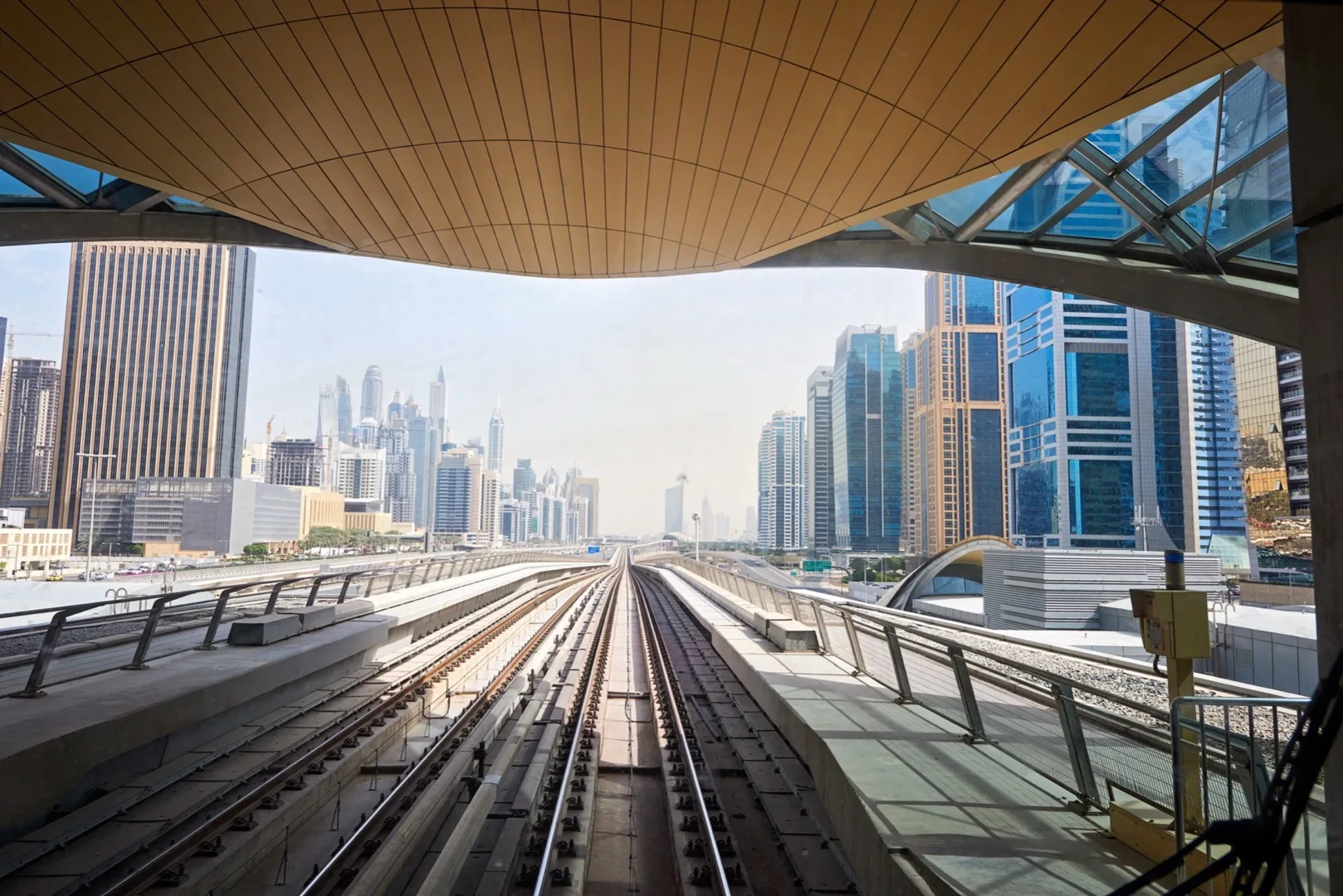
The RTA's Metro Blue Line is under construction with a stated target of operational service around 2029, but key construction milestones — station structure, alignment finalisation, surrounding road network reconfiguration — happen well before opening. Areas along the route (Mirdif, International City, Dubai Silicon Oasis, Academic City, Festival City corridor) typically see price acceleration 2–3 years ahead of opening as smart capital positions early. By 2027, the Blue Line catalyst will be deeply priced into nearer-line communities.
3. Al Maktoum International Airport (DWC) Expansion
Dubai's announced shift of operations from DXB to Al Maktoum International (DWC) over the coming decade is the largest single infrastructure catalyst for South Dubai property. The expansion is scheduled in phases through 2027 and beyond, ultimately growing DWC into the world's largest airport by capacity. Residential communities in Dubai South, Jebel Ali, Damac Hills 2, and the surrounding ring directly benefit from airport-employee demand, airport-corridor logistics jobs, and rising land-value optics. By 2027, several of the airport-adjacent residential communities will have completed initial supply waves and shown demand absorption — making them more institutional in feel.
4. Palm Jebel Ali First-Phase Handovers
Palm Jebel Ali — Nakheel's mega-development that was paused for over a decade and relaunched in 2023 — has its first-phase villa and apartment handovers scheduled across 2026–2028. These handovers materially shift the supply-and-demand picture for premium beachfront in West Dubai, Jebel Ali Village, Dubai Investment Park, and Discovery Gardens. Areas surrounding Palm Jebel Ali become more desirable as the new island's ecosystem (retail, beach clubs, hospitality) builds out.
5. Dubai Square (Creek) and Creek Harbour Maturation
Emaar's Creek Harbour is one of the largest single-developer mega-projects in Dubai. By 2027, several core handovers — including parts of Sobha Square (Sobha's adjacent development), additional Emaar towers, and progress on the marina and retail components — will have shifted Creek Harbour from "promising new district" to "established premium waterfront." This maturation phase historically delivers strong capital appreciation as the area gains amenity density and reputation.
Top 10 Dubai Areas for 2027 Capital Appreciation
The ranking below combines current price levels (entry point), expected demand catalysts arriving by 2027, supply absorption (how much new stock comes online before prices can move), and present yield characteristics. Price ranges are based on current market data and should be considered indicative — actual transaction prices vary by tower, view, finish, and timing.
| Rank | Area | Current Price (AED/sqft) | Projected 2027 Range | Key Catalyst |
|---|---|---|---|---|
| 1 | Dubai South | AED 800–1,300 | AED 1,000–1,700 | Al Maktoum airport expansion + Etihad Rail station |
| 2 | Dubai Creek Harbour | AED 2,000–2,800 | AED 2,400–3,500 | Sobha Square + Dubai Square + maturation phase |
| 3 | Al Furjan | AED 1,100–1,600 | AED 1,400–2,000 | Existing metro proximity + Palm Jebel Ali halo |
| 4 | Sobha Hartland (MBR City) | AED 1,800–2,500 | AED 2,100–3,100 | Mall of the Emirates / Meydan / waterfront premium |
| 5 | JVT (Jumeirah Village Triangle) | AED 1,000–1,400 | AED 1,200–1,750 | Oversupply absorbed + value catch-up vs JVC |
| 6 | Bukadra (Meydan) | AED 1,200–1,800 | AED 1,500–2,300 | Sobha One + emerging villa supply + Meydan ecosystem |
| 7 | Tilal Al Ghaf | AED 1,800–2,800 (villas/townhouses) | AED 2,200–3,500 | Lagoon community maturation + premium family demand |
| 8 | Damac Hills 2 | AED 700–1,100 | AED 900–1,400 | Airport-corridor demand + low entry point |
| 9 | Dubai Islands | AED 2,200–3,500 (premium beachfront) | AED 2,600–4,200 | Beachfront new supply + Deira regeneration thesis |
| 10 | Dubai Maritime City | AED 1,800–2,500 | AED 2,200–3,100 | Niche waterfront + central position + early-cycle supply |
The Detailed Thesis Per Area
1. Dubai South — The Airport Play
Dubai South is the most direct beneficiary of Al Maktoum International (DWC) expansion. The community has master-planned residential, commercial, logistics, and aviation zones. As DWC scales — from current operations toward its long-term role as Dubai's primary airport — the demand for housing within 15-minute commute of the airport grows with it. Add the planned Etihad Rail station and the Expo City legacy demand from neighbouring Expo 2020 grounds, and the demand picture is multi-layered.
Today's pricing remains relatively low because Dubai South is geographically far from the city's traditional centres. By 2027, as more inventory completes, the airport phase advances, and rail comes closer, the area's relative value should compress versus the city centre. For a deeper view of Expo City as part of this corridor, see our Expo City area guide.
2. Dubai Creek Harbour — The Maturation Play
Creek Harbour was launched as Emaar's "next Downtown" — and over the past few years, it has steadily delivered. By 2027, Sobha Square (Sobha's adjacent mega-development), additional Emaar towers, the marina, and the retail component will combine to give Creek Harbour the amenity density and visitor flow that drives premium pricing. The community already commands waterfront premium pricing; it is positioned to keep that premium and grow it. Our Creek Harbour area guide covers the present picture in detail.
3. Al Furjan — The Metro + Palm Jebel Ali Combo
Al Furjan already has Metro Red Line proximity (Discovery Gardens / Al Furjan stations on the Route 2020 extension). Pricing remains moderate compared to Marina or JVC. The opening of Palm Jebel Ali's first-phase amenities by 2027 directly elevates the entire West Dubai corridor — and Al Furjan is the most established residential community within that corridor. Add an oversupply phase that has now largely absorbed, and Al Furjan looks well positioned to outperform its current price band.
4. Sobha Hartland (MBR City) — The Premium Family Play
Sobha Hartland combines premium villa and townhouse stock with central Mohammed Bin Rashid City positioning. The area benefits from Meydan adjacency, Mall of the Emirates within reach, and the emerging waterfront / canal ecosystem that MBR City is building. Premium family buyers continue to compress to a small number of trusted communities — Hartland is one. By 2027, supply will have absorbed and the area's reputation as a premium family district should be cemented.
5. JVT (Jumeirah Village Triangle) — The Value Catch-Up Play
JVT has long traded at a discount to its neighbour JVC despite similar product, similar amenities, and arguably better road connectivity. The discount reflects oversupply during 2018–2022 that has been steadily absorbing. By 2027, the supply overhang should be substantially cleared, and the natural value gap to JVC should narrow. For an investment thesis on the JVC side, see our JVC investment guide.
6. Bukadra (Meydan) — The Sobha One Halo
Bukadra sits in the Meydan area and has seen significant launches centered on Sobha One and adjacent Sobha developments. The area combines Meydan racecourse adjacency, central positioning, and a wave of premium new supply. By 2027, several of these developments deliver — bringing residents, retail, and amenity density. Pricing should reflect the ecosystem maturation.
7. Tilal Al Ghaf — The Lagoon Community Play
Tilal Al Ghaf has pioneered the lagoon-community lifestyle in Dubai, with crystal lagoons, premium villas and townhouses, and a focus on resort-style outdoor living. The community continues to deliver new phases. By 2027, Tilal Al Ghaf reaches a level of completion and reputation that supports premium family demand at higher price points than current. The community's success has also accelerated similar lagoon-style projects across Dubai — Tilal Al Ghaf benefits from being the original.
8. Damac Hills 2 — The Affordable Airport-Corridor Play
Damac Hills 2 (formerly Akoya) sits in the south-west corridor with relatively low entry pricing (under AED 1,000/sqft for many units). It benefits from the same airport-corridor demand thesis as Dubai South, with even lower entry capital. The community has matured significantly with its various clusters delivering. For investors prioritising entry capital, Damac Hills 2 is one of the most accessible plays on the airport thesis.
9. Dubai Islands — The Beachfront New-Supply Play
Dubai Islands (formerly Deira Islands) is Nakheel's revived multi-island development off Deira's coast. It combines new beachfront stock, a Deira regeneration thesis (the historic district is seeing renewed investment), and central proximity. The first-phase deliveries through 2026–2027 establish the area's market. Beachfront supply in Dubai is structurally constrained, so new beachfront with credible amenity build-out generally appreciates well.
10. Dubai Maritime City — The Niche Waterfront Play
Dubai Maritime City is a niche waterfront district with smaller total supply than Marina or JBR, central positioning between Bur Dubai and Jumeirah, and an early-cycle position on its residential supply build-out. The market is thin (less liquid) but for investors comfortable with niche plays, the supply scarcity supports the appreciation thesis. By 2027, more residential deliveries should establish the area as a recognised waterfront alternative.
Investing in Dubai?
Get Weekly Investment Insights
ROI analysis, rental yields, off-plan opportunities, and data-driven market updates.
✓ You're in! Check your inbox.
Areas to Watch But Be Cautious On
Not every area with infrastructure investment delivers strong appreciation. A few areas worth watching but with caveats:
- JVC. Strong fundamentals but supply remains heavy. Capital appreciation may lag rental yield growth — strong income plays continue, but appreciation could be muted if new launches keep pace with demand.
- Business Bay. Mature area with high-quality stock, but the sheer volume of upcoming supply (Damac, Sobha, Omniyat, others) constrains capital appreciation per unit. Selective tower selection matters more than area-level bet.
- Downtown Dubai. Premium and stable but already at high pricing. Appreciation typically tracks broader luxury index rather than outperforming. See our Downtown investment analysis for tower-level detail.
- Marina. Mature with limited new supply, but rental yields are pressured by the sheer volume of resale stock. Capital appreciation in 2027 may be respectable but unlikely to lead the city.
The Macro Risks to Any Forecast
Forward-looking area selection assumes a benign macro environment. The macro factors most likely to disrupt the 2027 thesis:
- Global interest rates. If US Federal Reserve rates spike (and the AED is pegged to the USD), UAE mortgage rates rise in lockstep. Higher rates compress affordability and slow appreciation.
- Oil price collapse. A sustained oil price below $50 would pressure GCC fiscal positions, government spending, and ultimately employment growth — slowing the demand engine that supports Dubai property.
- Supply over-delivery. Dubai launches tend to come in waves. If 2025–2027 deliveries materially exceed demand absorption, area prices can stagnate or decline regardless of long-term catalyst.
- Geopolitical disruption. Regional conflict, sanctions, or capital-flight events would alter Dubai's safe-haven appeal — sometimes positively, sometimes negatively.
- Regulatory tightening. CBUAE LTV/DBR rules could tighten further; Golden Visa or property-investor visa thresholds could change. See our CBUAE 50% rule guide for the current framework.
How to Use This Analysis
This is a thesis, not a portfolio recommendation. To translate it into actionable investment:
- Match areas to your strategy. Yield-focused investors should weigh current rental yield and stability over capital appreciation projections. Capital growth investors can prioritise this list.
- Diversify across areas. Putting capital into 2–3 different theses (e.g., Dubai South + Creek Harbour + Al Furjan) reduces single-area risk.
- Visit before buying. Each of these areas has very different on-the-ground feel. What looks promising in a forecast can feel sparse and underdeveloped in person — and vice versa.
- Budget conservatively. Use lower-end projected 2027 prices when running ROI scenarios. Use our ROI calculator to model total returns across both rental income and projected capital gains.
- Plan exit timing. Capital appreciation realises on sale. Have a clear hold-period plan before buying.
Frequently Asked Questions
How is "capital appreciation" different from "rental yield"?
Rental yield is the annual rent divided by the property value — what you earn while holding. Capital appreciation is the increase in the property's value over time — what you make on sale. Total return combines both. Some areas (JVC, Arjan) are stronger on yield; others (Creek Harbour, Tilal Al Ghaf) emphasise appreciation. Our 2026 rental yields guide covers the income side.
Are these projections guaranteed?
No. They are forward-looking estimates based on current public infrastructure timelines and historical Dubai patterns. Actual outcomes depend on macro factors (interest rates, oil cycle, geopolitics) and supply-demand dynamics that cannot be precisely forecast. Treat all projections as scenarios, not promises.
Is off-plan or ready property better for capital appreciation?
Off-plan typically offers a "developer discount" (effectively buying below market) plus the time value of price growth during construction. Ready property offers immediate occupancy or rental and clearer pricing. For high-conviction area bets where construction is well-managed, off-plan can outperform. For risk-averse investors, ready property eliminates construction-delivery risk.
Should I use mortgage leverage to amplify capital gains?
Mortgage leverage is the single biggest amplifier of equity return on appreciation. A 20% rise in property value, financed with 80% mortgage, produces a 100% return on the original equity (before fees and interest costs). The downside is that leverage amplifies losses too — a 20% price drop wipes out 100% of equity. Use leverage with realistic stress-testing.
Which area is best if I have a small budget (under AED 1M)?
Damac Hills 2 and Dubai South have the lowest entry points in the top 10 list, with units available under AED 1M. For other budget-friendly options, see our guide to best Dubai properties under AED 1M.
Is Palm Jebel Ali a separate appreciation play?
Palm Jebel Ali itself is a premium long-cycle play — the first phases deliver 2026–2028, with the broader development continuing through the early 2030s. Direct investment in Palm Jebel Ali is high-conviction but requires patience. The areas in the top 10 (Al Furjan, Damac Hills 2) benefit from the Palm Jebel Ali halo without the same capital commitment.
How far in advance should I buy ahead of an infrastructure catalyst?
Historical Dubai patterns suggest the strongest appreciation often comes 12–24 months ahead of infrastructure delivery, as smart capital positions early. By the time the infrastructure opens, much of the appreciation is already priced in. Buying 3–4 years ahead can capture more upside but increases timing and macro risk.
How does this 2027 view differ from your 2026 analysis?
The 2026 analysis focuses on areas where catalysts are operational or imminent — current metro lines, established communities reaching maturation, present-day yield/appreciation balance. The 2027 view shifts further forward, weighing infrastructure that delivers in 12–24 months and supply that absorbs over the same window. Both views are complementary — investors with longer holding periods benefit from the 2027 lens. Read both side by side: 2026 capital appreciation analysis.
The areas above span budgets from under AED 1M to premium villa stock. Pair the area thesis with rigorous financial modelling — use our ROI calculator to model rental income plus projected capital gain scenarios, and our mortgage calculator to size affordable leverage. The REC investment community discusses these specific areas regularly — drop in to see what other investors are positioning for 2027.
Need Investment Advice?
Get personalized analysis for your Dubai property investment.
Thank You!
We'll get back to you within 24 hours.
Real Estate Agencies in Dubai
Explore providers from our business directory
Still have questions?
Ask a follow-up, or get connected with a vetted Dubai professional.
Follow us on LinkedIn
Dubai market analysis and industry insight for professionals.