Israeli Investors in Dubai After the Abraham Accords: Where They Buy in 2026

- The Abraham Accords (September 2020) established formal UAE-Israel diplomatic relations, opening direct flights, banking corridors, visa-on-arrival access, and a bilateral investment framework that remains the legal basis for cross-border activity in 2026.
- Israeli passport holders can buy freehold property in any of Dubai's designated freehold areas under exactly the same terms as any other foreign national — no nationality-based restriction, no special clearance, no surcharge.
- Preferred areas among Israeli buyers cluster around Marina, Downtown, Palm Jumeirah, and Business Bay — urban, multilingual, with international amenity infrastructure that fits dual-citizen and global-mobile profiles.
- Tel Aviv prime is roughly USD 11,000–18,000 per sqm; Dubai prime is roughly USD 6,800–12,000 per sqm. Israeli capital gains tax sits at 25% versus 0% in the UAE on property held by individuals.
- Periods of regional tension (notably from October 2023) temporarily reduced direct flight schedules and slowed transaction velocity, but the bilateral legal framework, freehold access, and banking corridor remained intact.
- Israel taxes worldwide income for residents. UAE residency triggered by 183+ days physically present (plus an Emirates ID and centre-of-life evidence) is the threshold most Israeli investors plan around for tax purposes.
The Abraham Accords: What Actually Changed in 2020
The Abraham Accords were signed on 15 September 2020, normalising diplomatic relations between the United Arab Emirates and Israel. For the first time, Israeli passport holders could enter the UAE without a third-country workaround, Israeli companies could open banking and trade channels with UAE counterparts directly, and the legal architecture for bilateral investment — covering double taxation, investment protection, and mutual recognition — was put in place over the following 18 months.
From a property investor's standpoint, four practical things changed almost immediately:
- Direct flights. Tel Aviv-Dubai flights launched in late 2020 with flydubai, Israir, and El Al, dropping travel time to roughly three hours and removing the cost and friction of routing through Istanbul, Athens, or Larnaca.
- Visa-on-arrival. Israeli passport holders gained 90-day visa-on-arrival access to the UAE, making property scouting, viewings, and signing visits practical in a single short trip.
- Banking corridor. SWIFT transfers between Israeli and UAE banks became routine, with major Israeli banks (Bank Hapoalim, Bank Leumi, Discount, Mizrahi Tefahot) and UAE banks establishing direct correspondent relationships.
- Investment protection treaty. The bilateral investment treaty signed in 2020 and the double tax treaty signed in 2021 (effective from 2022 tax year) gave Israeli investors the same protections any treaty-partner investor would expect — fair treatment, dispute resolution, and clarity on cross-border tax position.
That framework is what underpins everything that has happened in the corridor since: by the end of 2025, hundreds of millions of US dollars in Israeli capital had been deployed into Dubai property, with concentration in residential freehold rather than commercial real estate.
Who Is Buying: The Israeli Investor Profile in Dubai
The Israeli buyer pool in Dubai is not monolithic. Based on transaction patterns observed at agencies handling Israeli clients and the public commentary from Dubai-based brokers, four overlapping profiles dominate:
- Tech founders and exits. Israel's high-technology export sector continues to generate concentrated liquidity events (acquisitions, secondaries, IPOs). Founders and early employees diversify away from Tel Aviv real estate, which is supply-constrained and expensive, into Dubai prime where the same capital buys substantially more square metres.
- Real estate professionals. Israeli developers, brokers, and property fund managers active in Tel Aviv, Herzliya, and Ramat Gan have allocated capital to Dubai both as principals and to support clients diversifying internationally.
- Dual-citizens. US-Israeli, French-Israeli, UK-Israeli, and Canadian-Israeli dual nationals make up a meaningful share of buyers. Their decision often combines pure investment with a global-mobility hedge — a property in a third jurisdiction, with a visa pathway attached.
- High-net-worth diversifiers. Established business families allocating a share of net worth outside Israel and outside Europe, often combining Dubai property with a Golden Visa to give the family unit additional optionality.
What the pool generally does not include in 2026: small-ticket retail buyers spending under AED 750,000. Israeli buyer activity tends to start at the AED 1.5–2 million level (often targeting Golden Visa eligibility) and runs upward from there.
What the Law Allows: Israelis as Foreign Buyers in Dubai
Dubai's freehold framework, established by Law No. 7 of 2006 and updated multiple times since, allows non-GCC foreign nationals to own freehold property in designated areas. The law makes no nationality-based distinction within the foreign-national category — a buyer from Israel, Germany, Brazil, or Australia is treated identically.
What this means in practice:
- Israeli passport holders can purchase property in any of Dubai's designated freehold zones (Marina, Downtown, Palm Jumeirah, Business Bay, JVC, Dubai Hills, Creek Harbour, MBR City, JLT, Arabian Ranches, and dozens more).
- The Dubai Land Department (DLD) registration process is identical: 4% transfer fee, AED 4,000 admin fee, broker commission (typically 2%), and trustee fee (around AED 4,000).
- Buyers do not need a UAE residence visa to purchase property. The transaction can be executed on a tourist entry, with documents apostilled and translated as required.
- Title is registered in the buyer's individual name (or the name of a UAE-incorporated corporate entity if the buyer prefers that structure).
For the official designated freehold zones list and process flow, the Dubai Land Department website is the authoritative source. For the buyer-side process from start to finish, our non-resident buyer's guide walks through documentation, escrow, transfer, and post-handover.
Visa and Entry: The Israeli Pathway
Pre-Accords, Israeli citizens needed a third-country routing and a UAE-arranged invitation. Since 2020, Israelis enter the UAE under the same general framework as most Western nationals.
| Pathway | Duration | Suited To | Notes |
|---|---|---|---|
| Visa-on-arrival | 90 days | Scouting, viewings, signing | Free; granted on entry to Israeli passport holders since 2020 |
| Property visa (2-year) | 2 years renewable | Investments AED 750K+, completed property | Property must be ready (not off-plan); private health insurance required |
| Golden Visa (10-year) | 10 years renewable | Investments AED 2M+ (combinable across properties) | Mortgaged value counts; sponsor family; no employer required |
| Employment visa | 2-3 years | Hired by UAE employer / own free zone company | Employer-sponsored; can sponsor dependants |
| Business / investor visa | 2-3 years | Founders setting up a free zone or mainland company | Common path for tech founders relocating partially |
For most Israeli investors with a meaningful Dubai allocation, the Golden Visa is the default. Our Golden Visa through property guide covers documentation, processing time, and family-sponsorship rules. The official visa procedural authority is the Federal Authority for Identity, Citizenship, Customs & Port Security (ICP).
Banking: How Israeli Buyers Move Capital
Banking is the area where the Accords made the most practical day-to-day difference. Pre-2020, an Israeli buyer wanting to fund a Dubai property purchase had to route capital through a third jurisdiction (typically Switzerland, Cyprus, or Hong Kong), which added cost, time, and complexity. Today, the corridor runs directly.
UAE bank account opening
UAE banks accept Israeli passport holders for personal and corporate account opening. The standard documentation set applies: passport, UAE entry stamp or residence visa, Emirates ID (once issued), proof of address, source-of-funds documentation, and a banker's reference where requested. Emirates NBD, Mashreq, ADCB, and FAB all process Israeli applicants in 2026; private banking arms of these institutions have dedicated relationship managers handling Israeli high-net-worth files.
For property purchases without a UAE account, buyers can transfer funds directly to the seller's escrow account or to the developer's escrow at a UAE bank — many transactions complete this way and a UAE personal account is established only afterward.
SWIFT transfer mechanics
Direct SWIFT transfers from major Israeli banks to UAE banks have been routine since 2021. Compliance reviews on both sides are standard for transfers above the equivalent of USD 50,000: buyers should expect to provide the sale-and-purchase agreement, NOC from the developer (for off-plan), and source-of-funds documentation (sale of Israeli property, business sale proceeds, salary accumulation, exit proceeds).
Mortgage availability
Non-resident mortgages are available to Israeli buyers from UAE banks, with LTV typically capped at 50–60% for non-residents (versus up to 80% for UAE residents on first property). For most Israeli investors with significant existing capital, a cash purchase is structurally simpler — but mortgage financing remains accessible if desired. The non-resident mortgage guide covers eligibility, documentation, and rate ranges.
Investing in Dubai?
Get Weekly Investment Insights
ROI analysis, rental yields, off-plan opportunities, and data-driven market updates.
✓ You're in! Check your inbox.
Where Israeli Buyers Concentrate
Transaction patterns and broker reporting in 2026 show a clear concentration in four areas. The pattern is consistent with what is observed for buyers from comparable urban global cities (London, New York, Paris) — preference for dense, walkable, amenity-rich, multilingual neighbourhoods over suburban villa communities.
| Area | Typical Israeli Budget Band | Why It Fits the Profile | Gross Yield Range |
|---|---|---|---|
| Dubai Marina | AED 1.5M–4M | Walkable, marina-front, dense international community, comparable feel to Tel Aviv waterfront | 5.5–7.5% |
| Downtown Dubai | AED 2M–8M | Trophy address, Burj Khalifa proximity, prestige-driven; favoured by tech-exit and HNW buyers | 5–6.5% |
| Palm Jumeirah | AED 3M–25M+ | Beachfront, scarce supply, family-friendly villas, branded residences; ultra-HNW concentration | 4.5–6% |
| Business Bay | AED 1.2M–3M | Central, canal-side, strong rental demand, business-traveller appeal | 6–7.5% |
| Dubai Hills Estate (secondary) | AED 2.5M–6M | Family relocators wanting villa lifestyle, schools, and golf community | 5–6.5% |
For deep-dives on these neighbourhoods, see the Marina area guide, Downtown investment guide, Palm Jumeirah guide, and Business Bay area guide.
Tel Aviv vs Dubai: The Core Property Comparison
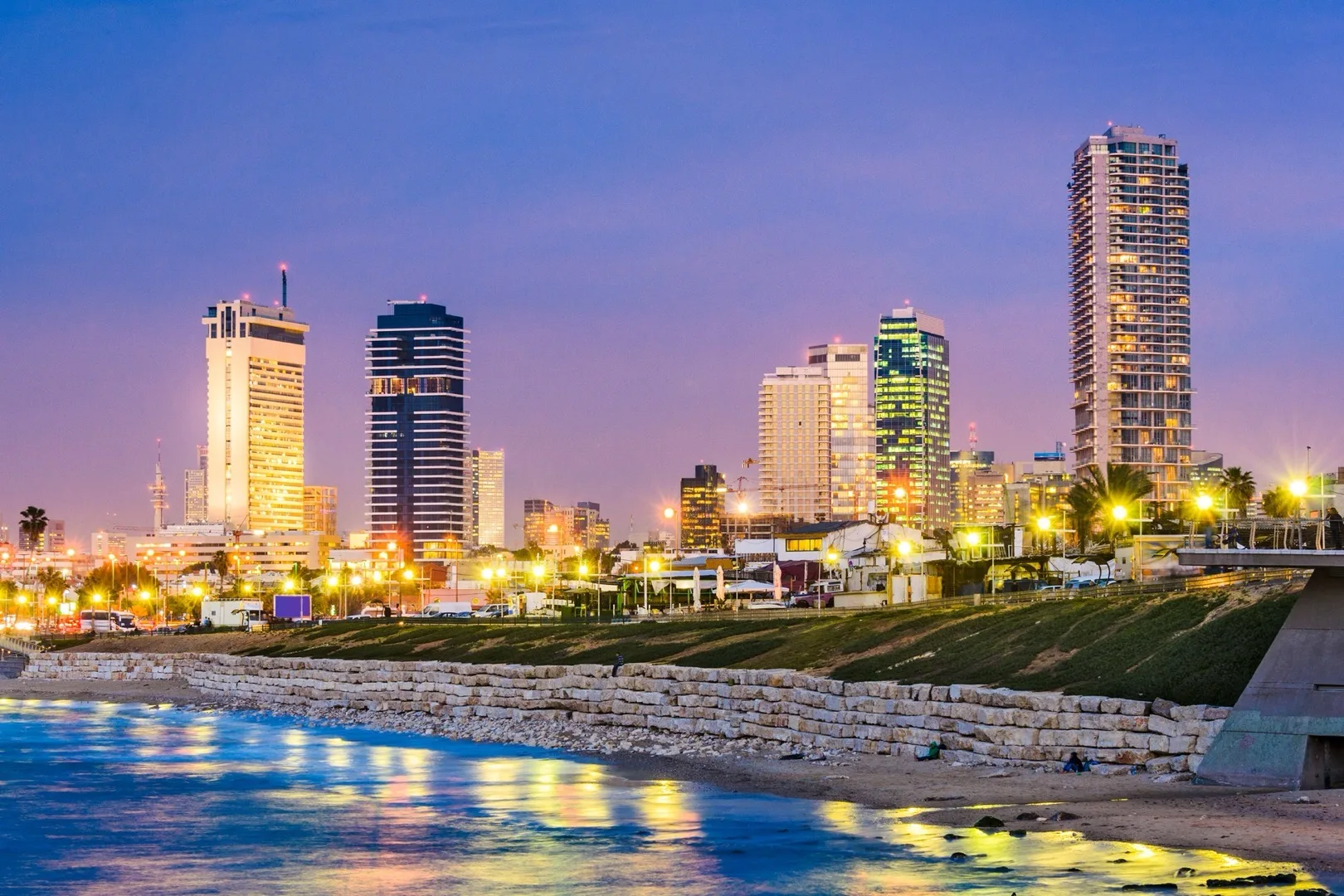
The Tel Aviv-Dubai comparison drives most of the investment thesis on the Israeli side. Tel Aviv is structurally supply-constrained — a small coastal strip, restrictive zoning, and persistent housing demand — which has pushed price-per-square-metre into a band that ranks among the highest globally. Dubai operates on the opposite supply dynamic: large land bank, active development pipeline, and prices that, on a per-square-metre basis at the prime end, sit materially below Tel Aviv.
| Metric | Tel Aviv (prime) | Dubai (prime) | Implication |
|---|---|---|---|
| Price per sqm (USD) | USD 11,000–18,000 | USD 6,800–12,000 | Same capital buys 30–60% more sqm in Dubai prime |
| Gross rental yield | 2.5–3.5% | 5–7.5% | Dubai delivers roughly 2x gross yield at prime end |
| Capital gains tax | 25% (linear betterment tax) | 0% for individuals | UAE position significantly better on disposal |
| Property purchase tax | Mas Rechisha (3.5–10% progressive) | 4% DLD transfer fee (flat) | Lower friction on Dubai purchase |
| Annual rental income tax (resident) | 10% on rental income above exemption | 0% for individuals (if no UAE corp tax exposure) | Net cashflow advantage to UAE |
| Supply pipeline | Constrained, slow approvals | Active, large pipeline through 2030 | Different price dynamics: TLV scarcity vs Dubai growth |
| Currency | ILS (volatile vs USD) | AED (USD-pegged at 3.6725) | Dubai assets effectively USD-denominated |
The currency point is structurally important. Dubai property is, in economic terms, a USD asset because the AED is pegged. For an Israeli investor whose home-currency exposure is already fully ILS, Dubai property delivers diversification away from ILS without taking on a separate currency risk decision.
For a closer look at yield by area, see our analysis of highest-yield areas in Dubai for 2026. For broader market comparisons, our Dubai vs Singapore investment comparison uses a similar prime-vs-prime framework.
Frictions: What Has Slowed the Corridor
The corridor has not been a straight line. Two friction patterns are worth understanding because they shape both transaction velocity and how Israeli investors structure deals.
Regional security periods
Periods of regional tension — most notably from October 2023 onward — have at times reduced direct flight schedules between Tel Aviv and Dubai, with some carriers temporarily suspending or thinning routes during specific weeks. Property transactions slowed but did not stop. Critically, the underlying bilateral framework (the Accords themselves, the investment treaty, the tax treaty, and the freehold ownership rights) has remained fully intact. UAE policy through these periods has consistently distinguished between geopolitical events and bilateral economic frameworks.
Compliance and due diligence
UAE banks apply enhanced due diligence on cross-border flows from any country, and Israeli buyers with complex source-of-funds (multi-jurisdictional businesses, prior tech exits, multiple holding entities) should plan for a longer file-build at account opening. This is not Israel-specific — it applies to any HNW buyer with structured wealth — but is worth budgeting time for.
Documentation language
Israeli documents (apartment sale records, tax certificates, court documents) often need apostille and certified Hebrew-to-English or Hebrew-to-Arabic translation for UAE use. The apostille is issued in Israel by the Ministry of Foreign Affairs or the Magistrate's Court depending on document type. Building this documentation set takes 1–3 weeks and is best done before the first Dubai trip rather than on-the-fly.
Investment Vehicles: How Israeli Capital Holds Dubai Property
The simplest structure — direct individual ownership — covers most Israeli buyers. Where complexity is added, it is typically driven by estate planning, family-office portfolio integration, or interaction with Israeli tax position.
- Direct ownership. Title in the individual's name. Simplest structure, lowest cost, easiest disposal. Default for most buyers under AED 5 million.
- UAE-incorporated entity (free zone or mainland LLC). Used by investors aggregating multiple properties or planning a portfolio. Adds annual maintenance cost (license renewal, registered agent) but enables structured estate planning, easy share-transfer disposal, and entity-level borrowing. See our company-ownership structure guide.
- Dubai-based REITs. Listed REITs (Emirates REIT, ENBD REIT) offer indirect exposure without direct property ownership. Used by investors wanting Dubai allocation in liquid, diversified form rather than a single trophy property.
- Off-plan with developer payment plans. Many Israeli buyers use off-plan staged payments (60/40 or post-handover plans) to spread capital deployment over 24–36 months while securing pre-handover prices. The mechanics are explained in our developer payment plans guide.
- DIFC Wills. For non-Muslim foreign owners (Israeli or otherwise), a DIFC Will is the standard mechanism to ensure inheritance follows the owner's chosen distribution rather than UAE default succession rules. Cost is typically AED 10,000–15,000 for the Will and registration.
Tax Position: Israel vs UAE Residency
The tax position is where most Israeli investor decisions get refined. The key principle: Israel taxes residents on worldwide income, while the UAE does not tax personal income at all. Where you sit on the residency line determines the entire tax position.
Israeli tax residency (the "centre of life" test)
Under Israeli tax law, you are an Israeli tax resident if Israel is your "centre of vital interests" — assessed on factors including days physically present, location of permanent home, family location, economic interests, and social ties. There is a quantitative presumption of residency at 183+ days in Israel in a single year, or 425+ cumulative days over three years (with at least 30 in the current year).
If you remain an Israeli tax resident, your worldwide income — including Dubai rental income — is reportable in Israel. The UAE-Israel double tax treaty (in force from 2022) prevents double taxation but does not exempt the income from Israeli reporting.
UAE tax residency
UAE tax residency for individuals is established by physical presence (183+ days in a 12-month period), or 90+ days combined with UAE permanent home/economic centre, or being a UAE national. With a residence visa and Emirates ID, plus genuine UAE-based residency, an Israeli investor can shift their tax position from Israeli resident to UAE resident — at which point worldwide reporting to Israel ends and only Israeli-source income remains taxable in Israel.
Olim and exempt regime
New immigrants to Israel (olim chadashim) and returning residents benefit from a 10-year exemption on foreign income and capital gains under Israeli law. For an Israeli with this status, Dubai property income may already be exempt for the duration of the regime — making the residency planning question different from a settled Israeli resident.
UAE corporate tax for landlords
The UAE introduced corporate tax at 9% from June 2023, applying to business profits above AED 375,000. For individuals owning property in personal name, residential rental income is typically outside the scope of corporate tax (it is personal investment income, not business income). Where ownership is through a UAE entity, the position is different and depends on the entity's specific qualifying status. Our landlord tax obligations guide covers when corporate tax actually applies.
Tax planning in this area is genuinely complex and individual-specific. Israeli investors with significant Dubai allocations typically engage both Israeli and UAE-side tax counsel rather than relying on general guidance.
Frequently Asked Questions
Can Israeli citizens legally buy property in Dubai?
Yes, with no restrictions. Israeli passport holders can purchase freehold property in any of Dubai's designated freehold areas under the same terms as any other foreign national. There is no nationality-based limitation, no special clearance, and no surcharge. This has been the legal position since freehold property law was established and is unaffected by political conditions.
What changed for Israelis after the Abraham Accords in 2020?
The Accords established direct diplomatic relations, opened direct flights, granted Israeli passport holders 90-day visa-on-arrival access to the UAE, enabled direct SWIFT banking corridors between Israeli and UAE banks, and led to bilateral investment and double tax treaties. These changes converted Dubai from a third-country-routing destination into a directly accessible market for Israeli investors.
Did the October 2023 conflict change the legal framework?
No. Direct flight schedules thinned during specific weeks of regional tension and some carriers temporarily adjusted routes, but the bilateral Accords framework, freehold property rights, banking corridor, visa-on-arrival access, and tax treaty all remained intact. Transaction velocity slowed but the legal architecture was not changed.
How does Dubai property compare to Tel Aviv on price and yield?
Tel Aviv prime sits at roughly USD 11,000–18,000 per square metre with gross rental yields around 2.5–3.5%. Dubai prime is roughly USD 6,800–12,000 per square metre with gross yields around 5–7.5%. The same capital buys 30–60% more square metres in Dubai prime, at roughly twice the gross yield, with 0% capital gains tax for individuals versus 25% in Israel.
Can I open a UAE bank account on an Israeli passport?
Yes. UAE banks have processed Israeli applicants since 2020 under standard documentation: passport, entry stamp or residence visa, Emirates ID once issued, proof of address, and source-of-funds. Major banks including Emirates NBD, Mashreq, ADCB, and FAB all handle Israeli files. Compliance review is standard for HNW applicants regardless of nationality and timelines run 2–4 weeks for full account activation.
Do I need to give up Israeli tax residency to invest in Dubai?
No. You can buy and hold Dubai property as an Israeli tax resident — the rental income and gains are reportable in Israel under worldwide-income rules, with the UAE-Israel tax treaty preventing double taxation. To avoid Israeli reporting on Dubai income entirely, you would need to shift tax residency to the UAE (typically 183+ days physically present plus an Emirates ID and centre-of-life evidence), which is a substantial life change rather than a paperwork exercise.
What property budget do most Israeli buyers in Dubai start at?
The Israeli buyer pool in 2026 is concentrated above AED 1.5 million, with a strong cluster at AED 2 million and above (the Golden Visa threshold). Sub-AED 1 million purchases happen but are uncommon — Israeli buyers tend to combine investment and visa pathway, which favours the AED 2M+ tier. Trophy-end purchases on Palm Jumeirah and in Downtown frequently run AED 8–25 million.
Is the Dubai Golden Visa a practical option for Israeli investors?
Yes, and it is the most common visa pathway for Israeli buyers above the AED 2 million property threshold. The 10-year Golden Visa is renewable, allows family sponsorship, does not require employer sponsorship or business activity, and counts mortgaged property at full purchase value. For an Israeli investor wanting a long-horizon UAE foothold without committing to relocation, it is structurally well-suited.
Decisions in this corridor benefit from concrete numbers — area-by-area yield, off-plan vs ready trade-offs, banking sequence, and visa pathway calibration to the actual purchase amount. Our team has supported Israeli buyers through end-to-end Dubai purchases since the Accords opened the corridor. If you would like a structured conversation about budget, area shortlist, and the visa-tax sequence, reach out through the REC community or contact our team directly.
Need Investment Advice?
Get personalized analysis for your Dubai property investment.
Thank You!
We'll get back to you within 24 hours.
Real Estate Agencies in Dubai
Explore providers from our business directory
Still have questions?
Ask a follow-up, or get connected with a vetted Dubai professional.
Follow us on LinkedIn
Dubai market analysis and industry insight for professionals.