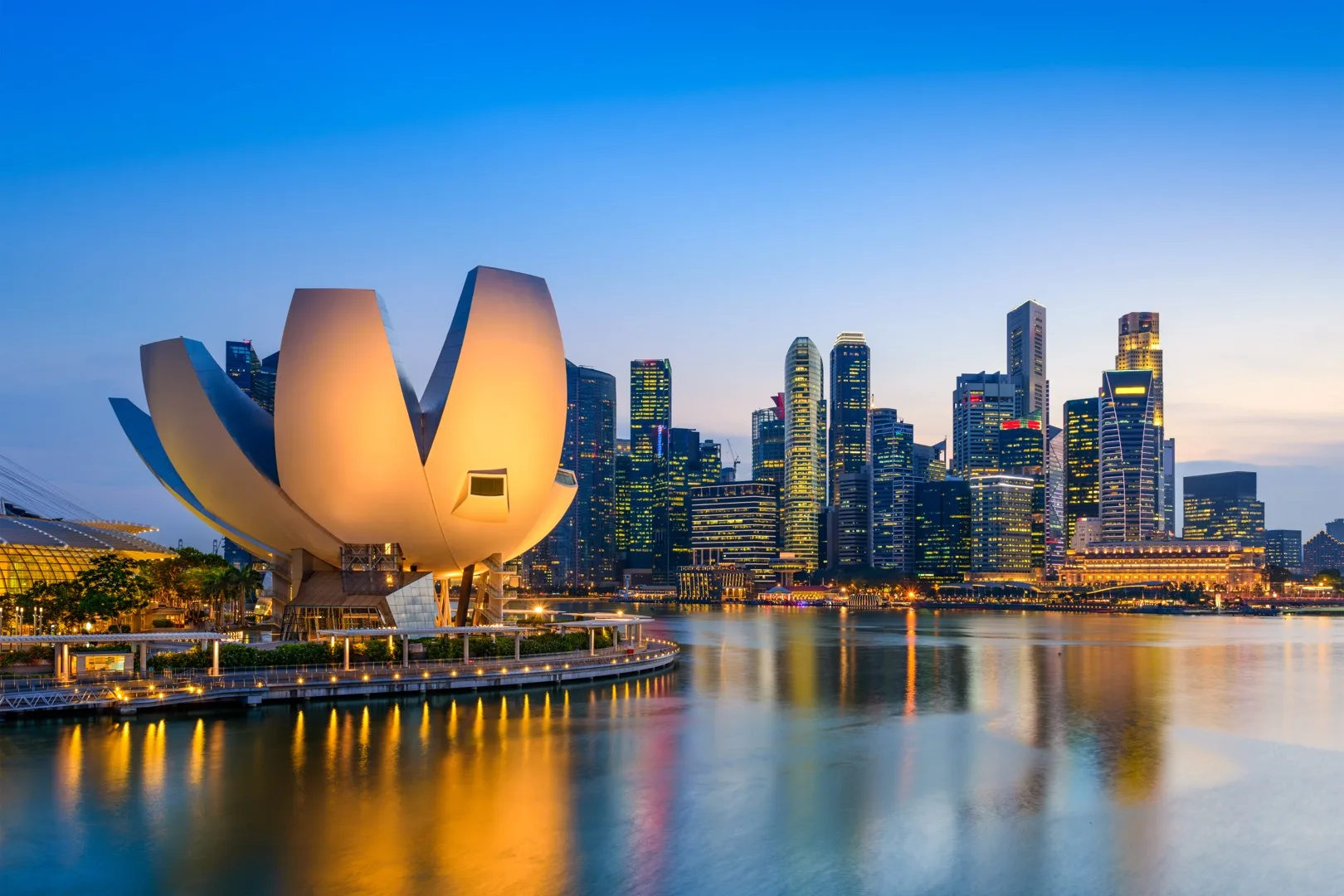
Moving to Dubai from Singapore: Tax, Property, Banking & Complete Relocation Guide 2026

- The Singaporean community in the UAE is estimated at around 10,000 and growing, fuelled by corporate transfers, entrepreneurs leaving high-cost SG property, and families seeking 0% personal income tax.
- Singapore passport holders enter the UAE visa-free for 30 days. Long-term options include employment visas, freelance permits, investor visas, and the 10-year Golden Visa via property investment of AED 2 million or more.
- Singapore's personal income tax tops out at 24% (resident) and GST is now 9%. The UAE has 0% personal income tax, 0% capital gains, and 5% VAT — a significant net-income shift for senior professionals.
- Dubai property is fully freehold for foreigners in designated areas. There is no Additional Buyer's Stamp Duty, no ABSD, and no 60% foreigner stamp duty equivalent — total transaction costs run roughly 7–8% of price.
- CPF stays locked in for citizens and PRs after relocation; PRs may apply to renounce status and withdraw, but it is irreversible. Most movers leave CPF intact and plan around it.
- Banking setup with Emirates NBD, HSBC, Standard Chartered, or DBS Dubai (DIFC branch) is straightforward for SG nationals once the residence visa and Emirates ID are issued.
Why Singaporeans Are Moving to Dubai
Singapore has long been the gold standard of Asian expat hubs — safe, efficient, well-connected, English-speaking. So when professionals and entrepreneurs choose to leave it for Dubai, the reasons tend to be specific and financial rather than emotional. The migration flow has accelerated noticeably since 2023 as Singapore introduced a 60% Additional Buyer's Stamp Duty for foreigners purchasing residential property, raised GST to 9%, and saw record-high private rents. At the same time, Dubai has consolidated its position as a tax-free hub with deeper capital markets, a stronger property freehold framework for foreigners, and an expanded Golden Visa programme.
The community of Singaporean nationals in the UAE is now estimated at around 10,000, with the majority in Dubai and Abu Dhabi. While that is small relative to Indian, Filipino, or British expat populations, it is well-networked. The Singapore Business Council Dubai is active, the High Commission organises National Day events, and several DIFC-based asset managers have become hubs for SG-trained finance professionals.
For Singaporeans, the move is rarely about chasing a lifestyle they cannot already afford at home — it is about a different financial geometry. A managing director paying 22% Singapore income tax plus 9% GST on most consumption, while servicing a high private mortgage in District 9 or 10, can find the same role in Dubai delivers a net retention rate that is meaningfully higher. Add in the option to bank significant amounts of capital into freehold Dubai property as a long-term yield play, and the trade becomes mathematical.
Visa Options for Singapore Citizens
Singapore passport holders enjoy visa-free entry to the UAE for 30 days, extendable for an additional 30 days. This makes initial scouting trips, property viewings, and relocation planning straightforward — no advance visa application required. For long-term residence, several pathways exist.
| Visa Pathway | Duration | Typical Cost | Best For |
|---|---|---|---|
| Visa on arrival | 30 days (+30 extension) | Free | Scouting trips, viewings, short stays |
| Employment visa | 2–3 years renewable | Sponsored by employer | Corporate transfers, regional roles |
| Freelance permit | 1–3 years renewable | AED 7,500–13,500 / year | Consultants, designers, content creators |
| Investor / business visa | 2–3 years renewable | AED 12,500–25,000 setup + visa fees | Founders, family offices, holding companies |
| Property visa (2-year) | 2 years renewable | Property AED 750K+ minimum | Smaller property buyers, flexible base |
| Golden Visa (10-year) | 10 years renewable | Property AED 2M+ or AED 2M+ deposit | HNW relocators, long-term planners |
The Golden Visa has become the headline route for Singaporean buyers with capital. The threshold is AED 2 million in property — and importantly, the property can be under mortgage, with the full purchase price counting toward the threshold rather than just equity. For details on the latest 2026 changes, see our Dubai Golden Visa 2026 guide and our deeper dive on the property-route Golden Visa. For employment-based moves, the costs are usually employer-borne, but it is still worth understanding the breakdown — our Dubai employment visa cost guide covers every fee line. Official requirements are published by the Federal Authority for Identity, Citizenship, Customs and Port Security.
Tax Comparison: Singapore vs UAE
This is the single biggest financial driver for most Singaporean relocators. Singapore's headline tax rates are still moderate by global standards, but the gap with the UAE has widened over the past three years as Singapore raised GST and tightened property duties for foreigners while the UAE introduced a 9% federal corporate tax with broad SME and free zone exemptions but kept personal income at 0%.
| Tax Type | Singapore | UAE / Dubai |
|---|---|---|
| Personal income tax | 0–24% progressive (resident) | 0% |
| Capital gains tax | 0% (general) | 0% |
| GST / VAT | 9% | 5% |
| Corporate tax | 17% headline | 0% (under AED 375K profit) / 9% above; free zones often 0% |
| Foreign property stamp duty | BSD 1–6% + ABSD 60% for foreigners | DLD transfer fee 4% (no nationality differentiation) |
| Inheritance tax | 0% (abolished 2008) | 0% |
| Property tax (annual) | 4–32% of annual value (owner-occupied higher tier) | No annual property tax (DEWA housing fee 5% of rent only) |
The headline that matters most: a Singaporean professional earning the equivalent of SGD 350,000 per year typically loses around SGD 60,000–70,000 to personal income tax. The same earner in Dubai keeps that money. Across a five-year stint, that difference alone — before any property gains, lower consumption tax, or capital gains shielding — is roughly AED 1 million in retained income. For founders running a regional business, the corporate tax delta is a second lever: free zone structures often allow 0% on qualifying income up to specific revenue ceilings. Our deeper comparison piece on Dubai vs Singapore property investment walks through the numbers on the property side specifically.
Important nuance: the UAE's tax framework is published and continuously updated on the official UAE Government portal. Always check current thresholds before making structural decisions, especially around free zone qualifying income.
Property Buying as a Singapore National
Singapore nationals enjoy the same freehold ownership rights in Dubai as any other foreign buyer — full ownership in designated freehold zones, registered title with the Dubai Land Department, no nationality-based restrictions, no special approvals, and no foreigner stamp duty premium. After Singapore's 60% ABSD for foreign residential buyers, this often comes as a relief. You are buying on the same terms as locals.
Total transaction costs in Dubai run roughly 7–8% of the purchase price, comprising the 4% DLD transfer fee, 2% agency commission (often split or negotiable), AED 4,000 trustee/registration fee, AED 540 title deed issuance, and a 0.25% mortgage registration fee if financing. There is no equivalent of Singapore's BSD escalator, no ABSD, and no Seller's Stamp Duty. For a complete numbers-level breakdown, see our true cost of buying Dubai property guide.
Singaporean buyers are effectively split into three patterns:
- Cash buyers. Often using funds repatriated from Singapore property sales or liquidated investment portfolios. Process is fastest — typically 30–45 days from MOU to title transfer.
- Non-resident financed buyers. Several UAE banks lend to non-residents at 50–60% LTV. Interest rates currently sit around 4.5–5.5% on AED-denominated loans. Our non-resident mortgage guide covers the documentation and bank-by-bank requirements.
- Resident financed buyers. Once on a UAE residence visa, LTV climbs to 75–80% on first property. The UAE LTV rules guide explains the tiers.
For a step-by-step walkthrough of the buying process from offer to title deed, our remote investor's complete guide is the standard reference. If you are still deciding between freehold and leasehold zones, our freehold vs leasehold explainer sets the boundaries.
Preferred Areas for Singaporean Buyers
Singaporeans tend to gravitate toward areas that map cleanly onto familiar Singapore lifestyle archetypes. Buyers coming from condo living in District 9 (Orchard) or District 10 (Bukit Timah) often shortlist Downtown Dubai or Dubai Marina. Families moving from landed property in Bukit Timah or Holland Village look at Dubai Hills Estate or Arabian Ranches. Those used to Sentosa Cove waterfront often land on Palm Jumeirah.
| Area | Typical Budget (1–2BR) | SG Lifestyle Equivalent | Why It Fits |
|---|---|---|---|
| Downtown Dubai | AED 1.6M–4M | Orchard / Marina Bay condos | CBD-adjacent, walkable, premium retail and F&B |
| Dubai Marina | AED 1.2M–3M | Tanjong Rhu / Marina Bay waterfront | High-rise waterfront, marina walk, beach access |
| Palm Jumeirah | AED 2.5M–25M+ | Sentosa Cove | Iconic waterfront, beachfront villas, exclusivity |
| Dubai Hills Estate | AED 1.6M (apt) / 4M+ (villa) | Bukit Timah / Holland Village | Family-oriented, golf, top schools (GEMS Wellington), parks |
| Arabian Ranches | AED 3M–10M+ | Serangoon Gardens / Holland Village | Established villa community, family-first, equestrian club |
| Business Bay | AED 1.1M–2.2M | Tanjong Pagar / Robertson Quay | Central, canal-side, strong rental demand from professionals |
For deeper area-by-area research, our Downtown Dubai investment guide, Dubai Marina guide, Palm Jumeirah guide, and Dubai Hills Estate guide cover the towers, schools, yields, and capital appreciation outlook for each. Investors focused on yield first should also review highest-ROI areas in Dubai.
Banking: Opening UAE Accounts as a Singaporean
UAE banks treat Singapore nationals as low-risk, well-documented applicants. Once your residence visa and Emirates ID are issued, the account-opening process typically takes 5–10 working days. Required documents are passport, residence visa, Emirates ID, proof of UAE address (Ejari tenancy contract or utility bill), salary certificate or proof of income, and three months of recent bank statements (UOB, DBS, OCBC statements are accepted directly).
The natural starting points for SG movers are:
- Emirates NBD. Largest local bank, widest branch and ATM network, strong wealth management arm in Singapore corridor.
- HSBC UAE. If you already bank with HSBC Premier in Singapore, the international transfer of relationship is seamless — same-day SGD–AED transfers between HSBC accounts at mid-market rates.
- Standard Chartered. Similar advantage if you already hold a Priority or Priority Private relationship in Singapore.
- DBS DIFC branch. DBS operates a wholesale branch in DIFC. It is not a retail bank, so it is most useful for HNW clients via DBS Treasures or Private Bank — they coordinate cross-border accounts.
- Mashreq, ADCB, FAB. All accept SG nationals, with ADCB known for fast onboarding and competitive mortgage products.
For ongoing SGD–AED transfers, the cleanest setups are HSBC global view, DBS multi-currency, or Wise. Wise consistently offers mid-market rates with 0.4–0.6% spread on SGD–AED, beating bank wire fees on most amounts. Our Wise sign-up covers fee waivers for first transfers.
Relocating to Dubai?
Get Your Relocation Checklist
Cost of living, visa requirements, housing tips, and everything you need to plan your move.
✓ You're in! Check your inbox.
CPF Considerations: What Happens to Your Singapore Savings
CPF is the question almost every Singaporean asks within the first hour of relocation planning. The mechanics:
- Singapore citizens. CPF cannot be withdrawn for relocation alone. Funds remain in OA, SA, and MA accounts, continue to earn the prescribed interest, and become accessible at standard ages (Retirement Account drawdown from age 55, with eligibility conditions). Most relocators leave CPF intact and treat it as a forced retirement tier in SGD.
- Singapore PRs. If you renounce PR status, you can withdraw CPF in full. This is irreversible — re-application for PR is at MOM/ICA discretion and not guaranteed. Most PRs moving to Dubai do not renounce immediately; they keep PR active and re-evaluate after a 5-year horizon.
- Property pledged with CPF. If you used CPF to buy your Singapore home, the CPF used (plus accrued interest) must be refunded to your CPF on sale. Selling before relocating is often cleaner than long-distance landlord management.
- SRS account. Supplementary Retirement Scheme contributions stay; you can continue contributing while non-resident, but the tax relief obviously does not apply once you are not paying SG income tax.
The practical playbook most Singaporean relocators follow: leave CPF as-is, dispose of or rent out the SG property based on yield analysis, and rebuild a parallel retirement layer through Dubai property yield, USD-denominated investment accounts, and (for entrepreneurs) free zone company structures. The CPF base remains a meaningful safety net you do not need to dismantle.
Cost of Living: Singapore CBD vs Dubai Marina/Downtown
The headline conclusion most movers reach: Dubai delivers more space, more car-centric lifestyle, and lower direct tax, while Singapore delivers better public transport, more compact convenience, and lower utilities (no air conditioning load May–October). On a strict like-for-like basis, total monthly cost for a couple living in a 2BR apartment in a comparable central area is broadly similar — Dubai 5–10% lower in many cases — but the income tax delta typically swings the net position decisively in Dubai's favour.
| Expense Category | Singapore (Monthly SGD / USD) | Dubai (Monthly AED / USD) | Notes |
|---|---|---|---|
| Rent (2BR, central) | SGD 6,000–9,500 / $4,500–7,100 | AED 13,000–22,000 / $3,540–5,990 | Singapore CBD rents have surged post-2022; Dubai Marina/Downtown still cheaper |
| Utilities (electric, water, cooling) | SGD 200–350 / $150–260 | AED 700–1,400 / $190–380 | Dubai AC peaks May–Sep; SG cooling load lower |
| Groceries (couple) | SGD 800–1,200 / $600–900 | AED 2,000–3,200 / $545–870 | Comparable; Dubai lower for produce and dairy at Carrefour/Lulu |
| Dining (mid-range, per meal) | SGD 35–60 / $26–45 | AED 110–220 / $30–60 | Dining out broadly comparable; Dubai often cheaper for high-end |
| Transport (couple) | SGD 200–400 / $150–300 | AED 1,500–3,500 / $410–950 | SG MRT excellent; Dubai requires car (fuel cheap, parking varies) |
| Health insurance (private, couple) | SGD 400–900 / $300–675 | AED 1,000–2,500 / $270–680 | Mandatory in Dubai; often employer-sponsored |
| School fees (per child, top-tier) | SGD 30,000–50,000 / yr | AED 70,000–115,000 / yr | Roughly comparable in USD terms at premium tier |
| Income tax (on $200K equivalent) | ~SGD 24,000–28,000 / yr | 0 | The decisive line for most movers |
For a fully itemised Dubai budget, our cost of living in Dubai 2026 guide is the standard reference. You can also run your own numbers via the Relocation Cost Estimator.
Schools for Singaporean Families
Education is usually the deciding factor for SG families. Two main approaches dominate:
IB and CBSE Curriculum (Singapore-Style Rigour)
The Global Indian International School (GIIS) in Dubai offers CBSE and IB streams — the closest curricular equivalent to an IB-track education at SJI International or UWCSEA. GEMS World Academy and Dubai International Academy also offer IB. Annual fees range from AED 50,000 at the value tier (GIIS) up to AED 90,000–115,000 at the premium tier.
British Curriculum (Anglophone, University-Pipeline)
Many SG families coming from Tanglin Trust School or Dover Court tend to favour British-curriculum schools in Dubai. GEMS Wellington International, Repton Dubai, Kings' School Dubai, and Jumeirah English Speaking School (JESS) are top-rated, with KHDA Outstanding ratings. Fees range from AED 60,000 to AED 110,000 per year. Dubai Hills Estate, Arabian Ranches, and Mirdif are particularly strong on school proximity.
Authoritative ratings, capacity, and fee filings for every Dubai school are on the KHDA portal. Our own best international schools in Dubai by area guide filters by curriculum, fees, and location. For families prioritising community fit alongside schools, the family-friendly communities guide is the right starting point.
What to Bring, What to Leave Behind
Cars
Importing a Singapore-registered car is technically possible but rarely worth it. Singapore COE pricing means most SG-registered vehicles have already been heavily depreciated, and UAE import duty (5%) plus shipping (USD 1,500–2,500) erodes savings. Selling in Singapore and buying in Dubai is almost always the better option. New and used cars are significantly cheaper in Dubai — a Toyota RAV4 that costs SGD 200K+ in Singapore (post-COE) is around AED 130K (SGD 47K) in Dubai.
Household Goods
Sea freight from Singapore to Dubai takes 18–25 days. Standard 20-foot container shipping runs USD 4,000–6,500 door-to-door, including packing and customs clearance. For most SG apartments, a 20-foot container suffices. Major movers operating Singapore–Dubai routes include Crown Relocations, Santa Fe Relocation, AGS Movers, and Allied Pickfords. UAE customs exempt personal household goods imported under residence visa from import duty, provided the visa has been held at least three months and goods are for personal use.
Pets
Singapore is on the UAE's approved country list. Requirements: ISO-compatible microchip, current rabies vaccination administered 21 days–12 months before travel, health certificate from an Singapore AVS-accredited vet within 10 days of travel, and an MOCCAE import permit (AED 300, applied online). Singapore Airlines and Emirates both accept pets in cargo. No quarantine on arrival for pets with complete documentation.
Driving Licence
Singapore is on the UAE's approved list for direct conversion. You can convert your Singapore driving licence to a UAE licence without taking a driving test — only an eye test and document submission at an RTA-authorised centre (around AED 870 total). Bring the original Singapore licence; if it is in English, no translation is required.
The Singapore Community in Dubai
The Singapore community is small but well-organised. The Singapore Business Council Dubai (SBCD) hosts regular networking events at DIFC, and the High Commission of the Republic of Singapore in Abu Dhabi services UAE-wide consular needs. National Day events typically take place around early August, organised at venues across Dubai and Abu Dhabi.
Several Singapore-Malaysian eateries operate in Dubai, including hawker-style outlets at Time Out Market and pop-ups in JLT and Marina. Hainanese chicken rice and kopitiam-style breakfasts are easier to find in 2026 than they were in 2020. Lulu Hypermarket and West Zone carry the broadest Asian-pantry inventory — see our grocery and supermarket guide.
Returning Home: What to Plan For
Many Singaporeans treat Dubai as a 5–10 year horizon rather than permanent. If you may return, plan early:
- Maintain CPF. Continue voluntary contributions if it suits your retirement plan. SRS top-ups stop being tax-efficient once you are non-resident, but you can resume on return.
- Keep a Singapore property if yields and timing allow. Singapore residential rents are at multi-year highs, and a tenanted 2BR in District 9–15 often delivers SGD 5,000–7,500 monthly gross. Run the numbers vs. ABSD-affected sale and re-purchase later.
- Track your residency days. If you intend to return mid-tax-year, time the move to optimise your residency status under IRAS rules — partial-year resident treatment can affect your effective rate.
- Dubai property as long-term yield hold. Most Singaporean owners keep their Dubai property even after returning, given AED 5,000–10,000 net monthly yields on AED 1.5M apartments and zero capital gains tax on eventual sale. Use a reputable property manager — see our property management companies in Dubai guide.
- Estate planning. If you own UAE assets, a DIFC will is the cleanest mechanism for non-Muslim expats to override default UAE inheritance rules. See our DIFC will guide.
Frequently Asked Questions
Do Singapore citizens need a visa to visit Dubai?
No. Singapore passport holders receive a visa-on-arrival for 30 days, extendable for another 30 days. For stays beyond 60 days, you need a residence visa through employment, business ownership, freelance permit, or property investment.
Can I buy property in Dubai with a Singapore passport?
Yes. Singapore nationals have full freehold ownership rights in all designated areas of Dubai. There are no nationality-based restrictions, no special permissions required, and no foreigner stamp duty premium — unlike Singapore's 60% ABSD on foreign residential purchases. You can buy without holding a UAE residence visa.
What happens to my CPF when I move to Dubai?
For Singapore citizens, CPF stays intact. Funds continue to earn prescribed interest and become accessible at the standard ages. Singapore PRs can renounce PR and withdraw CPF in full, but renunciation is irreversible. Most relocators keep CPF as-is and treat it as a forced retirement tier.
Is Dubai actually cheaper than Singapore?
On direct expenses, Dubai is roughly 5–15% cheaper for a couple in comparable central areas (rent, groceries, dining). On taxes, the gap is much wider — 0% personal income tax in Dubai vs. up to 24% in Singapore plus 9% GST. For a senior professional or founder, the net retained income advantage in Dubai is substantial.
How much do I need to invest to get a Golden Visa?
The minimum property investment for a 10-year Golden Visa is AED 2 million. The property can be under mortgage — total purchase value counts, not just equity. Multiple properties can be combined. A 2-year property visa is available from AED 750,000.
Is my Singapore driving licence valid in Dubai?
Singapore is on the UAE's approved list for direct conversion. You can convert your SG licence to a UAE licence without a driving test — only an eye test and document submission at an RTA centre (around AED 870 total). The Singapore licence is also valid for the first 30 days after arrival as a tourist.
Can I keep my Singapore bank account while living in Dubai?
Yes. Most SG banks allow expat customers to keep their accounts active. HSBC Premier and DBS Treasures accounts in particular travel well — relationship managers can be assigned to the Dubai region. Note that some banks require updated address documentation and may ask about tax residency status under CRS reporting.
Are Singaporean qualifications recognised in Dubai?
Generally yes. Most Dubai employers recognise NUS, NTU, SMU, and other Singapore university degrees directly. For licensed professions (medicine, law, engineering, architecture), separate UAE licensing is required — typically through DHA (medicine), UAE Bar (law), or the relevant federal authority. KHDA-equivalency for school qualifications is typically straightforward.
Every relocation is shaped by family situation, career path, asset structure, and timeline. If you are weighing the move from Singapore — whether for a corporate transfer, a Golden Visa property purchase, or a full family relocation — our REC Lifestyle and Investment Specialists can help you map out visa, property, banking, and schooling decisions in the right order. Reach out via the community or drop us a message; we have helped Singaporean families through every stage of this transition.
Planning Your Move?
Get personalized relocation advice from our Dubai team.
Thank You!
We'll get back to you within 24 hours.
Moving & Relocation Companies in Dubai
Explore providers from our business directory
Still have questions?
Ask a follow-up, or get connected with a vetted Dubai professional.
Join our Telegram channel
Handover alerts, new launches & DLD data — first, in real time.