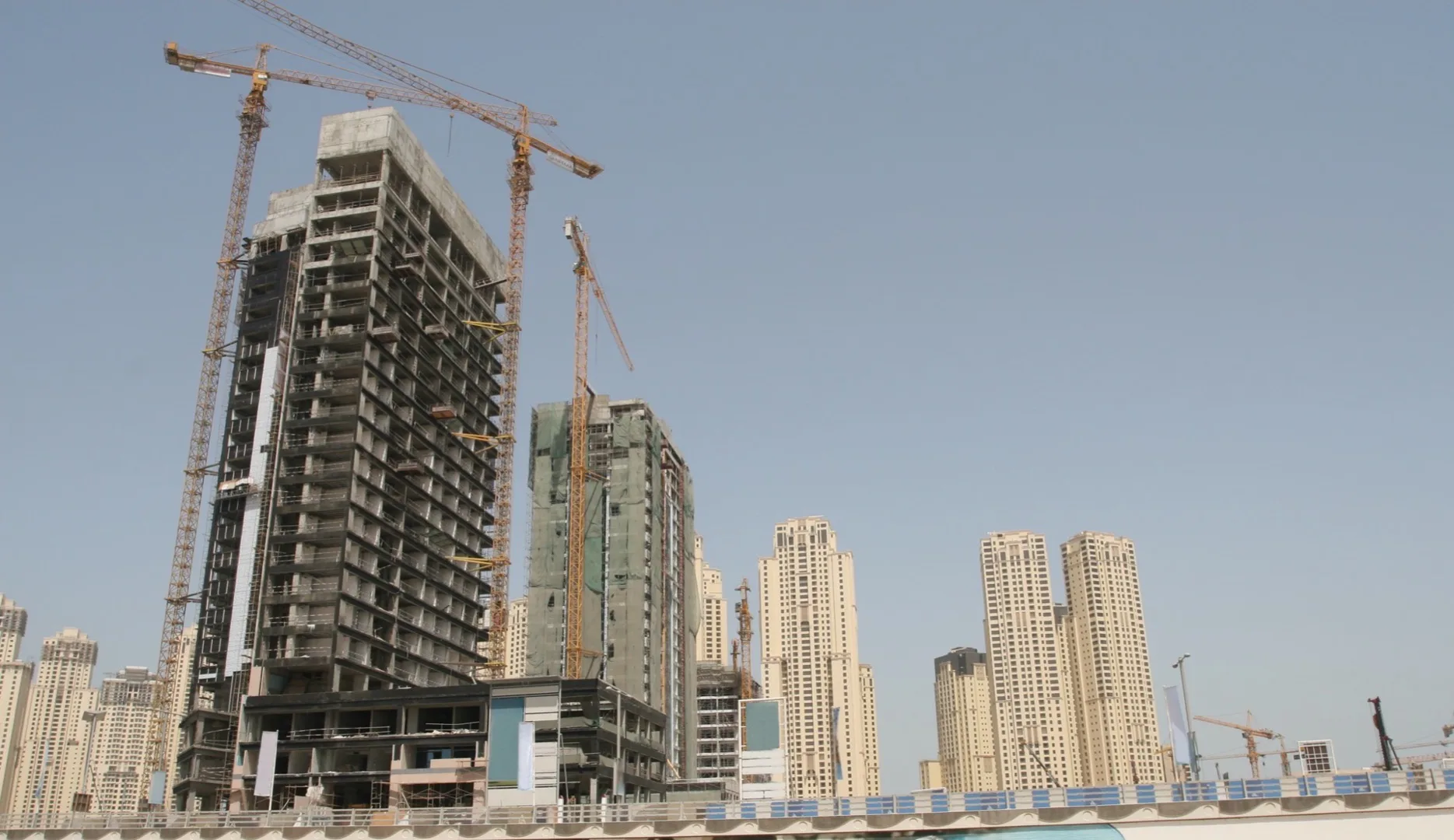
Off-Plan vs Secondary Market Resale in Dubai 2026: Which Wins Where, Real Examples

Last updated: May 25, 2026
- The Dubai market is now genuinely balanced. DLD recorded 270,000+ transactions worth AED 917bn in 2025, and off-plan accounted for ~63% of volume — but ready (secondary) transactions are growing faster on a financed-purchase basis.
- Off-plan wins when you have time, want a payment plan, accept construction risk and target capital appreciation. Secondary wins when you need immediate yield, can pay 20-30% down today and want zero handover-delay exposure.
- Mortgage rules differ sharply. UAE Central Bank capped off-plan mortgages at 50% LTV versus 80% for expat first ready homes under AED 5M.
- Handover delays are real. Industry trackers indicate only ~62% of 2025 expected units delivered on schedule, with mid-tier developer delays of 18-24 months not uncommon.
- Buyer protection is strong on paper — Law 8/2007 mandates project escrow accounts and RERA monitors release of funds against construction milestones.
- For a 2-bed at Emaar Beachfront ready vs Sobha Hartland 2 off-plan, the upfront cash gap is roughly AED 1.6M (ready) vs AED 280-440K (off-plan over Year 1) — but the all-in 5-year economics tighten significantly once rent income and DLD fees are included.
- The "best of both" strategy: buy off-plan, sell on assignment 6-12 months before handover after paying 30-40% of price. Captures appreciation without taking handover risk or service charges.
- Use our Dubai Mortgage Calculator and DLD Fee Calculator to model both paths with your specific numbers.
"Should I buy off-plan or go to the secondary market?" is the single most common question among buyers entering Dubai property in 2026. The honest answer is that there is no universal winner — the right answer depends on your time horizon, financing mix, target area, intent to live or invest, and tolerance for construction risk. The off-plan vs ready debate is not a moral question. It is an engineering question with five inputs.
This guide gives you the full decision framework, the regulatory mechanics, and two real worked examples — Emaar Beachfront (ready) versus Sobha Hartland 2 (off-plan), and a JVC ready studio versus a Damac Lagoons off-plan townhouse. By the end you should be able to predict which path wins for your specific case and your specific budget, without hand-waving.
The Decision Framework: 5 Variables That Shift the Answer
The off-plan vs secondary question only has a clean answer once you fix five inputs. Most generic articles compare averages — but averages hide the real decision. Here is the framework we use to evaluate every Dubai client case.
| Variable | Off-plan leans favourable when | Secondary leans favourable when |
|---|---|---|
| Time horizon | 5+ years, no urgency to live or rent today | Need yield/occupation within 0-12 months |
| Cash vs mortgage mix | Want low entry cash (10-20%) and staggered payments | Have 20-30% cash and want a mortgage today |
| Risk appetite | Comfortable with handover delay and quality risk | Want zero construction or quality uncertainty |
| Target area | Emerging or master-plan area without ready stock | Established prime area with established yields |
| Intent | Pure investment, flip-on-assignment, or long-term hold | End-user (live in it) or income-generating rental |
If three or more of your five variables sit in the off-plan column, off-plan is probably the right call. If three or more sit in the secondary column, secondary wins. The 50/50 splits are where the worked examples below become essential.
The most expensive mistake is buying off-plan with the intent to live in it within 18 months — because handover delays make that intent statistically unreliable. The second most expensive mistake is paying a 25-30% premium for ready stock in an area where comparable off-plan launches 200 metres away will deliver in 24 months.
Current Market Snapshot 2026: Off-Plan vs Ready Transaction Share
Dubai's market is now genuinely two-engined. Both off-plan and secondary segments are setting records simultaneously, which is unusual historically and important to understand before you choose a side.
Headline numbers from the official and analyst data:
- 270,000+ total transactions in 2025, worth AED 917 billion, +20% year-on-year by both volume and value, per DLD-aggregated data.
- Off-plan share ~62-63% of 2025 volume — meaning roughly 6 in 10 transactions are still pre-handover stock.
- Q3 2025 narrowed to ~55% off-plan / 45% ready on certain DLD splits, per Knight Frank's Q3 2025 review and aggregator analysis.
- Mortgage-funded purchases dominate secondary. Knight Frank notes that the number of mortgaged home purchases in nine months of 2025 was more than double the level seen four years earlier — and the majority of those are ready stock, since off-plan caps at 50% LTV.
- ~45,000 units scheduled for 2026 handover, with industry trackers expecting ~48% to deliver on time and the balance slipping into 2027.
What this means for you: the off-plan-only story you may have heard from 2022-23 is over. Secondary stock now has its own bull case — primarily mortgage-financed end-users and yield-seeking investors who want occupancy from Day 1. Off-plan still dominates by volume but secondary is the faster-growing leg of the market on a financed-buyer basis.
| Metric | Off-plan 2025 | Secondary/ready 2025 |
|---|---|---|
| Transaction share | ~62-63% (volume) | ~37-38% (volume) |
| Mortgage usage | Low (50% LTV cap, post-completion handover finance) | High (up to 80% LTV first home expat) |
| Average entry cash | 10-20% of price | 20-30% + ~7-9% closing fees |
| Typical end-user share | Lower (more investors) | Higher (more end-users) |
| Time to yield | 2-4 years (post-handover) | Immediate (1-3 months) |
For the broader market context, see our Q1 2026 market report and the 2026-27 delivery wave analysis for area-level supply risk.
Off-Plan: When It Wins (Payment Plan, Brand-New, Customisable)
Off-plan wins in a clear, definable set of scenarios. It is not a default — it is a specific strategy for buyers whose constraints favour low initial cash, long time horizons and acceptance of construction risk.
The six structural advantages of off-plan in Dubai 2026:
- Lower entry cash. Most major developers (Emaar, Sobha, Damac, Nakheel, Aldar, Meraas) offer 10-20% down payment with the balance spread across 2-5 years. Sobha Hartland 2, for example, runs an 80/20 plan with 10% deposit and the balance spread to handover. The cash flow benefit versus a 20-30% secondary down payment is substantial for buyers stretching to access the market.
- Brand-new everything. New finishes, new appliances, new MEP systems, latest building technology, current architectural design. No deferred maintenance, no aged AC units, no 10-year-old kitchens.
- Customisation windows. Many developers allow upgrade choices on flooring, kitchen, bathroom, smart-home packages while the unit is still in construction — typically not available for secondary purchases.
- Capital appreciation through construction. In hot launch cycles, off-plan units have historically appreciated 15-25% between launch and handover in sought-after locations. This is not guaranteed but is the structural opportunity that secondary cannot match.
- Escrow protection. Under Dubai Law 8 of 2007, every off-plan project must have a separate RERA-monitored escrow account. Developer cannot access funds without verified construction milestones. RERA retains 5% of escrow value for one year post-handover as a defect warranty fund.
- DLP defect liability period. New properties come with a 1-year defect liability period and 10-year structural warranty from the developer — see our DLP guide for the legal mechanics.
The honest reasons off-plan often outperforms in capital appreciation terms: launch pricing is typically calibrated to attract early commitment, master-plan amenities improve over the build cycle, and resale pricing during construction can ride the broader market uplift. The risk side: handover delays, finishing quality variance between developers, market shifts during the build, and the 50% LTV cap if you eventually need a mortgage.
For deeper mechanics on payment plans and the post-handover plan ecosystem, see our off-plan payment plans guide and the 60/40 and post-handover plans breakdown.
Secondary: When It Wins (Immediate Yield, No Construction Risk, Established Building)
Secondary wins for buyers who value certainty over upside. The secondary market is structurally older, structurally lower-risk, and structurally cheaper on a deal-economics basis once mortgage access is factored in.
The six structural advantages of secondary in Dubai 2026:
- Immediate yield. Cash flow starts from Month 1 (or Month 3 after handover from previous tenant). For investors targeting income rather than appreciation, this is decisive — a 7% gross yield compounded across the construction-delay period of an off-plan competitor adds materially to total return.
- Zero construction or handover risk. You see what you are buying. The walls, the snagging, the finish quality, the lift speed, the neighbour profile — all observable.
- Mortgage access at 80% LTV. Per UAE Central Bank rules, expat first-home buyers can borrow up to 80% LTV on ready properties under AED 5M. Off-plan caps at 50%. For a buyer with 25% cash this is the difference between buying or not.
- Known service charges. The Mollak system publishes actual service charges per tower. You can see real annual maintenance costs before buying instead of estimates from a brochure — see our Mollak explainer for how to look these up.
- Established community. Schools, supermarkets, restaurants, gym, beach access, neighbour mix — all visible. No "promised in master plan" risk.
- Negotiability. Secondary prices are negotiable. A motivated seller in a slow market can give 5-10% off asking. Developer pricing on off-plan is non-negotiable (you can sometimes negotiate fees and unit selection but not list price).
The secondary trade-offs: higher entry cash (20-30% down plus 4% DLD plus 2% broker plus mortgage costs ≈ 27-37% of value), older finishes, potentially deferred maintenance, service charges that may rise as the building ages.
For the full purchase cost map, see our complete buying cost breakdown and the full Dubai cost guide.
Mortgage Availability: Different Rules for Each
The mortgage rules are where most buyers get caught out. Off-plan and ready properties operate under fundamentally different regulatory regimes. Pretending otherwise leads to bad budgeting and worse deals.
Key rules from the UAE Central Bank Rulebook:
| Scenario | Max LTV | Min down payment |
|---|---|---|
| Off-plan, any buyer, any value | 50% | 50% |
| Ready, expat first home, < AED 5M | 80% | 20% |
| Ready, expat first home, > AED 5M | 70% | 30% |
| Ready, expat second/investment | 60% | 40% |
| Ready, UAE national first home, < AED 5M | 85% | 15% |
| Ready, UAE national second/investment | 65% | 35% |
What this means in practice:
- Off-plan is a cash-heavy game. You need 50% of price across the payment-plan window (often spread 3-5 years), with no mortgage support during construction. Mortgage only kicks in after handover and is constrained by the post-handover LTV regime.
- Secondary lets expats access 80% gearing on first home. An AED 2M ready apartment requires AED 400K down + ~AED 160-180K closing fees = AED 560-580K cash. The same AED 2M as off-plan requires AED 1M total cash across the build, with no mortgage relief.
- The off-plan payment plan effectively replaces a mortgage during construction. It is non-interest-bearing but inflexible — miss instalments and you risk cancellation or fines.
- Buyers who plan to mortgage their off-plan at handover should pre-qualify before committing. DBR (debt burden ratio) rules cap monthly debt at 50% of monthly income, which constrains how much you can borrow.
For deeper mortgage mechanics and bank comparisons, see our Dubai mortgage pillar, 2026 mortgage rates comparison, and the LTV rules explainer.
Live DLD data
When will your building actually hand over?
Track any Dubai project's official construction percentage and expected completion — re-verified against the DLD registry twice a week. Get an email only when it moves.
The Hidden Costs Each Path Has
The list-price comparison between off-plan and secondary is misleading. Each path has fees, charges and structural costs that the brochure won't show. Honest budgeting requires modelling all of them.
| Cost item | Off-plan | Secondary |
|---|---|---|
| DLD transfer fee (4%) | Yes — at Oqood or handover | Yes — at transfer |
| DLD admin and trustee fees | ~AED 4,000-5,000 | ~AED 4,000-5,000 |
| Broker commission | Usually 0% (developer-paid) | 2% + 5% VAT (buyer-paid) |
| Mortgage registration (0.25%) | Only if mortgaging at handover | Yes — at registration |
| Mortgage processing/valuation | AED 3,000-5,000 (if applicable) | AED 3,000-5,000 |
| Developer admin fee | AED 3,000-7,000 | N/A |
| NOC fee (if assigning before handover) | 2-4% of original price | AED 500-5,000 (resale NOC) |
| Service charges (year 1) | ~AED 12-15/sqft (new builds) | ~AED 14-25/sqft (older stock) |
| Snagging cost | AED 1,500-5,000 (recommended) | AED 500-2,000 (advisable) |
| Furnishing/fit-out | AED 80-200K (often required) | AED 0-100K (often inherited) |
| Lost rent during construction | 2-4 years of opportunity cost | Zero — rent starts Month 1 |
Model both columns explicitly with our DLD fee calculator. The opportunity-cost line for off-plan is the most under-modelled — buyers focus on the appreciation upside and ignore the rent income they would have collected on a secondary equivalent. Across 2-4 years of construction, foregone gross rent on a similar ready property typically equals 14-28% of property value.
For the full fee landscape, see fees for buying property in UAE 2026 and our DLD service fees deep-dive.
Worked Example: Emaar Beachfront Ready vs Sobha Hartland 2 Off-Plan
Let's compare two real options on the table for an investor with AED 1.5-1.8M of liquid cash and an interest in mid-luxury 2-bedroom stock. Both have strong developer track records, both are in master-plan communities — but the economics are very different.
Setup (schematic, May 2026):
- Option A: Emaar Beachfront 2-bed ready resale, mid-tower, ~1,200 sqft. List price AED 4.5M (~AED 3,750/sqft, in line with current 2026 secondary asking).
- Option B: Sobha Hartland 2 2-bed off-plan, payment plan 80/20 to Dec 2027. List price AED 2.2M (~AED 1,800/sqft new launch).
- Buyer: expat, first Dubai property, 25% LTV deposit available, target 5-year hold.
| Cost / cash flow item | A — Emaar Beachfront ready | B — Sobha Hartland 2 off-plan |
|---|---|---|
| List price | AED 4,500,000 | AED 2,200,000 |
| Down payment (Year 1) | AED 1,125,000 (25% — note > AED 5M tier uses 30%) | AED 440,000 (20% booking + early instalments) |
| Mortgage (Year 1) | AED 3,375,000 @ ~4.5% | None during build; ~AED 1.1M @ handover |
| DLD 4% transfer | AED 180,000 | AED 88,000 (at Oqood) |
| Broker commission (2%+VAT) | AED 94,500 | AED 0 (developer-paid) |
| Construction-period payments (Years 2-3) | N/A | AED 880,000 (instalments toward 80% pre-handover total) |
| Year 1 gross rent (occupied) | ~AED 270,000 (6% gross yield) | AED 0 |
| 5-year rent income (post-handover for B) | ~AED 1.35M (5 yrs of gross) | ~AED 360-450K (only Years 4-5 income, 7-8% gross on 2027 handover) |
| 5-year capital appreciation (assumed) | ~25-30% (~AED 1.1-1.35M, prime mature) | ~30-40% (~AED 660-880K, emerging master plan) |
| 5-year all-in estimate (rent + appreciation) | ~AED 2.45-2.70M | ~AED 1.02-1.33M |
| 5-year return on cash invested | ~60-70% on AED 1.4M cash deployed | ~70-90% on AED 1.3M cash deployed |
The interpretation:
- Both paths produce strong returns. The absolute AED gain favours the more expensive Emaar Beachfront ready (more capital base, more rent compounding). The return-on-cash favours the Sobha off-plan slightly (lower entry, higher % appreciation).
- The Sobha play is sensitive to handover risk. A 12-month delay slips rent income by 12 months and adds carrying cost. Emaar Beachfront ready has zero such exposure.
- The Emaar Beachfront option requires substantially more upfront cash (AED ~1.4M vs AED ~440K Year 1). For a buyer whose cash is tight, off-plan is mechanically the only accessible option.
- Service charges differ. Emaar Beachfront runs ~AED 22-28/sqft as a premium beachfront tower. Sobha Hartland 2 at launch is projected ~AED 12-15/sqft.
Use our Dubai mortgage calculator to run your specific deposit/mortgage mix. For the deeper version of this analysis, see off-plan vs ready investment and our true Dubai property ROI 2026 case studies.
Worked Example: JVC Ready Studio vs Damac Lagoons Off-Plan Townhouse
Different buyer, different end-goal. Here the comparison is a yield-driven entry-level studio versus an off-plan family-product townhouse with a 4-year payment plan. The economics swing differently.
Setup (schematic, May 2026):
- Option A: JVC ready studio resale, ~400 sqft, in established 6-year-old tower. List AED 650,000 (~AED 1,625/sqft).
- Option B: Damac Lagoons 3-bed townhouse off-plan, ~2,200 sqft, handover Dec 2028. List AED 2.95M.
- Buyer: expat, first Dubai property, AED 600K cash. Goal — income or capital growth.
| Item | A — JVC ready studio | B — Damac Lagoons townhouse |
|---|---|---|
| List price | AED 650,000 | AED 2,950,000 |
| Year 1 cash needed | ~AED 200K (20% down + 6-9% fees) | ~AED 590K (20% booking + early instalments) |
| Mortgage feasibility | Yes, 80% LTV available | Only at handover, 50% LTV |
| Year 1 rent (gross) | ~AED 55-60K (8-9% gross yield) | AED 0 |
| Construction-period payments | N/A | ~AED 1.18M (40% over 2 years) |
| 5-year cumulative rent | ~AED 280-320K (assume 4% rent growth) | ~AED 200-280K (post-handover Years 3-5) |
| 5-year capital appreciation (assumed) | ~15-20% (~AED 100-130K, mature JVC) | ~25-35% (~AED 740K-1.03M, master-plan emerging) |
| 5-year all-in estimate (rent + appreciation) | ~AED 380-450K | ~AED 940K-1.31M |
| 5-year return on cash invested | ~80-100% on AED 200K (mortgage-leveraged) | ~55-75% on AED 1.77M (low leverage) |
The interpretation:
- The JVC ready studio is a cash-light, yield-focused, leverage-amplified play. AED 200K invested can return ~AED 380K+ across 5 years, mostly from yield and modest appreciation.
- The Damac Lagoons townhouse is a capital-deployment play. Bigger ticket, bigger growth in absolute terms, but tied up in low-yield construction phase. ROI on cash actually trails the studio because the mortgage leverage is much lower.
- For a buyer with AED 600K and a goal of "compound the cash hardest in 5 years," the JVC studio actually wins on ROI-on-cash even though absolute Dirham gain is smaller. For a buyer with AED 600K and a goal of "park capital and ride appreciation," the townhouse wins.
- Use this lens whenever you compare differently-priced options. Returns on the gross investment ≠ returns on your cash. Mortgage leverage is the variable that most often swings the answer.
For more on JVC specifically, see our JVC investment guide, and for Damac Lagoons see Damac Lagoons community guide.
The "Best of Both" Strategy: Off-Plan Assignment Before Handover
The institutional and sophisticated retail strategy in Dubai is rarely "off-plan all-in to handover" or "secondary all-in." It is the off-plan assignment — buying off-plan, paying 30-40% of price across early instalments, then selling the contract to another buyer before handover. Done well it captures most of the appreciation without taking handover risk or service charges.
The mechanics of an off-plan assignment in Dubai 2026:
- Minimum payment threshold. Most developers require the original buyer to have paid 30-40% of the price before allowing assignment — see our Oqood vs Title Deed guide for the underlying register mechanics.
- NOC required from developer. The developer must approve the assignment, confirm the original buyer is current on payments, and consent to transferring the SPA to the new buyer.
- Developer assignment/NOC fee. Typically 2-4% of the original purchase price, charged by the developer for processing.
- DLD 4% transfer applies. Just like a freehold transfer, paid by the new buyer at the Oqood transfer step.
- Oqood transfer at DLD trustee office. Both parties attend; new Oqood issued in name of new buyer within 24 hours.
- New buyer assumes remaining payment plan. All future instalments, service charges (post-handover) and SPA obligations transfer.
Why it works as a strategy:
- You capture appreciation in the build-up phase (typically the steepest part of the off-plan appreciation curve).
- You skip handover quality and finishing risk.
- You skip the post-handover service charges, the snagging dispute, and any rental management setup.
- Your capital cycle is shorter (typically 18-30 months vs full 3-5 year hold), so you can redeploy faster.
The honest risk: if the broader market softens between your purchase and your planned assignment exit, the secondary market for the contract may be thin. Off-plan assignments need willing buyers, and willing buyers depend on the launch cycle for the same area still being hot. This is why timing matters — see our buy-now-vs-wait framework for cycle reads, and the flip vs rent decision matrix for the playbook by area.
Decision Matrix by Buyer Profile
Here is the compressed decision table we use for client recommendations. Find your row, read the column.
| Buyer profile | Recommended path | Key reason |
|---|---|---|
| End-user wanting to move in < 12 months | Secondary ready | Handover risk and delay incompatible with timeline |
| Yield investor (target 6-8% gross) | Secondary ready | Income from Month 1, mortgage-financed up to 80% LTV |
| Capital-light first-time investor (cash < 25%) | Off-plan with payment plan | 10-20% entry vs 27-37% for secondary |
| Capital growth investor (5+ year hold) | Off-plan in emerging master plan | 15-25% appreciation curve through construction |
| Active flipper (1-3 yr cycle) | Off-plan with assignment exit | Skip handover, capture growth, redeploy faster |
| Golden Visa-targeted (AED 2M minimum) | Either, with explicit visa-readiness check | See our golden visa off-plan rules guide |
| Pre-retiree wealth preservation | Secondary in prime mature area | Stability, known yield, no construction or handover risk |
| Diversified investor (already owns 1+ Dubai unit) | Mix — off-plan for growth + secondary for yield | Portfolio balance across both engines |
For Golden Visa considerations specifically, see our golden visa pillar and the dedicated golden visa off-plan rules guide — the 2026 updates removed the 50% down requirement for off-plan, materially changing the calculus for visa-driven buyers.
For the headline buying journey end to end, our buy property in Dubai pillar walks through every step regardless of which path you pick.
Frequently Asked Questions
What percentage of Dubai property transactions are off-plan in 2026?
Based on 2025 DLD data (the latest full year), off-plan accounted for roughly 62-63% of total transaction volume — about 134,000+ off-plan transactions versus 270,000+ total. Q3 2025 specifically saw a narrower ~55% off-plan / 45% ready split, and the ready share has been growing faster on a mortgage-financed basis through 2026. Treat any single percentage as directional — the mix moves by quarter, by area and by price band.
Can I get a mortgage on an off-plan property in Dubai?
Yes, but with constraints. UAE Central Bank rules cap off-plan LTV at 50% regardless of buyer nationality or property value. The mortgage typically activates at handover, not at booking — so during construction you must fund instalments from cash (or the developer payment plan). Some banks now offer "off-plan finance" products that release tranches against construction milestones, but pricing and availability vary by developer. For off-plan with mortgage intent, pre-qualify before signing the SPA.
Are off-plan properties actually cheaper than ready ones in Dubai?
On launch they typically are — by 15-30% versus comparable ready stock in nearby buildings. That gap is the developer's incentive to capture early commitment and finance construction. However the gap closes as construction progresses, and at handover the off-plan unit may be priced in line with ready market levels. Whether you are "buying cheaper" depends entirely on when you enter and how the market moves during the build.
What happens if the developer delays handover?
Most SPAs grant a 6-12 month grace period beyond the contractual completion date. After that, RERA allows buyers to claim compensation, typically up to 1% per month of the purchase price, though terms vary by SPA. Industry data suggests only about 62% of anticipated 2025 units delivered on time; mid-tier developer delays of 18-24 months have occurred. Check the developer's track record before committing — see our delay analysis on the related guide for the framework.
How does escrow protect my off-plan deposit?
Under Dubai Law 8 of 2007, every off-plan project must hold buyer payments in a separate RERA-monitored escrow account at an accredited bank. Developers cannot withdraw funds without verified construction milestones approved by DLD inspectors. RERA retains 5% of escrow value for one year after handover as a defect warranty fund. Misappropriation of escrow funds carries criminal penalties of imprisonment and minimum AED 100,000 fines. The system is one of the strongest off-plan buyer protections globally on paper, though it does not eliminate handover delay risk.
Can I sell my off-plan property before handover?
Yes — via an assignment (sometimes called "flip" or "secondary off-plan sale"). Most developers require you to have paid 30-40% of the purchase price first. You need a No Objection Certificate (NOC) from the developer, both parties attend a DLD-approved trustee office for the Oqood transfer, the new buyer pays 4% DLD transfer plus the developer's assignment fee (typically 2-4% of original price). The new buyer assumes the remaining payment plan and SPA obligations.
Which has better capital appreciation: off-plan or secondary?
Off-plan in emerging or master-plan areas typically captures 15-25% appreciation between launch and handover during hot cycles, with some projects seeing larger gains. Secondary in prime mature areas typically grows in line with the broader market — 5-10% per year in 2026 conditions for established prime stock. Off-plan upside is higher in percentage terms but comes with handover risk; secondary appreciation is more predictable but lower-magnitude. Returns on cash invested depend heavily on mortgage leverage, which favours secondary in expat first-home scenarios.
What about service charges — are new buildings cheaper?
Initially yes, often AED 12-15/sqft for brand-new towers versus AED 14-25/sqft for older established stock. However service charges typically rise after 7-10 years as major maintenance kicks in (chillers, lifts, facade), so the initial gap narrows over time. Check the actual Mollak record for any building before buying — see our Mollak system guide. For premium beachfront and prime towers, expect AED 22-30/sqft regardless of building age.
Should I buy off-plan if I want a Golden Visa?
You can. The 2026 update removed the prior 50% down payment requirement for off-plan Golden Visa qualification — a buyer with AED 2M+ in off-plan property can now qualify under updated rules without the historic 50% paid threshold. Confirm specifics against your developer and the current DLD/GDRFA process, since case-by-case treatment varies. See our golden visa off-plan rules and 2026 update articles for the current mechanics.
Is it safer to buy from Emaar, Sobha, Nakheel or Damac?
All four are Tier-1 Dubai developers with strong track records, but track records differ by project. Emaar and Nakheel have the longest delivery histories. Sobha is known for higher-quality finishes and longer build cycles. Damac is a high-volume developer with broader project variance. Before committing to any off-plan, check the specific project's escrow status, the developer's recent delivery on-time percentage, and the construction progress on-site. Brand alone does not eliminate project-level risk.
The right answer depends on your cash position, mortgage capacity, target area and timeline. Run your specific scenario with our Dubai mortgage calculator and DLD fee calculator, then sanity-check the path against our complete buying pillar. For the deeper mortgage rules, the Dubai mortgage pillar covers LTV by buyer type, DBR rules and bank-by-bank options.
If you are stuck between two specific options, the REC community has investors who have run exactly your case — share the numbers and get them pressure-tested before you commit.
Thinking About Buying?
Get a free, no-pressure consultation on your Dubai purchase plan.
Thank You!
We'll get back to you within 24 hours.
Mortgage Brokers in Dubai
Explore providers from our business directory
Still have questions?
Ask a follow-up, or get connected with a vetted Dubai professional.
Join our Telegram channel
Handover alerts, new launches & DLD data — first, in real time.